 These
Last Days News - September
26, 2011
These
Last Days News - September
26, 2011| Home - Latest News | Introduction | Bayside Prophecies | Directives from Heaven | Order Form | Testimonies | Veronica Lueken | Miraculous Photos | Bible | Radio Program |
These
Last Days News - September
26, 2011
The Beautiful Speeches of Dr Dieter Graumann, President of the Central Council of Jews in Germany, and Pope Benedict XVI in the Reichstag Building, Berlin on 22 September 2011...
"My child and My children, you are all My children. I judge you not by color or race, and I do not judge you by your creed; however, should the knowledge of the One True Church be given to you, and the way to Heaven along the narrow road be given to you, you will follow it or you will be rejected." - Our Lady, August 21, 1985
Dr Dieter Graumann, President of the Central
Council of Jews in Germany
Speech on the occasion of the meeting with Pope Benedict XVI in the
Reichstag Building on 22 September 2011
Your Holiness,
It is a great honor and a pleasure for us that we have this opportunity to meet with you here today during your journey to Germany, an event following on from your remarkable, historic visit to Cologne Synagogue in 2005, which as far as I know was the first visit ever made by a Pope to a synagogue outside Italy. You certainly have a more than demanding, ambitious, and almost sporting, intensive and tightly-scheduled visiting programme today. The fact that you have nonetheless found time for this meeting, that you have taken time for us, shows us that dialogue with Judaism is a real matter of the heart for you. We would therefore like to offer you our most heartfelt welcome with the traditional Jewish greeting and the Jewish welcome blessing: “Baruch Haba!”
It is nice to be able to see clearly that the relationship between the Catholic Church and Judaism has really improved in recent decades in a highly dramatic manner. There are so many people on all sides who have made a major contribution towards this achievement. And we are highly aware that you in particular have personally always considered reconciliation with Judaism to be important, in fact an absolute matter of the heart. It was therefore with joy and considerable relief that we Jews in Germany also very recently heard your clear words: Your rejection of any mission work among the Jews and your more than unambiguous rejection of the centuries old accusation of deicide. This did us all good. Jews have been persecuted, expelled and killed for centuries on the pretext of deicide. You have now put a final end to this. It is therefore good that you have found such clear words here.
Major steps have however already been taken by the Catholic Church in its relations with Judaism. These are steps which we greatly appreciate! However: There is still a lot to do. For all of us. And openness and friendship which are growing and are to grow further also include saying to one another and confessing frankly what hurts and burdens us. Good friendship must therefore be resilient to tension and indeed be able to sustain the headwind of occasional differences; on the understanding, naturally, that these winds are neither too strong nor too frequent. The bridges which we wish to build in order to create connections must have sound foundations. These must be foundations of trust, of reliability, of friendship, so sound that they can also stand up to open words.
Please therefore permit me to tackle those points which really hurt us in the openness that is required of friendship: The topic of the “Pius Brotherhood”*, which in our view still stands for fanaticism, fundamentalism, racism, anti-Semitism, in fact simply for the darkest Middle Ages and for irreconcilability pure and simple, is one which we still find painful. The same goes for the topic of the Good Friday prayers. And the envisioned beatification of Pope Pius XII, which would further hurt our feelings and cause us disappointment. Having said all that, one thing is absolutely certain: The course of reconciliation being steered together by Judaism and the Vatican, and which we have experienced in recent decades, is so important and so valuable to all of us. The late Pope John Paul II, whom you yourself so recently beatified, pushed forward this course with such energy and warmth. His words and deeds warm our hearts to the present day. And we know full well that you yourself always supported, encouraged and contributed to his initiative with decisiveness. And we see and feel that you will continue the course of community and friendship in your own responsibility and even accelerate it.
Contacts between the Jewish community in Germany and the Catholic Church here in the country have now become highly varied, trustful, reliable and close. We feel this particularly clearly, again and again, especially in difficult situations. This is particularly when friendship needs to prove itself – and this is indeed what we experience, again and again in a really moving way. I would like to express my explicit thanks for this living solidarity and established loyalty. Our dialogue remains so important for us, but it is not to be understood in isolation. We must all be measured by its results, and by our good relationship becoming even better, closer, deeper – that is what we all hope and wish for together in our innermost hearts!
Your Holiness, I would therefore like to use today’s opportunity to affirm our desire for a lively, open, temperamental, trusting and life-affirming dialogue with one another. For a dialogue devoid of all formality, one of close friendship, of trusted partnership and deep friendship; for a dialogue in which open words are appreciated and expected and in which the deeply-established trust is to continue to grow further. I would like to see a dialogue between Jews and Christians emphasizing what we have in common, which confirms and strengthens our two communities. And in a world in which, at least in Europe, the power of faith unfortunately sometimes seems to be becoming weaker and less popular, we have so many more common goals and interests, and so much more which unites us now and which must unite us forever.
I would like to see a Church which holds its “older brothers” in its heart; I would like to see us treating one another with respect, in a dialogue and in friendship, on an equal footing. I would therefore like to see fraternal relations between Judaism and Christianity becoming a matter of course, every day, everywhere and for all times. We should know in the spirit and always feel in our hearts: We have so much that joins us. We are united by much more than can ever separate us. We have such strong joint roots – perhaps we should occasionally communicate this to others together, more frequently and more strongly. We really have such strong common roots – how should they not be able to bear fruits together? And another thing we would like to see: That the fullness and the fruits of what we have in common grow and blossom. To be sure: Even then, because the world is the way it is, the trees we plant together will not yet always grow to the sky. Perhaps however we will nonetheless all come a little bit closer to Heaven. And we ourselves will perhaps grow together by what binds us – how wonderful that would be!
We are here together; we believe together – and we quite simply belong together! Let us therefore jointly bear the responsibility for this common foundation of heartfelt friendship, enhanced trust and new closeness being strengthened and established again and again. This is certainly our most heartfelt wish.
Apostolic Journey To Germany 22-25
September 2011 Meeting With Representatives Of The Jewish Community
Address Of His Holiness Benedict
XVI Reichstag Building, Berlin Thursday, 22 September 2011
Ladies and Gentlemen,
Dear Friends,I am truly glad to be taking part in this meeting with you here in Berlin. I warmly thank President Dr Dieter Graumann for his kind and thoughtful words. They make it very clear to me how much trust has grown between the Jewish people and the Catholic Church, who hold in common a not insignificant part of their essential traditions, as you emphasized. At the same time it is clear to us all that a loving relationship of mutual understanding between Israel and the Church, each respecting the essence of the other, still has further to grow and needs to be built into the heart of our proclamation of the faith.
On my visit to the Synagogue in Cologne six years ago, Rabbi Teitelbaum spoke of remembrance as one of the supporting pillars that are needed if a future of peace is to be built. And today I find myself in a central place of remembrance, the appalling remembrance that it was from here that the Shoah, the annihilation of our Jewish fellow citizens in Europe, was planned and organized. Before the Nazi terror, there were about half a million Jews living in Germany, and they formed a stable component of German society. After the Second World War, Germany was considered the “Land of the Shoah” where, for a Jew, it had become virtually impossible to live. Initially there were hardly any efforts to re-establish the old Jewish communities, even though Jewish individuals and families were constantly arriving from the East. Many of them wanted to emigrate and build a new life, especially in the United States or Israel.
In this place, remembrance must also be made of the Kristallnacht that took place from 9 to 10 November 1938. Only a few could see the full extent of this act of contempt for humanity, like the Berlin Cathedral Provost, Bernhard Lichtenberg, who cried out from the pulpit of Saint Hedwig’s Cathedral: “Outside, the Temple is burning – that too is the house of God”. The Nazi reign of terror was based on a racist myth, part of which was the rejection of the God of Abraham, Isaac and Jacob, the God of Jesus Christ and of all who believe in him. The supposedly “almighty” Adolf Hitler was a pagan idol, who wanted to take the place of the biblical God, the Creator and Father of all men. Refusal to heed this one God always makes people heedless of human dignity as well. What man is capable of when he rejects God, and what the face of a people can look like when it denies this God, the terrible images from the concentration camps at the end of the war showed.
In the light of this remembrance, it is to be acknowledged with thankfulness that a new development has been seen in recent decades, which makes it possible to speak of a real blossoming of Jewish life in Germany. It should be stressed that the Jewish community during this time has made particularly laudable efforts to integrate the Eastern European immigrants.
I would also like to express my gratitude for the deepening dialogue between the Catholic Church and Judaism. The Church feels a great closeness to the Jewish people. With the Declaration Nostra Aetate of the Second Vatican Council, an “irrevocable commitment to pursue the path of dialogue, fraternity and friendship” was made (cf. Address in the Synagogue in Rome, 17 January 2010). This is true of the Catholic Church as a whole, in which Blessed John Paul II committed himself to this new path with particular zeal. Naturally it is also true of the Catholic Church in Germany, which is conscious of its particular responsibility in this regard. In the public domain, special mention should be made of the “Week of Fraternity”, organized each year during the first week of March by local Societies for Christian-Jewish Partnership.
On the Catholic side there are also annual meetings between bishops and rabbis as well as structured conversations with the Central Council of Jews. Back in the 1970s, the Central Committee of German Catholics (ZdK) took the initiative of establishing a “Jews and Christians” forum, which over the years has issued many well-written and helpful documents. Nor should I omit to mention the historic meeting for Jewish-Christian dialogue that took place in March 2006 with the participation of Cardinal Walter Kasper. That cooperation is proving fruitful.
Alongside these important initiatives, it seems to me that we Christians must also become increasingly aware of our own inner affinity with Judaism, to which you made reference. For Christians, there can be no rupture in salvation history. Salvation comes from the Jews (cf. Jn 4:22). When Jesus’ conflict with the Judaism of his time is superficially interpreted as a breach with the Old Covenant, it tends to be reduced to the idea of a liberation that mistakenly views the Torah merely as a slavish enactment of rituals and outward observances. Yet in actual fact, the Sermon on the Mount does not abolish the Mosaic Law, but reveals its hidden possibilities and allows more radical demands to emerge. It points us towards the deepest source of human action, the heart, where choices are made between what is pure and what is impure, where faith, hope and love blossom forth.
The message of hope contained in the books of the Hebrew Bible and the Christian Old Testament has been appropriated and continued in different ways by Jews and Christians. “After centuries of antagonism, we now see it as our task to bring these two ways of rereading the biblical texts – the Christian way and the Jewish way – into dialogue with one another, if we are to understand God’s will and his word aright” (Jesus of Nazareth. Part Two: From the Entrance into Jerusalem to the Resurrection, pp. 33f.). This dialogue should serve to strengthen our common hope in God in the midst of an increasingly secularized society. Without this hope, society loses its humanity.
All in all, we may conclude that the exchanges between the Catholic Church and Judaism in Germany have already borne promising fruits. Enduring relations of trust have been forged. Jews and Christians certainly have a shared responsibility for the development of society, which always includes a religious dimension. May all those taking part in this journey move forward together. To this end, may the One and Almighty, Ha Kadosch Baruch Hu, grant his blessing. I thank you.
Pope Benedict XVI
Address to Representatives of the Jewish Community
Reichstag Building, Berlin
September 22, 2011"You have been given by your baptism entrance into the only true religion upon earth, the Roman Catholic Church under My Son, Jesus. Though man in his arrogance and pride has forgotten His role and His rule, you must carry it forward. Retain the Faith and the truth in the hearts of mankind." - Our Lady of the Roses, September 7, 1978
"I gave you a simple plan with the construction of My House, My Church, upon earth. But now you want to reform it, until you will split My House asunder with many denominations, many new denominations. I ask that My Church be universal, apostolic, and the saver of souls. However, there are rules to be followed, doctrines to remain unchanged." - Jesus, September 7, 1978
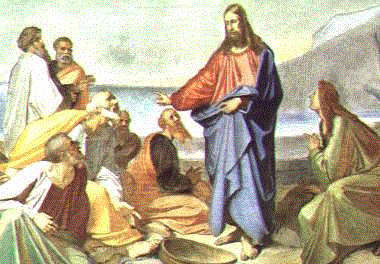 Four Marks of the True Church: One, Holy, Catholic, and Apostolic…
The following is taken from the booklet, "Faith and common sense", + Imprimatur: Most Reverend John F. Whealon, Archbishop of Hartford:
After Christ left this world, His Church did spring
into action, fully prepared to carry on His work. This Church was not something
vague in character. Christ said precisely what He wanted it to be. His Church
was to be built upon the Apostles. It would continue down to the end of time in
the same way, ruled by the successors of the Apostles. That is perhaps the
clearest thing of all.
He also intended it to be one Church, not a number of
churches. The Church He had in mind was to be for all men. It would work for
their sanctification and salvation. These qualities were so clearly built into
the Church that they were marks setting off the true Church of Christ from all
other institutions claiming the name. Catholics say that these marks are unity,
catholicity, holiness and apostolicity.
When we examine the early Church as it appears in the
time of the Apostles, we find that it had all these qualities. One Church and
only one is in existence today which clearly shows the same four marks. This is
the Catholic Church.
Around the dome of St. Peter’s Basilica in Rome are
inscribed the words, “Thou art Peter and upon this rock I will build my Church.”
Those words are as true of the present Pope as they were of St. Peter. The Pope
is the successor of Peter, and he has the same authority as the Prince of the
Apostles once had.
That is a truth which can be amply proved by the facts. No other religious
society can trace its heritage back through the centuries to St. Peter.
Pope Paul VI, the present Bishop of Rome [Note: Paul
VI was Pope at
the time this article was written], is a successor of St. Peter. Year by
year the succession can be traced back to the time of the great Apostle himself.
Some of the Popes lived for only a few years or months; some have had very long
terms of office. Some of them have been great leaders in world affairs; some
relatively obscure. But they are all known to history.
Today in the Catholic Church the Pope holds the
fullness of power the same as Peter did in the early Church. He is not like a
democratically-elected president whose power depends on the consent of the
governed. Like Peter he has been made the shepherd of the flock by the Lord, and
he has the same absolute power as Peter.
Under him in the administration of the Church are the Bishops and priests. Their
power comes from God, as once the power of the Twelve came from Christ. St. Paul
said to the presbyters of Ephesus, “Take heed to yourselves and to the whole
flock in which the Holy Spirit has placed you as bishops to rule the Church of
God” (Acts 20:28).
There is no doubt that the Catholic Church today is
apostolic in the line of succession of its Bishops and the Pope, and that it
possesses an authority which was once given to the Apostles.
UNITY OF RULE, BELIEF, RITUAL
St. Paul told the Ephesians to remember that they
had “one Lord, one Faith, one Baptism” (Eph. 4:5). The Catholic Church does have
that unity of rule, belief and ritual.
All Catholics everywhere recognize the authority of the
Pope, the Vicar of Christ. He is the representative of the Lord, and presents
the final judgments or decision on matters of faith and morals. Catholics do not
accept the official pronouncements of the Pope only when they agree with them.
They accept them at all times because they recognize his authority.
All Catholics believe the same faith. There is no
difference in the essential doctrines which various priests teach. One Bishop
does not have his own truths about religion which are different from the beliefs
of another Bishop. Both are explaining the doctrine of the Catholic Church, not
their own ideas about doctrines. The manner of preaching may be different; the
doctrine is the same throughout the world. There is “one faith” in the Catholic
Church.
So also there is but one “Baptism.” The term embraces
all those essential rites which the Catholic Church practices. The most
important rite of the Catholic Church is the Mass. The Mass is the re-enactment
of the Last Supper, as was commanded by Christ. All Catholics are obliged to
attend Mass every Sunday and on the important religious festivals of the year.
This obligation is world-wide. So is the Mass. Our soldiers serving in foreign
countries are always at home when they go into the Catholic churches of those
nations; they find the Mass essentially as they knew it in the United States.
The Mass is celebrated in every Catholic church throughout the world and
consists of the same essential rite of the consecration of the bread and wine
into the Body and Blood of Jesus Christ.
The seven sacraments–Baptism, Confirmation, the
Eucharist, Penance, Matrimony, Holy Orders and the Anointing of the Sick–are the
same throughout the world. They are administered in the same way in all places.
Every Catholic is obliged to make use of them at appropriate times; there are no
national differences.
THE MARK OF HOLINESS
Not only does the Catholic Church have that mark of
unity which Christ wished His Church to have; it also has the mark of holiness.
Christ instituted His Church to make men holy and to bring them to heaven. The
Catholic Church does just that. None of its teaching ever leads men away from
God; none ever twists human nature into some frightening form. All its practices
and teachings tend to make men better.
Moreover, the Catholic Church provides men with the
means to become better. It does not simply offer the “consolation of religion.”
It does something about man’s ceaseless struggle to become better. To those who
are conscious of sinfulness, it does not merely say, “Repent in the secret of
your heart and try to do your best in the future.” It says, “Go to the sacrament
of Penance; have your sins forgiven, and receive the grace which that sacrament
provides to help you avoid these sins for the future.” At the bedside of those
seriously ill, the Catholic priest does not merely exhort the Catholic to be
sorry for his sins and cast himself upon the mercy of God. The Catholic Church
has a rite, the sacrament of the Anointing of the Sick which forgives sins and
brings the spiritual and physical help which men need in grave sickness.
“Is any one among you sick?” asks St. James. “Let him
bring in the presbyters of the Church, and let them pray over him, anointing him
with oil in the name of the Lord. And the prayer of faith will save the sick
man, and the Lord will raise him up, and if he be in sins, they shall be
forgiven him” (James 5:14-16). That is what the Catholic Church does for her
members.
Finally, the Catholic Church is world-wide. That is a
fact today as it has been a fact for all these centuries past. The membership of
the Catholic Church consists of people of all nations, from every part of the
world.
That is not an accident or the result of good salesmanship. It is the result of
the very nature of the Church of Christ. He sent His Apostles to make disciples
of all nations. The doctrine and practices which He left them were of such a
nature that they appeal to all nations. There has never been a nation which
found the doctrine of the Catholic Church contradictory to its own culture or
thought.
When Pere Marquette journeyed down the Mississippi,
preaching the Gospel, he found Indians who were anxious to listen to the story
of the death of Christ upon the Cross. They were baptized and accepted
Christianity wholeheartedly. When St. Francis Xavier reached Japan, he found the
natives eager to hear the message. So firm were they in their faith that for two
centuries during persecution they held on to that faith despite martyrdom. The
Catholic Church is an ancient faith in Japan today, not a recent development.
So it has been everywhere. The Catholic Church has not
been the product of one culture or one nation. Catholicism followed the Spanish
armies into this country, and the Spanish armies were defeated. It has little to
do with the English colonization of the eastern seaboard. Yet today the Catholic
Church is the largest single religious body in the United States and a native
part of our culture. The Catholic Church is universal in its appeal. That is why
it is called “Catholic,” for catholic means universal.
THE TRUE CHURCH OF CHRIST
These are the qualities which mark out the Catholic
Church today as the one religious organization in the world which is identical
with the Church which Jesus Christ founded. It is one, holy, catholic and
apostolic, just as was the Church in the time of the first Apostles.
These four marks point out the Catholic Church as the
true Church of Christ in another way. Only God can work a miracle. Now these
four qualities in a society are obviously miraculous.
Take unity, for example. We have erected a society called the United Nations to
make something of that unity. But it seems the more nations we have in it, the
less unity there is.
Political parties meet in convention to draw up a
“platform” of action. But the platform cannot be too definite. There have to be
compromises in deference to sharply conflicting views. The more divergent the
factions in the party, the less agreement can be reached. All things human show
the same tendency to disintegrate under the pressure of expansion.
The truths held by all Catholics are numerous and
detailed; sometimes they are involved. For example, all Catholics believe in
transubstantiation. Transubstantiation is the term applied to the change of the
whole substance of bread into the Body of Christ and the change of the whole substance
of wine into the substance of the Blood of Christ, the appearance of bread and
wine remaining. That is a very definite belief, though a rather involved one. It
is not the kind of truth people would come to know and believe on their own. All
Catholics hold it with equal belief and with complete acceptance.
So it is with many other points of Catholic belief. The
unity of the Catholic Church is something which is not matched anywhere else in
the world. It is not that the Catholic Church is a little more united than other
societies. It is that the Catholic Church is unified in a way which no other
society was ever united. The ordinary laws of sociology do not apply here. That
is what we mean by a miracle. Such unity cannot be explained on any natural
basis.
Take the case of the Church’s apostolic tradition. It
is just not reasonable that a society which has lived so vigorously as the
Catholic Church should not have burned itself out by this time. Every other
society which was in existence when Christ founded His Church–the Roman Empire,
nation of the Gauls, the great universities of Greece–has passed away. Groups
have broken off from the Catholic Church during its almost two thousand years of
existence. They have followed the curve of disintegration which governs all
natural societies. They have waxed strong for a while, grown old and they have
passed away.
As the man in the Gospel who was born blind said after
receiving his sight, “If this man were not from God, he could do nothing” (John
9:33). If the Catholic Church were not from God, it could not continue to
possess, as the Catholic Church does, the four marks which Christ’s True Church
must possess–apostolicity, catholicity, unity and holiness. Any church may claim
these symbols of authenticity and authority. But only one may truly possess them.
"You have been given by your baptism entrance into the only true religion upon earth, the Roman Catholic Church under My Son, Jesus. Though man in his arrogance and pride has forgotten His role and His rule, you must carry it forward. Retain the Faith and the truth in the hearts of mankind." - Our Lady of the Roses, September 7, 1978
"I gave you a simple plan with the construction of My House, My Church, upon earth. But now you want to reform it, until you will split My House asunder with many denominations, many new denominations. I ask that My Church be universal, apostolic, and the saver of souls. However, there are rules to be followed, doctrines to remain unchanged." - Jesus, September 7, 1978
Our Lady of
the Roses awesome Bayside Prophecies...
https://www.tldm.org/../Bayside/
These prophecies came from Jesus, Mary, and the saints to Veronica
Lueken at Bayside, NY, from 1968 to 1995.
ONLY TRUE RELIGION
"O My children, I will not go into a long discourse now with you about charity
and love for your neighbor, but you must understand: you cannot judge your
neighbor. You must pray for them. However, you cannot become weak and
permissive. You must stand forth as bearers of the light, carriers of the truth.
You have been given by your baptism entrance into the only true religion upon
earth, the Roman Catholic Church under My Son, Jesus. Though man in his
arrogance and pride has forgotten His role and His rule, you must carry it
forward. Retain the Faith and the truth in the hearts of mankind." - Our
Lady, September 7, 1978
YOUR BIRTHRIGHT
"As in the past, rejection has been the start of a fallen man. Sin has become a
way of life with many. You live in a delusion if you believe that you can offend
the Eternal Father and then gain eternal life in the Kingdom. No, I say to you:
many are called, but few are chosen.
"Ask and you shall receive, believe and you will be given the way. But you
must merit the Kingdom. Your birthright was a start, but you must make your way
to the Kingdom. Others may gain these graces for you by prayer and acts of
sacrifice, but you will accept or reject the key." - Jesus, May 26, 1976
ONE TRUE CHURCH
"My child
and My children, you are all My children. I judge you not by color or race, and
I do not judge you by your creed; however, should the knowledge of the One True
Church be given to you, and the way to Heaven along the narrow road be given to
you, you will follow it or you will be rejected." - Our Lady, August 21, 1985
RELIGION OF THE
CROSS
"There is
only one religion that can save your country and all of the countries of the
world: the religion of the cross and My Son's sacrifice upon that cross." -
Our Lady, November 25, 1978
SEPARATED BRETHREN
"O My
children, pray much! We do not want to see a division in My Son's House. The
Roman Catholic Church must remain one! But this does not mean, as the church of
man states, that you will bring all manner of heretics and separated brethren
in. No, My children, that is an error, a delusion from satan. You cannot change
My Son's House and bring them in and change for them! They must change and come
back to the original rule given by My Son and those who were with Him in the
building of the foundation.
"I repeat, My child and My children: separated brethren must change. They
have protested in the past; they have taken themselves away from the truth and
the one true Church. They must reject the errors they have made in the past and
come back and start again. They cannot bring their errors into My Son's House.
"You are opening the doors now for all manner of heretics, separated
brethren. They do not come to unite in good spirit and heart; they come to take
over. They seek to change you, O pastors, who are being deluded. And what do I
see in My Son's House but separated brethren upon His pulpit! Even from the
temples, the synagogues of satan, upon His pulpit! And for what?
"And who are My pastors now that have joined in this plan of destruction? Who
ordained some of them? Not legitimate hands. They come to destroy. They come in
like rats, burrowing, undermining My Son's Church! Do you think you are not
watched? Are you above your Creator that you think you can deceive the world
permanently? No, I say unto you! You are being given your time, for you who have
given yourselves to satan are now exposing your true nature to the world." -
Our Lady, March 18, 1977
ESTABLISHED BY
JESUS CHRIST
"There
are many deceptions taking place among you, and one being the falsification of
the manner of the salvation of souls. When I was upon earth, I established the
rules and I gave you My Church, My House. However, now I watch as many have gone
forward with itching ears and novelty, and they are setting upon the world a new
religion." - Jesus, May 20, 1978
WILL STAND
"Do not
be deluded, My children, by the agents of satan among you in human form who
preach doctrines of devils. The truth has been given to mankind through the
ages. The Holy Roman Catholic Church of My Son will stand. The members shall be
reduced to few. Only a remnant, My child, shall carry the banner Faithful and
True. But the gates of hell shall fight a heavy battle against My Son's Church,
but they shall not succeed." - Our Lady, May 14, 1977
ONLY SANCTIFIED
HOUSE
"Your
children are wandering into the web of satan, going farther from the House of My
Son. The truth is being removed from their hearts. They are setting among
themselves groups. They shall not remove from their lives vows of My Son. As the
only sanctified House upon earth, their souls will be destroyed when they are
not given the Bread of living life. This Bread will only be obtained in the
sanctified House of My Son. Satan seeks to remove the tabernacle from among
you." - Our Lady, August 5, 1973
Directives from Heaven... https://www.tldm.org/directives/directives.htm
D85 - Tradition
D123 - Catholic Church, Part 1
D124 - Catholic Church, Part 2
D125 - Ecumenism
Articles...
Outside the Catholic Church ... no salvation
https://www.tldm.org/News6/Church2.htmHow old is your church?
https://www.tldm.org/News6/Church.htmRedemption and its effects
https://www.tldm.org/lent/redemption.htm
| Home - Latest News | Introduction | Bayside Prophecies | Directives from Heaven | Order Form | Miracles & Cures | Veronica Lueken | Miraculous Photos | Bible | Radio Program |
We encourage everyone to print or email copies of this web page to all the Bishops and all the clergy. Also, send this page to as many people as possible.
The electronic form of this document is
copyrighted.
Quotations are permissible as long as this web site is acknowledged through
hyperlink to:
http://www.tldm.org
Copyright © These Last Days Ministries, Inc. 1996 - 2011 All rights
reserved.
P.O. Box 40
616-698-6448
Lowell, MI 49331-0040
Revised:
September 19, 2018


