 These
Last Days News - May
11, 2012
These
Last Days News - May
11, 2012| Home - Latest News | Introduction | Bayside Prophecies | Directives from Heaven | Order Form | Testimonies | Veronica Lueken | Miraculous Photos | Bible | Radio Program |
These
Last Days News - May
11, 2012
From Bob Jones University to the Catholic Church: The Conversion Story of Fr. Dwight Longenecker...
"My child and My children, you are all My children. I judge you not by color or race, and I do not judge you by your creed; however, should the knowledge of the One True Church be given to you, and the way to Heaven along the narrow road be given to you, you will follow it or you will be rejected." - Our Lady, August 21, 1985
Why I'm Catholic reported on May 9, 2012:
Fr. Dwight Longnecker is a former Anglican minister who entered the Roman Catholic Church alongside his family in 1995. Fr. Dwight is an author, speaker, and parish priest serving at Our Lady of the Rosary Parish in Greenville, South Carolina.
From Bob Jones University to the Catholic Church
by Fr. Dwight Longenecker
Taking dramatic steps of faith runs in the family. In the eighteenth century my Mennonite ancestors left Switzerland for the new colony of Pennsylvania to find religious freedom. Seven generations later my part of the family were still in Pennsylvania, but they had left the Mennonites, and I was brought up in an Bible church which was part of a loose-knit confederation of churches called the Independent Fundamental Churches of America.
The independent Bible church movement was an offshoot of that conservative group of Christians who were disenchanted with the liberal drift of the main Protestant denominations in the post-war period. The same independent movement saw the foundation of a fundamentalist college in the deep South by the Methodist evangelist Bob Jones. After World War II my parents and aunts and uncles went to study there and it was natural for my parents to send me and my brothers and sisters there in the 1970s.
The religion in our own home was simple, Bible-based and balanced. I will always be thankful for the sincere and deep faith of my parents, and will always regard with pride the great Christian heritage which I was given. Like our Mennonite forebears there was a quiet simplicity and tolerance at the heart of our family's faith. We believed Catholics were in error, but we didn't nurture hatred towards them. At Bob Jones the tone was different. There the Catholic Church was clearly the 'whore of Babylon' and the Pope was the Anti-Christ.
Ironically it was at Bob Jones that I discovered the Anglican Church. We were allowed to go to a little Episcopalian breakaway named 'Holy Trinity Anglican Orthodox Church.' The church was founded by a 'bishop' whose orders were 'valid, but irregular'. He had been made a bishop by a renegade Eastern Orthodox bishop as well as a breakaway Catholic. Despite the bizarre background, the little Anglican Church connected us with a faith that felt more ancient than the local independent Bible Church. So along with some other disenchanted Baptists I went to the little stone church in the bad part of town and discovered the glories of the Book of Common Prayer, lighting candles and kneeling to pray. We learned to chant the psalms, discovered Lent and Advent and felt we were in touch with the religion of C.S.Lewis, the Inklings and the great English writers.
While at Bob Jones I had visited England a couple of times, and feeling the call to the ministry I wondered if I might be ordained as an Anglican priest in England and maybe look after one of the beautiful medieval churches in the English countryside. Naturally for any lover of C.S.Lewis, Oxford was a kind of mecca, so when the opportunity to study at Oxford came my way I jumped at the chance and came to England for good. After theological studies the door opened for me to be ordained, and a life of ministry in the Anglican church opened up.
This whole period was a time of great growth and learning. Often it is the little bit of wisdom which makes the most impression, and I will never forget a little quotation from the great Anglican socialist F.D. Maurice while I was studying theology. He wrote, "A man is most often right in what he affirms and wrong in what he denies." After the negative attitude of American fundamentalism and the cynical religious doubt that prevailed at Oxford, Maurice's statement was like a breath of fresh air. It was sometimes tempting to feel guilty about leaving the religion of my family and upbringing, but with Maurice's viewpoint I increasingly felt the Anglican riches I was discovering were not so much a denial of my family faith, but an addition to it. So I took Maurice's dictum as my motto, and whenever I came across something new, asked if I was denying or affirming. If I wasn't able to affirm the new doctrine or religious practice I wouldn't deny it--I would simply let it be.
During my time as a student a Catholic friend in American named June suggested I might like to visit a Benedictine monastery. I made my first visit and found myself drawn to the quiet life of prayer and study that the monks followed. After finishing my theological studies I was ordained as a curate (assistant minister) in the Anglican Church. When my curacy was finished I had three months free and decided to hitch-hike to Jerusalem. So with backpack and a pair of sturdy shoes I headed across France and Italy staying in various monasteries and convents along the route. I found my journey went best when I fit in with the monastic routine. So I would begin a day's journey with Mass and morning offices in one monastery, say my Anglican office whilst travelling, then arrive at the next monastery in time for Vespers, the evening meal and Night Prayer.
The pilgrimage to the Holy Lands also took me further into Christian history. Part of the appeal of being ordained into the Church of England was to leave the modern 'do as you please 'church of Protestant America and find deeper routes in the history and faith of Europe. I wanted to be part of the 'ancient church in England.' Suddenly travelling through France, Italy and Greece to Israel I was immersed in a religion obviously older and deeper still than Anglicanism. The Benedictine monasteries put me in touch with roots of faith which were deeper and more concrete than I imagined could exist. Although I realised my views were becoming 'more Catholic' I didn't fight it. I wanted to 'be right in what I affirmed."
I had been ordained for about six years when my dream came true and I went to be the parish priest of two beautiful old churches on the Isle of Wight, just off the South coast of England. By this time I had come to regard my ministry in a very Catholic way. I knew we were separated from Rome, but I considered my ministry to be part of the whole Catholic Church. Despite the formal separation I thought of Anglicanism as a branch of the Catholic Church, and prayed for the time of our eventual re-union. My pilgrimage thus far had been mostly intuitive. I simply adopted the Catholic practices that seemed suitable, and when it came time to question certain doctrines I looked at them and made every effort to affirm and not deny. This mindset brought me almost unconsciously to the very doorstep of the Catholic Church. What I said to some friends who were considering conversion was true of me as well -- I was more Catholic than I myself realised.
As a result of this gradual process my thinking remained fuzzy for some time. It was the Church of England's decision to ordain women as priests that helped clear my vision. For me, women ministers were not the problem. Instead it was what the General Synod's decision-making process revealed about the true nature of the Church of England. The key question was--"Is the Anglican Church a Protestant church or a part of the Catholic Church? If she wishes to be considered Catholic then she does not have the authority to ordain women as priests. But if the Anglican Church was a Protestant Church, then like all Protestant groups, I guessed she could do whatever she wanted.
So when the General Synod took the decision I was in a quandary. Everything within me said a church that claimed to be Catholic could not make such a decision on her own. Yet I hated taking a negative position about anything. According to my motto I was denying women priests and I was wrong to do so. Then a Catholic friend gently pointed out that greater affirmations often include smaller denials. In other words you can't have everything. Choices need to be made. Denying women priests was merely the negative side of affirming something greater--the apostolic ministry; and affirming Catholicism had to include the denial of those things contrary to Catholicism.
Once I began to look again at the different churches and the claims of the Catholic Church I realised how very strange it was to have so many different Christian denominations. How could Jesus command and prophesy for there to be 'one flock and one shepherd.' (John 10:16) then we quite happily make thousands of different flocks with thousands of different shepherds?
I began to study the writings of the early Church fathers and got a copy of the Catechism of the Catholic Church. In our parish Bible study I took our people through a study of the New Testament Church. We considered the role Jesus gave the apostles. We considered what St Paul had to say about the Church. We considered the New Testament's clear teaching that Church unity must be maintained at all costs. We confronted the verses which taught that the Church was built of the foundation of the apostles and prophets (Eph. 2:20) and that it was the Church through which God has made manifest his wisdom. (Eph. 3:10) and that the Church is the 'pillar and foundation of truth' (I Tim. 3:15) I was stunned when one lady in the Bible study said, 'If what you are saying is right vicar, all of us ought to become Roman Catholics!' She had drawn the very conclusions that I was trying to run away from.
When I began to express my own increasing convictions about the strong claims of the Catholic Church the people were shocked and upset. Some had listened closely to my preaching and had seen the whole crisis coming. Others were angry and accusatory. I was being disloyal to my own troubled church. Even worse, I was calling their Christian life into question by leaving. Still others were confused and frustrated. Their feelings were summed up by a good Methodist lady who came to our church with her Anglican husband, "Surely the only thing that matters is how much we love Jesus!" she cried.
Her question was difficult to answer, not because there was no answer, but because there were too many. In a letter to an enquirer Cardinal Newman said, 'Catholicism is a matter, it cannot be taken in a teacup.' But that he meant that Catholicism was so vast and the reasons for conversion so overwhelming and complex, that it was impossible to sum up the whole thing in a neat and pithy formula.
In a sense my Methodist friend was right, "The only thing that matters is how much we love Jesus". Hers is the right answer, but it is also the right question. How much do we love Jesus, and how can we be sure that we love Jesus and not just our idea of Jesus? I had seen so many Jesuses amongst different Christians, and each one was strangely like that particular Christian. Charismatics saw a Spirit-filled prophet of God, people concerned with justice and peace saw a radical revolutionary who spoke for the poor, Intellectuals saw a Jesus who was cleverer than anybody else and suffered for it. Tasteful Christians saw a Jesus who was a kind of persecuted poet. Snobs saw a lofty Jesus who was head and shoulders above everyone else while working class people saw Jesus the carpenter. The list could go on and on. More importantly, I began to see that my Jesus was also a reflection of myself. I'm inclined to be intellectual, contemplative and intuitive by nature. I followed a Jesus who pondered problems, went out to the wilderness to pray and found crowds of people difficult. My Jesus was one who walked a lonely path to a distant cross because that's how I was walking through life myself.
But to follow Christ means to lose yourself, not to worship yourself. More and more I wanted an objective Jesus-- one who was not my own reflection. I wanted a Christ who was cosmic, not a Christ who was comfy. Where was this Jesus to be found? In the incarnation. In other words, in his body. Where was his body to be found? The Scriptures were clear. The body of Christ was the church. Saint Paul was inspired to use this image for the Church. I had been taught that the church was the body of Christ in a symbolic way, that all of us in a particular congregation should work together like members of a body. But the emphasis in that teaching was on only one half of the image: it stressed 'body'-not Christ. When I put the two together and saw the church as the body of Christ a window opened.
As an Evangelical I was taught that the different churches were all man-made organizations which were useful, but essentially un-necessary. Suddenly I saw the Church as the mystical body of Christ-a living, dynamic organism empowered by the Holy Spirit to continue the work of the risen Lord in the world. The Church was suddenly a sacrament of Christ. In my brothers and sisters I could find Jesus. In my service to the Church I could find Jesus. In our worship I could find Christ. In obedience to the teaching of the church I could find Jesus. By immersing myself in the Church I was immersing myself into Jesus himself and transcending the limitations of my personal walk with the Lord. But if my church was simply a gathering of people like myself, and Jesus was a reflection of ourselves, then we were only serving ourselves not him.
As an Anglican with increasingly Catholic sensibilities I began to feel that my experience of Christ within the Anglican Church was simply a larger version of the individualistic Christ I had experienced within Evangelicalism. In other words, if the Evangelical Christian was inclined to find a 'Jesus' who was rather like himself, then the same problem could be seen on a denominational level as well. I began to see that Anglicans worshipped a very Anglican Jesus. He was a refined, softly spoken gentleman. He was tolerant, tasteful and forgiving. He was eventually persecuted by the barbaric, bigoted religious people. There was much that was good and true in the Anglican portrait of Jesus, but there was also a fair bit missing. If individual Christians made Jesus in their own image, so did the various denominations.
The problem with a Jesus who is only personal is that he becomes private property. There were only two ways around this problem of the merely personal Jesus. One way is the Anglican way in which every opinion is tolerated and encouraged. By allowing every personal Jesus-even heretical ones-the Anglican hopes to obtain a comprehensive Jesus.
The other option is to break away into a little Christian group where everyone shares the same vision of Jesus, and that one becomes the only one. The first way is called latitudinarianism- or indifferentism. The second way is called sectarianism. In the first option every type of personal Christ is tolerated. In the second only one type of personal Christ is tolerated.
But surely both ways had an element of truth? All the different personal Jesuses reflected a dimension of Jesus Christ, but it was also true that there had to be one which was the fullest, and most complete experience of Christ. Somewhere there had to be a Church which embraced all the varied portraits of Jesus while still holding up an objective Christ who transcended and completed all the partial portraits. If Jesus promise to be with us always was true, and if the Church was the mystical body of Christ, then there had to be a Church which presented an objective Christ to the world in a personal way.
To offer a universal Christ in a personal way the Church had to speak with an authority that was bigger than any one individual. That authority had to have certain traits to offer a Christ who was both personal and universal. I began to draw up a little list to outline what traits such an authority ought to have. First such an authority would need to be historical. In order to give me a Jesus which was bigger than me this church's teaching and experience had to be rooted in history. Through her roots in history I could share in a Christian experience which transcended my own personal feelings and background.
Secondly, this authority had to be objective. In other words, it couldn't be subject to my personal whims, the whims of my local pastor or any local prophet or teacher. The authority had to operate above the interests and concerns of the church itself. To prove its objectivity, this authority had to be spread out over a large number of people over a long period of time while remaining consistent in its themes and purpose.
Connected with the criterion of objectivity is that this authority should be universal. It cannot be the voice of just one person, one nationality, one theological grouping or one pressure group. This authority has to transcend geographical, cultural and intellectual boundaries. Not only does this authority have to be universal in geographical terms, but it has to transcend time as well. It has to be universal down through the ages-connecting authentically with every age.
But if this authority is universal it must also be particular. This fourth trait means the authority must be specified in a particular place and through a particular person. It cannot be just a vague 'body of teaching' or some kind of 'consensus of the faithful'. To speak to me personally it must speak with a clear, particular and authentic voice. If it is particular, then it also has to be able to speak to particular problems and circumstances. A particular authority will apply the universal truths of the gospel to particular problems with confidence.
Fifth, this authority should be intellectually satisfying. While it must be simple enough for every person to understand and obey, it must also be challenging enough for the world's greatest philosophers. As Jerome said of Scripture, 'it must be shallow enough for a lamb to wade and deep enough for an elephant to swim.'This authority must be intellectually coherent within itself, and it must be able to engage confidently with all other intellectual religions and philosophical systems. Furthermore, if it is intellectually satisfying it must offer a world view which is complete without being completely closed. In other words, there must be both answers and questions which still remain.
Sixth, this authority needs to be Scriptural. Since Scripture is a primary witness to the revelation, this authority should be both rooted in Scripture, and founded by Scripture. If it is Scriptural it will also look to Scripture continually as a source of inspiration and guidance. While this authority will flow from Scripture it will also confirm Scripture and offer the right interpretation of Scripture with confidence-never contradicting Scripture, but always working to further illuminate Scripture.
If an authority can be shown to fulfil all six of these traits, then these are a good confirmation that the authority is not ephemeral and merely human but is of divine origin. If this authority can be found then it would be able to give my personal experience of Jesus Christ the universal depth and breadth which lifts me out of that worship of that Jesus in my own image, which is essentially the worship of myself.
I now accepted that my faith had to be Catholic if it was to be universal, however, I still felt that I could be a good Catholic while remaining an Anglican. According to my Evangelical viewpoint, since denominations didn't matter one could subscribe to Catholic views while remaining in another denomination.
But something still niggled. How could I claim to be 'Catholic' while I was rejecting one of the basic principles of Catholicism-that being Catholic means being in full communion with the head of the family of the Catholic Church, the Bishop of Rome? How could I be Catholic while rejecting the rock on which the Catholic Church was built?
I then came across Cardinal Newman's famous Essay on the Development of Christian Doctrine. In a logically clear, but dense passage he says, "If Christianity is both social and dogmatic, and intended for all ages, it must, humanly speaking, have an infallible expounder, else you will secure unity of form at the loss of unity of doctrine, or unity of doctrine at the loss of unity of form; you will have to choose between a comprehension of opinions and a resolution into parties; between latitudinarian and sectarian error... You must accept the whole or reject the whole...it is trifling to receive all but something which is as integral as any other portion. Thus it would be trifling indeed to accept everything Catholic except the head of the body of Christ on earth."
In other words, if I wanted that Catholic fullness of the faith I couldn't pick and choose. How can you have fullness when you are still the one who is choosing what is 'full' and what isn't? To accept the body of Christ in its fullness one has to accept it all. That's what fullness implies. Not wanting to give up my ministry and my beautiful home, churches and congregations, I agreed to 'accept the Pope' but remain in the Anglican Church. Before long it became clear that I could not accept the Pope without submitting to his teaching, and that his teaching said to enjoy the fullness of the faith I had to be in full communion with the faith.
St Paul's word's haunted me. There is one bread and one body. We who are one body share in the one bread.' Eventually I accepted that the only way for my personal vision of Jesus to be enlarged to a universal experience of the risen Lord was to be received into full communion and personal union with his Body on earth--the universal Church.
The next few months were terrible time of indecision. By now I was married and we had two young children. I hadn't trained for any other career and if we left the Anglican church there seemed nothing but an uncertain future. Then one Sunday evening I went to Quarr Abbey for Vespers and Benediction. As the monks chanted I agonized over the decision to leave the Church of England.
"But I only wanted to serve you in the ancient church in England!" I cried out to the Lord.
As the incense wafted heavenward and the monstrance was lifted, the still small voice replied, "But THIS is the ancient church in England." Then the struggles ended. My mind was made up, and in the Autumn of 1994 my wife and I began our course of instruction at Quarr.
Once we were received the St. Barnabas Society continued to be there with practical advice and financial assistance. As we went through our instruction I not only read the documents of Vatican II, but did further reading in the apostolic fathers. Day by day I discovered that all the things I had come to affirm intuitively were part of the great unity of the Catholic faith.
When I became an Anglican I felt my Bible Christian background was being completed, and as we prepared to be received into the Catholic church I realized that I could still affirm everything my non-Catholic friends and family affirmed, I simply could no longer deny what they denied. F.D. Maurice's little snippet of wisdom had brought me across the Tiber, and in becoming a Catholic I was affirming all things and denying nothing that was true.
Our reception took place in a quiet service one February evening in the crypt of Quarr Abbey church. That night all was harvest. There as the monks sang and we were finally received into full communion, the simple faith of my Mennonite forebears, the Bible Christians' love of the Scriptures and the ancient beauties of Anglicanism were all gathered together and fulfilled in a new and dynamic way.
EDITOR'S COMMENT: Evil is accelerating and the Anti-Christ forces are gaining power in the world. When the persecution starts, all Christian web sites on the internet will be forced to close. Be sure to have in your possession all the following items: the Bayside Prophecy books, Bayside Medals, Douay-Rheims Bibles, the Protection Packets, Candles, Sacramentals, and Religious Books. Purchase these items now while they are still available! You will urgently need them in the days ahead. Also, you can print out all PDF files for the Directives from Heaven and all of the Bayside Prophecies. Copy Our Lady's messages and the Directives from Heaven now while they are still available! Pray to the Holy Spirit for wisdom and guidance on how to prepare now and for the days ahead when the Antichrist is revealed. God bless.
 Let
Us All Pray the Rosary Together Around the World for the Conversion of All
Protestant Christians... Click
here...
Let
Us All Pray the Rosary Together Around the World for the Conversion of All
Protestant Christians... Click
here...
A MUST READ: Pope Benedict's Apostolic Constitution Anglicanorum Coetibus Providing for Personal Ordinariates for Anglicans Entering Into Full Communion with the Catholic Church, 09.11.2009 Read more...
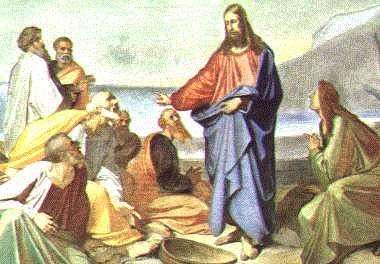 Four marks of the True Church: One, Holy, Catholic, Apostolic…
The following is taken from the booklet, "Faith and common sense", + Imprimatur: Most Reverend John F. Whealon, Archbishop of Hartford:
After Christ left this world, His Church did spring into action, fully prepared to carry on His work. This Church was not something vague in character. Christ said precisely what He wanted it to be. His Church was to be built upon the Apostles. It would continue down to the end of time in the same way, ruled by the successors of the Apostles. That is perhaps the clearest thing of all.
He also intended it to be one Church, not a number of churches. The Church He had in mind was to be for all men. It would work for their sanctification and salvation. These qualities were so clearly built into the Church that they were marks setting off the true Church of Christ from all other institutions claiming the name. Catholics say that these marks are unity, catholicity, holiness and apostolicity.
When we examine the early Church as it appears in the time of the Apostles, we find that it had all these qualities. One Church and only one is in existence today which clearly shows the same four marks. This is the Catholic Church.
Around the dome of St. Peter’s Basilica in Rome are inscribed the words, “Thou art Peter and upon this rock I will build my Church.” Those words are as true of the present Pope as they were of St. Peter. The Pope is the successor of Peter, and he has the same authority as the Prince of the Apostles once had.
That is a truth which can be amply proved by the facts. No other religious society can trace its heritage back through the centuries to St. Peter.
Pope Paul VI, the present Bishop of Rome [Note: Paul VI was Pope at the time this article was written], is a successor of St. Peter. Year by year the succession can be traced back to the time of the great Apostle himself. Some of the Popes lived for only a few years or months; some have had very long terms of office. Some of them have been great leaders in world affairs; some relatively obscure. But they are all known to history.
Today in the Catholic Church the Pope holds the fullness of power the same as Peter did in the early Church. He is not like a democratically-elected president whose power depends on the consent of the governed. Like Peter he has been made the shepherd of the flock by the Lord, and he has the same absolute power as Peter.
Under him in the administration of the Church are the Bishops and priests. Their power comes from God, as once the power of the Twelve came from Christ. St. Paul said to the presbyters of Ephesus, “Take heed to yourselves and to the whole flock in which the Holy Spirit has placed you as bishops to rule the Church of God” (Acts 20:28).
There is no doubt that the Catholic Church today is apostolic in the line of succession of its Bishops and the Pope, and that it possesses an authority which was once given to the Apostles.
UNITY OF RULE, BELIEF, RITUAL
St. Paul told the Ephesians to remember that they had “one Lord, one Faith, one Baptism” (Eph. 4:5). The Catholic Church does have that unity of rule, belief and ritual.
All Catholics everywhere recognize the authority of the Pope, the Vicar of Christ. He is the representative of the Lord, and presents the final judgments or decision on matters of faith and morals. Catholics do not accept the official pronouncements of the Pope only when they agree with them. They accept them at all times because they recognize his authority.
All Catholics believe the same faith. There is no difference in the essential doctrines which various priests teach. One Bishop does not have his own truths about religion which are different from the beliefs of another Bishop. Both are explaining the doctrine of the Catholic Church, not their own ideas about doctrines. The manner of preaching may be different; the doctrine is the same throughout the world. There is “one faith” in the Catholic Church.
So also there is but one “Baptism.” The term embraces all those essential rites which the Catholic Church practices. The most important rite of the Catholic Church is the Mass. The Mass is the re-enactment of the Last Supper, as was commanded by Christ. All Catholics are obliged to attend Mass every Sunday and on the important religious festivals of the year. This obligation is world-wide. So is the Mass. Our soldiers serving in foreign countries are always at home when they go into the Catholic churches of those nations; they find the Mass essentially as they knew it in the United States. The Mass is celebrated in every Catholic church throughout the world and consists of the same essential rite of the consecration of the bread and wine into the Body and Blood of Jesus Christ.
The seven sacraments–Baptism, Confirmation, the Eucharist, Penance, Matrimony, Holy Orders and the Anointing of the Sick–are the same throughout the world. They are administered in the same way in all places. Every Catholic is obliged to make use of them at appropriate times; there are no national differences.
THE MARK OF HOLINESS
Not only does the Catholic Church have that mark of unity which Christ wished His Church to have; it also has the mark of holiness. Christ instituted His Church to make men holy and to bring them to heaven. The Catholic Church does just that. None of its teaching ever leads men away from God; none ever twists human nature into some frightening form. All its practices and teachings tend to make men better.
Moreover, the Catholic Church provides men with the means to become better. It does not simply offer the “consolation of religion.” It does something about man’s ceaseless struggle to become better. To those who are conscious of sinfulness, it does not merely say, “Repent in the secret of your heart and try to do your best in the future.” It says, “Go to the sacrament of Penance; have your sins forgiven, and receive the grace which that sacrament provides to help you avoid these sins for the future.” At the bedside of those seriously ill, the Catholic priest does not merely exhort the Catholic to be sorry for his sins and cast himself upon the mercy of God. The Catholic Church has a rite, the sacrament of the Anointing of the Sick which forgives sins and brings the spiritual and physical help which men need in grave sickness.
“Is any one among you sick?” asks St. James. “Let him bring in the presbyters of the Church, and let them pray over him, anointing him with oil in the name of the Lord. And the prayer of faith will save the sick man, and the Lord will raise him up, and if he be in sins, they shall be forgiven him” (James 5:14-16). That is what the Catholic Church does for her members.
Finally, the Catholic Church is world-wide. That is a fact today as it has been a fact for all these centuries past. The membership of the Catholic Church consists of people of all nations, from every part of the world.
That is not an accident or the result of good salesmanship. It is the result of the very nature of the Church of Christ. He sent His Apostles to make disciples of all nations. The doctrine and practices which He left them were of such a nature that they appeal to all nations. There has never been a nation which found the doctrine of the Catholic Church contradictory to its own culture or thought.
When Pere Marquette journeyed down the Mississippi, preaching the Gospel, he found Indians who were anxious to listen to the story of the death of Christ upon the Cross. They were baptized and accepted Christianity wholeheartedly. When St. Francis Xavier reached Japan, he found the natives eager to hear the message. So firm were they in their faith that for two centuries during persecution they held on to that faith despite martyrdom. The Catholic Church is an ancient faith in Japan today, not a recent development.
So it has been everywhere. The Catholic Church has not been the product of one culture or one nation. Catholicism followed the Spanish armies into this country, and the Spanish armies were defeated. It has little to do with the English colonization of the eastern seaboard. Yet today the Catholic Church is the largest single religious body in the United States and a native part of our culture. The Catholic Church is universal in its appeal. That is why it is called “Catholic,” for catholic means universal.
THE TRUE CHURCH OF CHRIST
These are the qualities which mark out the Catholic Church today as the one religious organization in the world which is identical with the Church which Jesus Christ founded. It is one, holy, catholic and apostolic, just as was the Church in the time of the first Apostles.
These four marks point out the Catholic Church as the true Church of Christ in another way. Only God can work a miracle. Now these four qualities in a society are obviously miraculous.
Take unity, for example. We have erected a society called the United Nations to make something of that unity. But it seems the more nations we have in it, the less unity there is.
Political parties meet in convention to draw up a “platform” of action. But the platform cannot be too definite. There have to be compromises in deference to sharply conflicting views. The more divergent the factions in the party, the less agreement can be reached. All things human show the same tendency to disintegrate under the pressure of expansion.
The truths held by all Catholics are numerous and detailed; sometimes they are involved. For example, all Catholics believe in transubstantiation. Transubstantiation is the term applied to the change of the whole substance of bread into the Body of Christ and the change of the whole substance of wine into the substance of the Blood of Christ, the appearance of bread and wine remaining. That is a very definite belief, though a rather involved one. It is not the kind of truth people would come to know and believe on their own. All Catholics hold it with equal belief and with complete acceptance.
So it is with many other points of Catholic belief. The unity of the Catholic Church is something which is not matched anywhere else in the world. It is not that the Catholic Church is a little more united than other societies. It is that the Catholic Church is unified in a way which no other society was ever united. The ordinary laws of sociology do not apply here. That is what we mean by a miracle. Such unity cannot be explained on any natural basis.
Take the case of the Church’s apostolic tradition. It is just not reasonable that a society which has lived so vigorously as the Catholic Church should not have burned itself out by this time. Every other society which was in existence when Christ founded His Church–the Roman Empire, nation of the Gauls, the great universities of Greece–has passed away. Groups have broken off from the Catholic Church during its almost two thousand years of existence. They have followed the curve of disintegration which governs all natural societies. They have waxed strong for a while, grown old and they have passed away.
As the man in the Gospel who was born blind said after receiving his sight, “If this man were not from God, he could do nothing” (John 9:33). If the Catholic Church were not from God, it could not continue to possess, as the Catholic Church does, the four marks which Christ’s True Church must possess–apostolicity, catholicity, unity and holiness. Any church may claim these symbols of authenticity and authority. But only one may truly possess them.
"You have been given by your baptism entrance into the only true religion upon earth, the Roman Catholic Church under My Son, Jesus. Though man in his arrogance and pride has forgotten His role and His rule, you must carry it forward. Retain the Faith and the truth in the hearts of mankind." - Our Lady of the Roses, September 7, 1978
"I gave you a simple plan with the construction of My House, My Church, upon earth. But now you want to reform it, until you will split My House asunder with many denominations, many new denominations. I ask that My Church be universal, apostolic, and the saver of souls. However, there are rules to be followed, doctrines to remain unchanged." - Jesus, September 7, 1978
Our Lady of
the Roses awesome Bayside Prophecies...
https://www.tldm.org/../Bayside/
These prophecies came from Jesus, Mary, and the saints to Veronica
Lueken at Bayside, NY, from 1968 to 1995.
ONLY TRUE RELIGION
"O My children, I will not go into a long discourse now with you about charity and love for your neighbor, but you must understand: you cannot judge your neighbor. You must pray for them. However, you cannot become weak and permissive. You must stand forth as bearers of the light, carriers of the truth. You have been given by your baptism entrance into the only true religion upon earth, the Roman Catholic Church under My Son, Jesus. Though man in his arrogance and pride has forgotten His role and His rule, you must carry it forward. Retain the Faith and the truth in the hearts of mankind." - Our Lady, September 7, 1978YOUR BIRTHRIGHT
"As in the past, rejection has been the start of a fallen man. Sin has become a way of life with many. You live in a delusion if you believe that you can offend the Eternal Father and then gain eternal life in the Kingdom. No, I say to you: many are called, but few are chosen.
"Ask and you shall receive, believe and you will be given the way. But you must merit the Kingdom. Your birthright was a start, but you must make your way to the Kingdom. Others may gain these graces for you by prayer and acts of sacrifice, but you will accept or reject the key." - Jesus, May 26, 1976ONE TRUE CHURCH
"My child and My children, you are all My children. I judge you not by color or race, and I do not judge you by your creed; however, should the knowledge of the One True Church be given to you, and the way to Heaven along the narrow road be given to you, you will follow it or you will be rejected." - Our Lady, August 21, 1985RELIGION OF THE CROSS
"There is only one religion that can save your country and all of the countries of the world: the religion of the cross and My Son's sacrifice upon that cross." - Our Lady, November 25, 1978SEPARATED BRETHREN
"O My children, pray much! We do not want to see a division in My Son's House. The Roman Catholic Church must remain one! But this does not mean, as the church of man states, that you will bring all manner of heretics and separated brethren in. No, My children, that is an error, a delusion from satan. You cannot change My Son's House and bring them in and change for them! They must change and come back to the original rule given by My Son and those who were with Him in the building of the foundation.
"I repeat, My child and My children: separated brethren must change. They have protested in the past; they have taken themselves away from the truth and the one true Church. They must reject the errors they have made in the past and come back and start again. They cannot bring their errors into My Son's House.
"You are opening the doors now for all manner of heretics, separated brethren. They do not come to unite in good spirit and heart; they come to take over. They seek to change you, O pastors, who are being deluded. And what do I see in My Son's House but separated brethren upon His pulpit! Even from the temples, the synagogues of satan, upon His pulpit! And for what?
"And who are My pastors now that have joined in this plan of destruction? Who ordained some of them? Not legitimate hands. They come to destroy. They come in like rats, burrowing, undermining My Son's Church! Do you think you are not watched? Are you above your Creator that you think you can deceive the world permanently? No, I say unto you! You are being given your time, for you who have given yourselves to satan are now exposing your true nature to the world." - Our Lady, March 18, 1977ESTABLISHED BY JESUS CHRIST
"There are many deceptions taking place among you, and one being the falsification of the manner of the salvation of souls. When I was upon earth, I established the rules and I gave you My Church, My House. However, now I watch as many have gone forward with itching ears and novelty, and they are setting upon the world a new religion." - Jesus, May 20, 1978WILL STAND
"Do not be deluded, My children, by the agents of satan among you in human form who preach doctrines of devils. The truth has been given to mankind through the ages. The Holy Roman Catholic Church of My Son will stand. The members shall be reduced to few. Only a remnant, My child, shall carry the banner Faithful and True. But the gates of hell shall fight a heavy battle against My Son's Church, but they shall not succeed." - Our Lady, May 14, 1977ONLY SANCTIFIED HOUSE
"Your children are wandering into the web of satan, going farther from the House of My Son. The truth is being removed from their hearts. They are setting among themselves groups. They shall not remove from their lives vows of My Son. As the only sanctified House upon earth, their souls will be destroyed when they are not given the Bread of living life. This Bread will only be obtained in the sanctified House of My Son. Satan seeks to remove the tabernacle from among you." - Our Lady, August 5, 1973
Directives from Heaven... https://www.tldm.org/directives/directives.htm
D85 - Tradition
D123 - Catholic Church, Part 1
D124 - Catholic Church, Part 2
D125 - Ecumenism
Articles...
Outside the Catholic Church ... no salvation
https://www.tldm.org/News6/Church2.htmHow old is your church?
https://www.tldm.org/News6/Church.htmRedemption and its effects
https://www.tldm.org/lent/redemption.htm
There are 4 things you must have to survive the days ahead:
1.) The Douay-Rheims Holy Bible...
"You must all obtain a copy of the Book of life and love, the Bible. Do not accept the new mods. Try to find in your bookstores the old Bibles, My children, for many are being changed to suit the carnal nature of man. I repeat, sin has become a way of life." - Our Lady, October 6, 1992
"I must ask you all to read but a few short chapters a day now, the Book of life and love, your Bible. Knowledge must be gained for all the disciples of My Son, for you will be attacked by scientific minds. But do not be concerned what you will say to them when accosted, for the words will be given to you by the Spirit." - Our Lady, April 10, 1976 (Order Form)
2.) The total Virgin Mary’s Bayside Prophesies in 6 paperback books...
The Virgin Mary brings directions from God, the Father in Heaven on how to survive the end times. God, the Father, through the Virgin Mary, tells what is coming, how to prepare for it, how to survive it, and how to even stop it. These six volumes along with the Bible are most important to save yourself and your loved ones. Order it now. Tomorrow may be to late. These 6 pocket size paperback books costs $33.00. (Order Form)
3.) Heaven's Home Protection Packet...
Heaven’s Home Protection Packet...
Our Lord stated we must have crucifixes upon the outside of all of our outside doors. In the "Heaven’s Home Protection Packet" there are instructions, four crucifixes, a tube of special cement for wooden or metal crucifixes. Wooden crucifixes adhere better to the doors when the aluminum strap is removed from the back. Put a light coat of cement on the back of the crucifix and then press it to the outside of the door. If you have any problems, you can call us at 616-698-6448 for assistance. This Heaven’s Home Protection Packet is available for a donation of $7.00 plus $3.00 shipping and handling. Send $10.00 to TLD Ministries, P.O. Box 40, Lowell, MI 49331. Item # P15 (Order Form)Crucifix on front and back door... The only real protection against terrorists...
Jesus - "Pray and wear your sacramentals. And, also, My children, I ask you again to place a crucifix upon your door. Both front and back doors must have a crucifix. I say this to you because there will be carnage within your areas, and this will pass you by if you keep your crucifix upon your doors." (6-30-84) (Testimonies of lives and homes saved by the crucifixes.) https://www.tldm.org/news/crucifix.htm (Order Form)
4.) Heaven's Personal Protection Packet...
Our Lady tells us to be protected from all evil, we must wear the following sacramentals around our necks: a Rosary, a crucifix, the St. Benedict medal, Our Lady of the Roses medal, the Miraculous Medal, and the scapular. We have all of these sacramentals in a packet we call "Heaven's Personal Protection Packet." This packet is available for a donation of $6.00 plus $3.00 shipping and handling. Send $9.00 to TLD Ministries, P.O. Box 40, Lowell, MI 49331. Item # P5 (Order Form)Heaven’s Personal Protection Packet . . .
Our Lady of the Roses, Mary Help of Mothers promises
to help protect our children. On September 13, 1977, She said, "He has an
army of ogres wandering now throughout your country and all of the countries
of the world. They are in possession of great power; so wear your
sacramentals, and protect your children and your households. Learn the use
every day of holy water throughout your household. Insist even with
obstructions, insist that your children always wear a sacramental. One day
they will understand that they will repel the demons."
On February 1, 1974, Our Lady said, "My children, know the value of
these sacramentals. Guard your children well. You must awaken to the
knowledge that you will not be protected without the sacramentals. Guard
your children's souls. They must be surrounded with an aura of purity.
Remove them if necessary from the sources of contamination, be it your
schools or even false pastors."
This Heaven’s Personal Protection Packet is available for a donation of
$6.00 plus $3.00 shipping and handling. Send $9.00 to TLD Ministries, P.O.
Box 40, Lowell, MI 49331. You may use your MasterCard, VISA, or American
Express and call 1-616-698-6448. Item # P5
(Order
Form)
| Home - Latest News | Introduction | Bayside Prophecies | Directives from Heaven | Order Form | Miracles & Cures | Veronica Lueken | Miraculous Photos | Bible | Radio Program |
We encourage everyone to print or email copies of this web page to all the Bishops and all the clergy. Also, send this page to as many people as possible.
The electronic form of this document is
copyrighted.
Quotations are permissible as long as this web site is acknowledged through
hyperlink to:
http://www.tldm.org
Copyright © These Last Days Ministries, Inc. 1996 - 2012 All rights
reserved.
P.O. Box 40
616-698-6448
Lowell, MI 49331-0040
Revised:
September 16, 2018


