 These Last Days News - March 18,
2022
These Last Days News - March 18,
2022
URGENT: Please Forward a link to this web page to your clergy,
family, friends and relatives.
Christian Militancy in the Prayer of the Church {VIDEO}...
CONSTANTLY
"My child and My children, pray constantly a vigil
of prayer going throughout your world and the earth, for the little time
that is being allotted to mankind." - Jesus, August 21, 1985
DAILY
"You must all now keep a constant vigilance of prayer.
And when I say constant, My children, it means daily." - Our Lady, March
18, 1978
"Realize
the power in your hand with the Rosary, for in your hands you hold the power of
God. If you do not recognize the Rosary, can you expect to be recognized by My
Son? How much can you expect? Why do you hide My Rosary? It was with a Mother's
loving heart that I chose to give you these pearls of Heaven that you reject.
"Woe to all dedicated who seek to remove these from the little ones' hands,
for their punishment will be metered in accordance to it!
"Why has sophisticated man cast aside these tokens of My love? Those who
remain true to My Rosary will not be touched by the fires. Gather these
treasures, My children, for the time will come that you will not find them on
the counters of your stores." - Our Lady of the Roses, October 6, 1970
The above Messages from Our Lady were given to Veronica Lueken at Bayside, New York. Read more
OnePeterFive.com report on March 16, 2022:
by Peter Kwasniewski, PhD
The following talk was given at a Call to Holiness event at Assumption Grotto in Detroit on Sunday, March 6, 2022. Please note that the sound quality in the video improves at the 2’15” mark, at which time the lapel mic begins working.
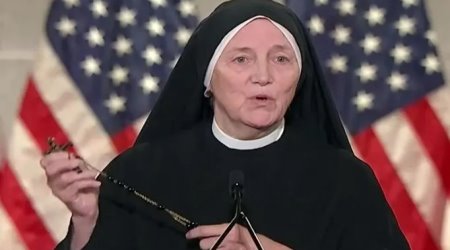
A long time ago, in a galaxy far, far away, at an event called the Republican National Convention, a religious sister named Deirdre Byrne gave a rousing pro-life speech that concluded with a promise of prayers for then-President Trump: “You’ll find us here with our weapon of choice, the Rosary.” The liberal Franciscan theologian Fr. Daniel P. Horán reacted with what a celebrity blogger would call a spittle-flecked nutty: “Weapons are, by definition, instruments of violence. Prayer is NOT a weapon, sacramentals for prayer like rosaries are not weapons. Christ preached and lived a message of nonviolence, and prayer is always about love—God’s love! Weaponizing faith is disgusting and idolatrous.”
Here Dede and Daniel offer us a perfect contrast: you might even call them “Sr. Rambo and Br. Bambi.” Which one has the right perspective on Christianity? It seems pretty clear, whatever else may be the case, that Fr. Daniel hasn’t cracked open the letters of St. Paul in a good long while, for he might have stumbled across some verses in 2 Corinthians that could have put ideas into Sr. Deirde’s head: “As servants of God we commend ourselves in every way: through great endurance, in afflictions, hardships, calamities…with the weapons of righteousness for the right hand and for the left” (that’s from chapter 6); and again, “the weapons of our warfare are not worldly but have divine power to destroy strongholds” (that’s from chapter 10).[1] One is reminded of how the pope said this past Epiphany that “faith is not a suit of armor,” seeming to forget that St. Paul in Ephesians tells Christians to “take up the full armor of God” and to use the “shield of faith.” One would think scriptural literacy is a job requirement for the papacy, but I guess there are exceptions to every rule…
“The life of man upon earth is a warfare” (Job 7:1). These words from the Book of Job express a fundamental truth of the Christian life. We are born into enemy territory: the world is in the grip of the Evil One, to whom our first parents gave the keys to the city. Scripture really leaves no doubt about it. The Apostle John writes: “We know that whosoever is born of God does not sin, but the generation of God preserves him and the wicked one does not touch him. We know that we are of God and the whole world lies in the power of the evil one [mundus totus in maligno positus est]” (1 Jn 5:18–19).
Within this world Christ has established a fortress, a beachhead, a kingdom that is at the same time not of this world, but of the enduring world of heaven, where the Evil One has already decisively lost. The fury with which he campaigns on earth is an expression of his despair at having been driven forth from heaven into hell. Either from malice or from ignorance and foolishness, many men end up enlisting in Satan’s army, and we are engaged with them in a struggle not only to repel their attacks but to capture them, if possible, and bring them over to our side.
The life of man is a battle in another and more distressing way: we have enemies within us, too, that we can never fully escape from—disordered concupiscence, bad habits, the memories of our past sins—although we can bring them into subjection. That, indeed, is what the season of Lent is supposed to help us to do. To paraphrase St. Benedict, our whole life should be salted with a Lenten spirit, but the Church wisely asks us to set apart a segment of time each year when we can hit the spiritual “restart” button.
We are not alone in the fight: we have many allies, many powerful friends. The most powerful weapons in our arsenal are the Holy Sacrifice of the Mass and the other sacraments, the Divine Office, and the sacramentals (especially the Rosary), which Christ and the Church provide for our sanctification, the strengthening of the inner man, the conquest of enemy territory within and without. These things are not just individual actions we perform; they are acts of the Mystical Body that carry the full weight of its indestructible essence. I came across a stirring passage in a book by an obscure French author, an old-school Jesuit writing before the Council, by the name of Taymans d’Eypernon. He says:
This, then, is the reason why God in His love has stooped so low to us. It is in a material universe that our destiny is shaped and shattered and remade. The material world is a vast plain of battle, scarred with the marks of our defeat, or resplendent with the trophies of victory. Matter is man’s strength and his weakness, for it is by his life amid material things and by his use of them that man rises above himself; and on the other hand, it is the material part of our nature that bleeds and is broken in the press of life. It was divinely fitting that God should come and apply His saving Omnipotence to this essential part of His creation, the most vulnerable of all. He does this by the sacraments. They not only are signs of His coming, they actually contain the divine healing power and apply it to our souls. In them, matter is elevated to the rank of a bond between God and man, and a symbol of the infinite mystery of God’s love. Raised to sacramental dignity, matter is not only the channel by which the thought and prayer of the creature rise to the Uncreated, but the channel by which God Himself really comes to His creatures to dwell in them forever. Et mansionem apud eum faciemus: And we will make our abode with him (Jn 14:23).[2]
Without this help from God throughout our lives, above all in the Most Holy Eucharist, the vast plain of battle will be scarred with the marks of our defeat, rather than resplendent with the trophies of victory. By God’s grace, given to us under material forms (even as the Son of God was “given to us” in the man Jesus of Nazareth), we can find healing, rise above ourselves, and join Christ our victorious King.
Fr. Christopher Smith has these rousing words for us:
As Christians we know that peace comes from the social reign of Christ as King over all peoples, and to establish that peace we engage first of all in a spiritual battle within ourselves. We absolutely must not be afraid to declare total war on the world, the flesh, and the Devil, which seek to carry our souls away from peace, away from the Prince of Peace. But that spiritual battle also means that we must learn how to defend our Faith and engage others for our freedom to practice what we know is the true religion. Now of course every age has its own particular fight for right. The spiritual battle takes on a different quality in different times and places but there is a very particular quality to what that looks like today.
Part of this “very particular quality” is surely fighting for the Church’s traditional rites of divine worship, which candidly acknowledge and boldly assist us in the spiritual battle we are facing. In my talk today, I want to show some of the many ways that the traditional Roman liturgy recognizes, with realism and supernatural hope, the true state of affairs in which we are involved. Roberto de Mattei notes that “the Church is the Mystical Body of Christ: a reality that transcends history, but in history lives and battles and hence is called the Church Militant.”[3] “The Church here on earth is not simply ‘on the pilgrim’s way,’ but it is rather a militant Church (ecclesia militans). Her ranks are called to battle.”[4]
Battles for Christendom
First, let’s look at the traditional liturgical calendar. Every year, Holy Mother Church reminds us again and again of battles fought by Christians to preserve the true Faith on earth. For the Kingdom of God is not far removed from us, in a heaven that cannot be reached, but is a reality present also on earth, albeit in the form of sacramental signs administered and received by imperfect men, and in the form of a hierarchical social body that coexists with the cities and nations of men. Wherever Christ is present, His kingdom is present; we are living at the fringes of His realm, with access to the King Himself. We do not pray “Thy Kingdom stay away,” but “Thy kingdom come.” We do not pray: “Thy will be done only in heaven, and as for earth, forget about it, it’s a hopeless disaster.” We pray: “Thy will be done on earth, as it is in heaven.” In Our Lord’s parable of the mustard seed, we should not overlook the fact that a seed must be planted in the earth, where it germinates and puts down its roots in order to grow into the heavens.
Christians are called first and foremost to beg the Lord for deliverance, but we are also called to make a good use of the natural gifts and abilities He has given us for living with dignity here below. That is the reason why, when the blossoming of the human-divine civilization known as Christendom was attacked by its enemies, Christians reasonably and rightfully took up arms to defend themselves, their families and peoples, their holy religion. We may find ourselves in the future needing our weapons to defend the most fundamental human and Christian rights against totalitarian progressivism in the State and Modernism in the Church. None of us can know exactly what this will look like, but it is important to see that we are not wrong to be thinking along these lines. The traditional Roman Martyrology, which is read as part of the office of Prime, puts us in mind of this fact over and over again. Some examples: on the 12th of September, we read about “The Feast of the Most Holy Name of the Blessed Virgin Mary, which Pope Innocent XI commanded should be celebrated by reason of the famous victory obtained over the Turks at Vienna in Austria by the help of the Blessed Virgin,” and on the 16th of the same month, “At Monte Cassino, blessed Pope Victor III, who … shed a fresh lustre on the Apostolic See, and with God’s help gained a famous victory over the Saracens.” On May 1st, we hear of St. Pius V that “he battled against the enemies of the Christian name.” On October 7th, we hear of “the Feast of the Blessed Virgin Mary of the Rosary and the commemoration of St Mary of Victory, which Pope St Pius V instituted to be kept yearly in memory of the glorious victory obtained on this same day in a naval battle by the Christians against the Turks [at Lepanto in 1571], by the help of the same Mother of God.” (And, in fact, it was a second victory over the Turks in Hungary in 1716 that prompted Pope Clement XI to extend the feast to the entire Catholic world.[5] Can you imagine what these popes would think about Abu Dhabi and Fratelli Tutti?) In his 1937 encyclical on the Rosary, Ingravescentibus Malis, Pope Pius XI expressly recalled Lepanto:
When the impious Mohammedan power, trusting in its powerful fleet and war-hardened armies, threatened the peoples of Europe with ruin and slavery, then—upon the suggestion of the Sovereign Pontiff—the protection of the heavenly Mother was fervently implored and the enemy was defeated and his ships sunk. Thus the Faithful of every age, both in public misfortune and in private need, turn in supplication to Mary, the benignant, so that she may come to their aid and grant help and remedy against sorrows of body and soul. And never was her most powerful aid hoped for in vain by those who besought it with pious and trustful prayer.[6]
On October 23, we read about “the birthday of St John of Capistrano, Priest of the Order of Friars Minor, Confessor, a man illustrious for holiness of life and zeal for the spreading of the Catholic faith. He by his prayers and miracles delivered from siege the town of Tornau, which was wasted by a powerful Turkish army.”[7] In the entry for “St Stephen, King of Hungary, Confessor, who was adorned with divine virtues,” we learn that “his feast is especially kept, by decision of Pope Innocent XI, on September 2, on which day the strong fortress of Buda, by the aid of the holy king, was valiantly recovered by the Christian army.”[8]
The traditional Martyrology mentions over 360 martyrs to Islam on over 30 separate dates in the year, with no month skipped. The Church does not want us to forget the memory of these heroes of the Faith who surrendered their lives for the love of Christ and the love of His truth. They were not combatants, but neither were they milquetoast Christians who apologized for offending people with the Gospel or who preached human fraternity and boundless tolerance of error. One of my favorite entries in the Martyrology appears on February 21st: “At Damascus, St Peter Mavimenus, who said to certain Arabs who came to him in his sickness: ‘Every man who does not embrace the Catholic Christian faith is damned as Mohammed, your false prophet, was,’ and was slain by them.” Not a surprising conclusion to that “interreligious dialogue.”
Soldiers for Christ
Then there are the soldiers: the ancient Roman calendar is full of soldier-saints. In ancient times Christianity struggled with the issue of whether believers ought to enlist (or remain in) the imperial army. The liturgy answered the question with a paradox: yes, there were many just men who fought for the emperor, but their righteousness was displayed above all when they refused to worship the emperor’s idols and, throwing down their arms, embraced martyrdom for the heavenly King, which is the ultimate act of fortitude or courage. In this way we see that being a soldier is not, in itself, incompatible with professing the Christian Faith—but also that our ultimate allegiance cannot be to any earthly ruler or his campaigns. As I said, the old calendar is full of these soldier-saints. Just to limit ourselves to the sanctoral cycle in the Roman Missal: St. Sebastian (January 20), the Forty Holy Martyrs of the garrison of Sebaste (March 10), St. George (April 23), Sts. Nereus and Achilleus (May 12), Sts. Basilides, Cyrinus, Nabor, and Nazarius (June 12), Sts. John and Paul (June 26), Sts. Processus and Martinian (July 2), St. Romanus (August 9), St. Hippolytus (August 13), St. Gorgonius (September 9), St. Eustace and Companions (September 20), St. Mauríce and Companions (September 22), St. Theodore (November 9), St. Martin of Tours (November 11), and St. Mennas (also November 11). That’s over 60 soldiers commemorated at Mass each year! While it is true that these soldiers are celebrated by us at Mass because they are martyrs for the Faith, not because they fought for the Roman Empire, they are not condemned for having been in the imperial army, even when it was a pagan army—and subsequent devotion to them has emphasized their military attire, virtues, and patronage, seeing in them models of Christian warfare.
The reason I make a point of mentioning Christian soldiers is that the Church today has been corrupted by the error of pacifism in various forms. We are not sure anymore if we are allowed to fight about anything. Isn’t it mean and nasty to speak against someone’s lifestyle choices, their opinions and views, their “orientation,” or whatever? Isn’t it lacking in meekness to resist attacks against our persons or our property? Shouldn’t we always “turn the other cheek” and let God alone defend us? This mentality was already influential during the Second Vatican Council, when memories of the horrors of World War II, together with a secular humanistic optimism about the potential of democratic government and the peacekeeping role of the United Nations, led all too many churchmen into believing that humanity had somehow “come of age” and could now deal with evils not by warring against them, or even condemning them, but rather by the gentle touch of negotiation and the warmth of universal benevolence. This attitude, alas, is reflected in certain texts drawn up for the Novus Ordo, which are notable for their naïveté and chumminess. And nearly all the soldier saints were removed from Paul VI’s calendar.
Catholics have never thought or acted this way until quite recently. According to St. Thomas Aquinas, some souls are called to a meekness that is supererogatory (that is, above-and-beyond-the-call-of-duty), even as some souls are called to the evangelical counsels of poverty, chastity, and obedience. It would not be edifying to see a Dominican friar wielding an AK-47. Yet Aquinas also notes that the structure of justice inherent to God’s creation is not suppressed or contradicted by divine revelation, but rather reinforced by it. This is why at least we the laity are allowed to defend ourselves, our families, our communities, our nation, our Church—with violence if necessary. One can put it this way: just as the advent of the more perfect way of the religious life does not cancel out the natural and supernatural goodness of marriage and family, so too the choice of some to allow themselves to be tortured and killed does not cancel out the natural and supernatural goodness of proportionate resistance to evil. While normally our fight against evil will take place in the spiritual domain and in the political arena, there is no reason to exclude the possibility that it may sometimes rightly take place on the physical level too.
Roberto de Mattei has spoken frequently of the danger of what he calls “catacombism.” Here is how he explains it:
Catacombism is the attitude of those who retreat from the battlefield and hide themselves in the illusion of being able to survive without fighting. Catacombism is the denial of the militant conception of Christianity. The catacombist does not wish to fight, because he is convinced of having already lost the battle; he accepts the situation of the inferiority of Catholics in the culture as a given, without going back to the causes that have determined it. But if Catholics today are in the minority, it is because they have lost a series of battles; they have lost these battles because they have not fought them; they have not fought them because they have removed the very idea of the “enemy,” turning their backs on the Augustinian concept of the two cities fighting each other in history, the only concept that can offer us an explanation of what is happening, and what has happened. If one rejects this militant concept, one accepts the principle of the irreversibility of the historic process, and from catacombism one inevitably passes to progressivism and modernism….
Wishing to portray that valorous Church [of ancient times], always ready to live on the forefront, as a community of draft dodgers, hiding themselves for embarrassment or cowardice, would be an insult to their virtues. They were fully aware of their duty of conquering the world for Christ, to transform private and public life according to the doctrine and law of the Divine Savior, out of which a new civilization could be born—another Rome, springing forth from the tombs of the two Princes of the Apostles. And they reached their goal. Rome and the Roman Empire became Christian.
In times past it was said that the Sacrament of Confirmation made us “soldiers of Christ,” and Pius XII, addressing the bishops of the United States, said: “The Christian, if he does honor to the name he bears, is always an apostle; it is not permitted to the Soldier of Christ that he quit the battlefield, because only death puts an end to his military service.” We need to recover this militant conception of the Christian life.[9]
A favorite hymn, “For All the Saints,” delivers this message loud and clear in one of its verses: “O may Thy soldiers, faithful, true, and bold, / Fight as the saints who nobly fought of old, / And win with them the victor’s crown of gold. / Alleluia, alleluia!”
The Prayers of the Missal
More important than the mere presence of saints in the calendar are the prayers we use at Mass for their feasts and commemorations. Among the most important public prayers of the Church are those we call Orations—namely, the Collects, Secrets, and Postcommunions of the Mass. The Collect itself is of special importance because it recurs throughout the Divine Office as well. If we want to understand how the Catholic Church prays—and therefore, what we should believe and how we should live—we must look carefully at some examples of these Orations.
“The prayers [of the old missal] identify those enemies and adversaries that the Church militant must continually encounter in the temporal as well as the spiritual life.”[10] Let’s have a look at some contrasts. The Collect on the optional memorial of St John of Capistrano, who spurred the Christian army to victory in 1456 at Belgrade, goes like this in the Novus Ordo:
O God, who raised up Saint John of Capistrano to comfort your faithful people in tribulation, place us, we pray, under your safe protection and keep your Church in everlasting peace.
By contrast, here’s the prayer found in the traditional missal for the obligatory feast of the same saint:
O God, Who through blessed John didst enable Thy faithful people to triumph over the enemies of the Cross by the power of the Most Holy Name of Jesus: grant, we beseech Thee, that by his intercession we may overcome the snares of our spiritual enemies and be found worthy to receive from Thee the crown of justice.
The traditional Collect for St. Patrick notes that he brought the Gospel not only to the Irish people (as it says in the Novus Ordo prayer), but to the heathens, whom we know fiercely resisted him. The Collect for St Augustine of Canterbury praises him not only for leading the English peoples to the Gospel (as the Novus Ordo says), but also for “shedding upon the English people the light of the true faith,” that is, casting out the darkness of pagan error. For St Irenaeus of Lyons, the great second-century opponent of the heresy of Gnosticism, the Novus Ordo Collect says:
O God, who called the Bishop Saint Irenaeus to confirm true doctrine and the peace of the Church, grant, we pray, through his intercession, that, being renewed in faith and charity, we may always be intent on fostering unity and concord.
The Latin Mass, on the other hand, uses this Collect:
O God, who didst vouchsafe unto blessed Irenaeus, Thy martyr and bishop, by his strenuous teaching of the truth, utterly to confute heresies, and happily to establish peace in Thy Church: grant unto us Thy people, we beseech Thee, to be steadfast in the practice of our holy religion, and in all our days to enjoy that peace which is from Thee.
The entire tone and much of the content of these prayers is so different! Thus, for St Robert Bellarmine, the old Collect pulls no punches:
O God, who didst adorn blessed Robert Thy Bishop and Doctor with wondrous learning and virtue that he might lay bare the snares of error and maintain the rights of the Apostolic See: grant by his merits and intercession that we may grow in love of the truth, and that the hearts of the wayward may return to the unity of Thy Church.
In contrast, the new Collect says nothing about the snares of error, maintaining the rights of the Apostolic See, love of the truth, or wayward hearts returning to the Church. Its Catholic content has been sucked out of it. Michael Fiedrowicz argues:
This [older version of the] prayer does not lessen the charism of this saint, but rather increases it. It was precisely his astute refutation of the Protestant errors that made Cardinal Bellarmine the Catholic theological controversialist most feared by the Protestant Reformers, and to whose refutation several “cathedrae anti-Bellarminianae” were established. Furthermore, it is only the traditional prayer that speaks of the necessity of a return of heretics to the true religion of the Catholic Faith. The classical missal opposes an abandonment of the so-called ecumenism of return, the conviction of the Church of all ages that all confessions are in no way equally on the path to truth. The traditional orations recall in an uncomfortable way that in questions of faith there are not only various opinions, but also errors that must be overcome, or at least fought against. An abandonment of this battle would amount to a victory of relativism.[11]
One of the votive Masses in the back of the Missale Romanum is the “Mass for the defense of the Church,” also known as the “Mass against the heathen”—something that would never have been allowed to exist in the Novus Ordo, and in fact does not exist. The Collect reads:
Almighty, everlasting God, in whose hand are the power and the government of every nation: look to the help of the Christian people, that the heathen nations, who trust in their own fierceness, may be crushed by the power of Thy right arm. Through Our Lord Jesus Christ…
The Gradual prays: “O my God, make them like a wheel and as stubble before the face of the wind.” The Alleluia verse adds: “Stir up Thy might, O Lord, and come: that Thou mayest save us.” The Secret prays: “Look, O Lord, upon the sacrifice which we immolate, that Thou wouldst deliver Thy champions [propugnatores tuos] from all wickedness of the heathen, and keep them secure in Thy protection.” This virile spirit of the traditional prayers is found throughout the Missale Romanum handed down to us by our forefathers.
The Virile Spirit Illustrated
As a more complete illustration, let’s take a look at the Mass of July 28th, the feast of the martyrs Nazarius, Celsus, and Pope Victor I, and the confessor Pope Innocent I—four saints who were given the axe in 1969, in spite of being called upon by the Church for a good 800 years.[12] The Introit is taken from Psalm 78: “Let the sighing of the prisoners come in before Thee, O Lord; render to our neighbours sevenfold in their bosom; revenge the blood of Thy saints, which hath been shed. Ps. O God, the heathens are come into Thy inheritance: they have defiled Thy holy temple: they have made Jerusalem as a place to keep fruit. Glory be to the Father… Let the sighing…” One of these verses was stigmatized as a “cursing” verse and therefore removed entirely from both the postconciliar Lectionary and the Liturgy of the Hours, as were 121 other psalm verses that are nowhere prayed in the Novus Ordo. In general, the more “spirited” or “militant” psalms have been minimized or excised, which corresponds to the generally effeminate presentation of Christianity in recent times. Think of the doe-eyed Sacred Heart images from the 19th and 20th centuries, where Our Lord is depicted as a saccharine, fragile, androgynous figure, as if He would flinch at a passing softball, or deflate when poked with a needle.
The Collect of the Mass is muscular: “May the confession of Thy saints Nazarius, Celsus, Victor, and Innocent fortify us, O Lord, and may it graciously win for us reinforcement in our weakness. Through Our Lord Jesus Christ…” The Lesson is from the Book of Wisdom (10:17–20):
God rendered to the just the wages of their labours, and conducted them in a wonderful way; and He was to them for a covert by day, and for the light of stars by night; and He brought them through the Red Sea, and carried them over through a great water. But their enemies He drowned in the sea… Therefore the just took the spoils of the wicked. And they sang to Thy holy name, O Lord, and they praised with one accord Thy victorious hand, O Lord, our God.
The Gradual and Alleluia verses are taken from the Book of Exodus (15:11, 6; 44:14).
God is glorious in His Saints, wonderful in majesty, doing wonders. Thy right hand, O Lord, is glorified in strength; Thy right hand hath broken the enemies. Alleluia, alleluia. The bodies of Thy Saints are buried in peace, and their name liveth unto generation and generation. Alleluia.
The Gospel is taken from Luke chapter 21 (9–19):
At that time, Jesus said to His disciples: When you shall hear of wars and seditions, be not terrified: these things must first come to pass, but the end is not yet presently. Then He said to them: Nation shall rise against nation, and kingdom against kingdom. And there shall be great earthquakes in divers places, and pestilences, and famines and terrors from Heaven, and there shall be great signs. But before all these things, they will lay their hands on you and persecute you, delivering you up to the synagogues and into prisons, dragging you before kings and governors for My name’s sake; and it shall happen unto you for a testimony…. And you shall be betrayed by your parents and brethren and kinsmen and friends, and some of you they will put to death: and you shall be hated by all men for My name’s sake; but a hair of your head shall not perish. In your patience you shall possess your souls.
Let us pause for a moment on this potent Gospel, so utterly relevant to our postmodern, post-Christian age of intensifying persecution. It is a Gospel read four times each year in the traditional Latin Mass (unless one of these dates happens to fall on a Sunday): on June 2, for Sts. Marcellinus, Peter, and Erasmus; on July 28, for Sts. Nazarius, Celsus, Victor, and Innocent; on September 16 for Sts. Cornelius, Cyprian, Euphemia, Lucy, and Geminian; and on January 22 for Sts. Vincent and Anastasius. In the postconciliar Lectionary, this Gospel is read on the 33rd Sunday of Ordinary Time every third year, and part of it is read on Wednesday of the 34th week (Years I & II). I leave you to draw your own conclusions.[13]
This proper Mass for July 28th—and it is only one of so many that we could choose from the Church’s year—has a spiritedness, a realism, a strength of character in it, massive and fortified as a Romanesque church, tall and straight as a Gothic column, orderly and graceful as a Renaissance façade, well-worn and rugged as a pilgrimage route, with a note of subdued triumph, as of soldiers assured of victory but prepared for hardship. We encounter in the traditional liturgy what we heard De Mattei calling the “militant conception of Christianity.” We are engaged in battle against our spiritual enemies: the seething world of unbelief, the flesh or disordered concupiscence, the devil and his minions. The old liturgy does not run away from this reality but confronts it head on. As the mainstream Church slides further into self-referential effeminacy and comfort-seeking compromises with the world, does it not become ever more apparent that what we need to hear—and once again, strive to live—is the truth embedded in the great ancient rite of the Church of Rome?
The Holy Angels
It’s highly appropriate to recall at the start of Lent the classic saying that we battle against three enemies: the visible enemy around us, “the world,” meaning fallen humanity insofar as it has turned against God by sin; the enemy within us, “the flesh,” which refers to the ravages of sin in our nature; and the invisible enemy above us in stature, namely, the devil and his fallen angels. Against these enemies we have the help of the saints of the Church Triumphant, among whom stand the mighty armies of holy angels. Let me share with you a story from the Desert Fathers.
While still a neophyte in monastic life, Moses the Black was warring against carnal desire. So he went, in a state of turbulence, to confess to Abba Isidoros. The elder listened to him sympathetically and, when he had given him words of appropriate counsel, told him to return to his cell. However, inasmuch as Abba Moses was still hesitant, for fear of the flame of evil desires rekindling during his return, Abba Isidoros took him by the hand and led him to a small roof atop his cell. “Look here,” he told him, directing him towards the West. Thereupon Moses saw an entire army of wicked spirits with drawn bows, ready for warfare, and was terrified. “Look towards the East now,” the elder told him once more. Myriads of angels in military formation were standing ready to confront the enemy. “All of these,” Abba Isidoros told him, “are assigned by God to help the struggler. Do you see how our defenders are many more and incomparably stronger than our enemies?” Moses thanked God with his heart for this revelation and, taking courage, returned to his cell to continue his struggle.[14]
It is not difficult to see that the angels are much frequently acknowledged in the traditional Mass and sacramental rites. The prayer at the end of the Asperges asks the Lord to “vouchsafe to send Thy holy angel from heaven, to guard, cherish, protect, visit and defend all that are assembled in this place.” The centuries-old version of the Confiteor expressly calls twice upon St. Michael the Archangel, prince of the heavenly host and the weigher of souls at the divine judgment, and does so three times each Mass. St. Michael is also called upon during the Offertory incensation of the gifts at High Mass, or in the Leonine Prayers at the end of Low Mass. That means he will be invoked a total of seven times each Mass. Shortly after the consecration, the priest whispers this mysterious prayer: “Most humbly we implore Thee, Almighty God, bid these offerings to be brought by the hands of Thy Holy Angel to Thine altar on high, before the face of Thy Divine Majesty.”
The traditional calendar generously makes room for five feasts in honor of the angels: St. Michael on September 29 and again on May 8, St. Gabriel on March 24th, St. Raphael on October 24th, and the Guardian Angels on October 2nd. The Novus Ordo collapsed all these feasts into only two, namely, September 29 and October 2, and abolished nearly all of the mentions of the angels in the Mass. That was a mistake. It’s rather obvious that in this period of ever-heightening spiritual warfare, we need to cultivate a strong devotion to the angels, and the traditional liturgy helps us to do exactly that.
Asceticism and Mortification
What is our help against the waywardness of the flesh? The answer is more complex, because human nature is complicated. We can boil it down to a via negativa and a via positiva, or a way of negation and a way of affirmation. The way of affirmation is the corporal and spiritual works of mercy, in which we give ourselves worthwhile activities, involving alike the body and the soul, done for love of God and neighbor. The way of negation, on the other hand, is to embrace asceticism, mortification, and penance. This was the original meaning and spirit of the season of Lent, which has now almost entirely disappeared from the consciousness of Catholics (and that’s no exaggeration).
Now, no one really wants to hear that we need to remove pleasure or add suffering to our lives. But the Church understands that we must do so. As even the pagan philosophers Plato and Aristotle saw, human beings are prone to excess in their appetites, and they need to “bend the stick in the opposite direction” by choosing to deny themselves legitimate goods in order to gain self-mastery and grow in strength for endurance. Beyond that, we are sinners in need of repentance, and we have debts of punishment to pay. Moreover, because of the solidarity of the Mystical Body, we can make reparation for the sins of others, which is pleasing to the Lord and meritorious for eternal life.
The traditional Mass itself places ascetical demands on us. The faithful are typically kneeling for long stretches, from the prayers at the foot of the altar to the Gospel, and from the Sanctus to the last Gospel. This demanding discipline keeps us mindful that we are in a special sacred place, taking part in a sacrifice to which we must unite ourselves, giving a small sacrifice of our own. At a High Mass, there will be a combination of standing, genuflecting, kneeling, and sitting, which, together with the signs of the cross, the beating of the breast, the bowing of the head, and the chanting of responses, immerses us in the act of worship, so that the Faith can enter into our bones, our muscles, our knees, our hands, as well as our ears, eyes, and noses. Catholic worship is physical through and through. Tragically, the Novus Ordo dropped a lot of these “muscular” and “sensuous” elements in favor of verbal comprehension and response, which, by themselves, constitute a fairly impoverished form of participation, in one ear and out the other.
If “the spirit is willing but the flesh is weak,” then our effort must be to strengthen the flesh to support the spirit. This is perhaps the greatest gap or oversight in modern Christianity, which has become altogether too “spiritualized,” too abstract, conceptual, “in the head.” If we want to be soldiers for Christ, we should be thinking as much of an army bootcamp as we do of getting more education. Obviously asceticism and learning belong together and we need both, but our knowledge will benefit us the most when we confirm it and support it with a regimen of prudent physical asceticism.
There is a lot we can start doing immediately, instead of putting it off for a future month or year when we are “more holy.” We will not become holy until we embrace discipline. So, for example, I mentioned fasting and abstinence. A fast is traditionally understood to be not eating until the evening of the day, when we take one meal. However, for those who are not ready to try that (or whose close relatives will not allow them to), an effective and more manageable fast is to refrain from eating until noon, and then to eat nothing after 8pm. The 16 hours of not eating, between 8pm and 12pm, will still be penitential, but you will probably not be as much of a burden to the people around you, and in any case, you’ll be asleep for half of the time. It is a good “middle option” for the season of Lent, for Ember and Rogation Days, and for Vigils of great feasts. As those who fast regularly have experienced, after initial difficulties we arrive at a better place, where we are not so dependent on our bodily urges and acquire better mental clarity and spiritual alertness.
I have noticed that young people struggle a lot with going to bed on time and getting up at a reasonable hour; I used to struggle with this challenge myself. If we do not pray first thing in the morning, our day will never go well. A major form of asceticism for the young is forcing themselves to go to bed at an hour that makes possible a consistent early rising for a morning prayer routine, which might, for example, take the form of reciting the Office of Prime and spending 15 minutes in quiet prayer, with or without a Bible. St. Alphonsus Liguori famously said: “He who prays is saved; he who does not pray is lost.” If we want to pray, we need to get up; if we want to get up, we need to go to bed; if we want to be strong and not sluggish, we should adopt some fasting and abstinence. This advice is common to all of the saints who talk about the spiritual life. I’m not saying anything that hasn’t already been known for over 1,700 years, ever since Christians first started heading out into the Egyptian wilderness to learn the secrets of sanctity.
A last thought about mortification: not everyone can do everything recommended by the saints, and some people are in a situation where they cannot handle any more challenges than life has already given them. For example, a mother with a nursing baby should not even dream about fasting. What God is asking of us is to take whatever steps we can, when and as we can, to pray more, to deny ourselves in little ways, and to order our lives more fully to the Lord, who deserves all our love. The traditional liturgy gives us tools for this lifelong work because its calendar, prayers, and customs continually remind us of the spirit of detachment and self-abnegation preached and practiced by Christ our King and His servants—always for the sake of more perfect love.
The Book of Psalms
As a Benedictine oblate, I pray the little hours of the Divine Office throughout the week. The one portion I always pray, come what may, is the Office of Prime, which is the shorter of the two morning hours, and which has been dubbed “the office of fighters and workers.” In the monastic use, Psalm 17 is divided between Friday and Saturday mornings. This Psalm is one of the most vigorous expressions in the Bible of the militant spirituality of the sons of God living in this land of exile and tribulation. I would like to quote some verses from it, to show how profoundly this message permeates the revealed Word of God. In the Psalter He is teaching us what to pray for and how to pray for it. We must take Him at His word; we must make His words our own, week after week.
The title of the psalm is: “Unto the end, for David the servant of the Lord, who spoke to the Lord the words of this canticle, in the day that the Lord delivered him from the hands of all his enemies, and from the hand of Saul.” King David begins:
I will love thee, O Lord, my strength: the Lord is my firmament, my refuge, and my deliverer. My God is my helper, and in him will I put my trust. My protector and the horn of my salvation, and my support.
Then come the words spoken at every Mass by the priest as he takes up the chalice, ready to drink the Precious Blood of His Lord and God: Laudans invocabo Dominum: et ab inimicis meis salvus ero. “Praising I will call upon the Lord: and I shall be saved from my enemies.” Skipping some verses, we come back to our theme:
He delivered me from my strongest enemies,
and from them that hated me:
for they were too strong for me….
For who is God but the Lord?
or who is God but our God?
God who hath girt me with strength;
and made my way blameless.
Who hath made my feet like the feet of harts:
and who setteth me upon high places.
Who traineth my hands to battle:
and thou hast made my arms like a brazen bow.
And thou hast given me the protection of thy salvation:
and thy right hand hath held me up:
And thy discipline hath corrected me unto the end:
and thy discipline, the same shall teach me….
I will pursue after my enemies, and overtake them:
and I will not turn again till they are consumed.
I will break them, and they shall not be able to stand:
they shall fall under my feet.
And thou hast girded me with strength unto battle;
and hast subdued under me them that rose up against me.
And thou hast made my enemies turn their back upon me,
and hast destroyed them that hated me….
And I shall beat them as small as the dust before the wind;
I shall bring them to nought, like the dirt in the streets….
The Lord liveth, and blessed be my God,
and let the God of my salvation be exalted:
O God, who avengest me, and subduest the people under me,
my deliverer from my enemies.
And thou wilt lift me up above them that rise up against me:
from the unjust man thou wilt deliver me.
Therefore will I give glory to thee, O Lord, among the nations,
and I will sing a psalm to thy name.
Giving great deliverance to his king,
and shewing mercy to David his anointed:
and to his seed for ever.The enemies against whom we are praying in this psalm are not, let’s say, the people we happen to dislike or despise. The enemies are, first and foremost, our own evil passions and vicious habits, since we carry around inside us a certain degree of enmity with God; the primary battlefield is our own soul. Second, these enemies are the demons who truly hate God and hate us, and who therefore seek our ruination. Against them we are to wage an implacable war, never showing mercy. Third, the enemies of Psalm 17 are the sworn human adversaries of the Church, not insofar as they are persons, but insofar as they are adversaries—such as Communists, Freemasons, BLM, Planned Parenthood, and, sad to say, many bishops in the episcopacy. What’s more, the “I” in this psalm—the one who is saying “I will break them, I shall beat them, I shall bring them to nought”—is Christ our King, the Head of the Church, for He alone has the authority to speak this way and to use us as His instruments. If we want Him to be the one who fights in us and through us so that we may share His triumph, we must remain united to Him in faith, strong in hope, ardent in charity, as living members of His Body. Only He can successfully defeat our enemies within and without; and He will defeat them for those who stay close to Him. He will defeat them for His Bride, the Church, immaculate in her heavenly glory. We have every reason to be confident and not to lose heart. For was it not our blessed Lord who said:
My sheep hear my voice, and I know them, and they follow me; and I give them eternal life, and they shall never perish, and no one shall snatch them out of my hand. My Father, who has given them to me, is greater than all, and no one is able to snatch them out of the Father’s hand. (Jn 10:27–29)
In the traditional Latin Mass, God is called “omnipotent” sixteen times. He is all-mighty, having power to do all things… and He is at work in you and in me. Deus Pater Omnipotens. That is why St. Paul can exclaim to the Ephesians:
Now to Him who is able to do all things more abundantly than we desire or understand, according to the power that worketh in us—to Him be glory in the Church, and in Christ Jesus, unto all generations, world without end. Amen. (Eph 3:20–21)
[1] 2 Cor 6:4, 7b; 2 Cor 10:4 (RSV). On Sr. Deirdre and Fr. Daniel, see Matthew MacDonald, “A Tale of Two Religious,” Crisis, September 16, 2020.
[2] Taymans d’Eypernon, S.J., The Blessed Trinity and the Sacraments (Westminster, MD: Newman Press, 1961), 15.
[3] Roberto De Mattei, Love for the Papacy and Filial Resistance to the Pope in the History of the Church (Brooklyn: Angelico Press, 2019), 180.
[4] Michael Fiedrowicz, The Traditional Mass: History, Form, and Theology of the Classical Roman Rite (Brooklyn: Angelico Press, 2020), 244.
[5] St Andrew’s Daily Missal (1945), p. 1491.
[6] We are reminded by this simple historical fact that Christianity, although supernatural in origin and oriented to the life to come, is nevertheless realistic in its willingness to confront and defeat evils in this world that would threaten the good of souls delivered by Our Lord’s precious Blood. The Rosary is indeed a weapon by which spiritual and temporal victories are won.
[7] His actual feast is celebrated on March 28th.
[8] One might also recall the entry in the Martyrology for August 18th, which speaks of “that most religious Emperor Constantine the Great, who was the first to show to other princes an example of the manner in which the Church should be protected and enriched.” For it was the appearance of the Chi-Rho in the heavens with the words En touto nika, “in this sign conquer,” that brought the persecution of Christians to an end, and laid the first foundations of Christendom.
[9] De Mattei, Love for the Papacy, 149–50.
[10] Fiedrowicz, Traditional Mass, 244.
[11] Fiedrowicz, Traditional Mass, 245–46.
[12] The revisers of the calendar say that Nazarius and Celsus came into the Roman Rite in the 12th century, Victor and Innocent in the 13th. In Van Dijk’s edition of the ordinal of Pope Innocent III, which is the first ancestor of the Missal of St Pius V, they are present on the calendar as a group from ca. 1200. In the Ordo Officiorum Ecclesiae Lateranensis, which was written by a guy named Bernard who died in 1176, they are celebrated without St Innocent.
[13] The Communion verse from the Book of Wisdom (3:4–6) is also striking, inasmuch as it reminds us that the true holocaust, the “whole burnt offering” that is pleasing to God, is Christ Jesus in His Passion on the Cross, and His saints who have emulated Him in their own passions and their unswerving fidelity to mission. “And though in the sight of men they suffered torments, God hath tried them; as gold in the furnace He hath proved them, and as a victim of a holocaust He hath received them.”
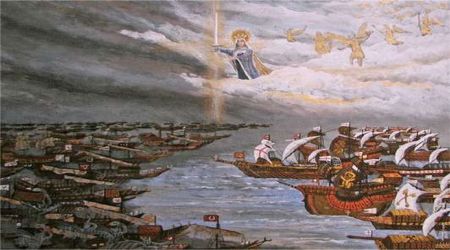 The Rosary Dealt a Crushing Defeat to the Muslims at the Battle of Lepanto...
The Story of the Battle of Lepanto...
Almost from the very beginning of Islam, there were wars upon wars between Christians and Muslims. We remember the Crusade wars, seven major and several minor, which lasted for centuries. This is the story of the Battle of Lepanto, which marked the end of the Crusades and was a turning point in the history of Christianity.
Charles Martel's victory at Poitiers definitely stopped the Moslem invasion of western Europe. In the east Christians held firm against attacks of the Muslims until 1453. In that year, Mohammed II threw huge assaults against Constantinople and by the evening of May 29 the Byzantine capital fell. By 1571 the Muslims were firmly installed in Europe. Their ships ruled the Mediterranean Sea from the Strait of Bosporus to the Strait of Gibraltar and constantly preyed on Christian vessels unless they flew the French flag.
Pope Pius V, in the last year of his papacy in 1571, tried to rally the nations of Europe to join in a Holy League to stop and roll back the Moslem enemy which threatened the entire continent. Spain, whose King Philip II was also King of Austria, responded favorably. The Muslims were then engaged in the conquest of Cyprus, an island belonging to the Republic of Venice.
Leading Venetian officials would have preferred to have worked out some peaceful-coexistence agreement with the Sultan, but under the crusading influence of Saint Pius V, they decided to join the Holy League along with the republics of Genoa and Lucca and the dukes of Savory, Parma, Ferrara and Urbino.
The Papal fleet was of course part of the Holy Alliance. Pius V asked Philip to appoint Don John of Austria, the 25-year old son of Emperor Charles V, as commander-in-chief of a planned expedition against the Muslims. After receiving the banner of the Holy League from the Pope, through Cardinal Granvalla, Don John's fleet set sail from Genoa for Naples on June 26, 1571.
Few historians mention that just before the departure, Philip II presented Don John with a picture of Our Lady of Guadalupe which she had caused to be miraculously imprinted on the cloak of the Indian peasant Juan Diego in Mexico 40 years before. Don John placed the picture in the chapel of the admiral-vessel, the Genoese John Andrew Doria, asking for Mary's protection of his expedition.
On September 16, the Christian fleet put to sea. Don John anchored off of Corfu where he learned that the Muslims had leveled entire towns and villages and then retreated to the coast of Lepanto in the Gulf of Corinth.
At dawn on October 7, at the entrance to the Gulf of Patras, the Christian and Moslem fleets finally came face to face for the battle of Lepanto.
The wind and all military factors favored the Muslims, but Don John was confident. He boarded a fast ship for a final review of his fleet. He shouted encouraging words to the men and they shouted back. After Don John returned to his own position, the wind mysteriously changed to the advantage of the Christian fleet. First-hand witnesses wrote about this moment as a most dramatic turn-of-events resulting from an "unknown factor".
At that very moment, at dawn on October 7, 1571-- as Vatican Archives later revealed--Pope Pius V, accompanied by many faithful, was praying the Rosary in the Basilica of Santa Maria Maggiore. From dawn to dusk the prayers continued in Rome as the Christians and the Muslims battled at Lepanto. When it was all over the Muslims had been defeated. Of some 270 Moslem ships, at least 200 were destroyed. The Turks also lost 30,000 men while Christian casualties numbered between 4,000 and 5,000.
The Rosary had won a great military victory. Like all truly great military leaders who hate war and love peace, Don John retired after his victory at Lepanto. He died a few years later at the age of 31. Another who took part in the great battle of Lepanto, Miguel de Cervantes, lived longer to write his famous tribute to Christian chivalry, Don Quixote.
 The
Origin of the Feast of the Most Holy Rosary on October 7th...
The
Origin of the Feast of the Most Holy Rosary on October 7th...
Following the great Christian victory at Lepanto, Pope St. Pius V declared that henceforth a commemoration of the Rosary would be a part of the Vatican's Mass on every October 7. His successor, Pope Gregory XIII, went further. In 1573 he established the Feast of the Most Holy Rosary--to be celebrated at all Churches which had specific altars dedicated to the Rosary.
In 1671 Pope Clement X extended observance of the feast to all of Spain.
Only 12 years later in 1683 the Muslims again swept into Europe. With 200,000 men, they laid siege to Vienna. After months of valiant resistance by a small garrison, the city was relieved by an army under John Sobieski, King of Poland. The Rosary, to which the King was dedicated, was again instrumental in a military victory. Pope Innocent XI consecrated September 12 of that year to the Holy Name of Mary. The Moslem hordes were hurled back yet again at Peterwardein in Hungary by Prince Eugene on the Feast of Out Lady of the Snows, August 5, 1716. As a result of this victory, Pope Clement XI extended the Feast of the Rosary to the Universal Church.
"The beads of prayer will be the major instrument for the lessening of the Chastisement upon your country." - Our Lady of the Roses, April 14, 1973
We urgently need your prayers and financial support to be able to continue to create these web pages. Click here... Thank you in advance.
We strongly encourage you to print and/or email copies of this web page to all the bishops and clergy. Also, email or mail a copy of this web page to the news media and as many other people as possible. Email a copy of this page to everyone you know.
When
you pray the Holy Rosary, you have Our Lady's hand in your hand. When you
pray the Holy Rosary, you have the power of God in your hands. Start now!
Let's All Pray the Rosary to save the United States
from destruction... Click
here...
Our Lady of the Roses Awesome Bayside End Times Prophecies... https://www.tldm.org/Bayside/ These prophecies came from Jesus, Mary, and the saints to Veronica Lueken at Bayside, NY, from 1968 to 1995.
MUSIC
"We wish to hear the prayers of atonement, for it is like music to Our hearts. The Rosary has always been music to Our hearts." - Jesus, September 14, 1985MOUNTAINS
"Prayer can move the mountains and reach the highest places in Heaven." - Our Lady, November 1, 1975POWER
"The power of God reaches out to prayer." - Our Lady, November 1, 1970REPENTANCE
"Prayers can move even the hardest of souls to repentance." - Our Lady, September 7, 1976TOGETHER
"Our home, my children, was a simple home of prayer.... The family that will pray together shall stay together." - St. Joseph, March 18, 1976MORE
"If you pray more, you will learn to love prayer. It will become a way of life that you cannot turn from, for it will give you something that you have never found in the world." - St. Theresa, May 17, 1975SUNDAY HOLY HOUR
"I wish that there be held on these sacred grounds an hour of reparation on the Day of the Lord. This hour will be for your Vicar and the fallen hierarchy in the House of God. This hour will also be in atonement for the discard of the holy Day of God." - Our Lady, September 14, 1972SAINTS
"The power of prayer has made saints from sinners." - Our Lady, October 2, 1972CHILDREN
"In order for your children to be saved, My parents, you must keep a constant vigilance of prayer going throughout your home, and those homes of your immediate families. One good example can save a dozen, My children." - Our Lady, October 5, 1985SOUL MEDITATION
"My children, We are always with you, but you must think your way to Us. This may be confusing at first, but really quite simple; for prayer is a form of soul meditation through the thinking process. What you hear within is the Spirit within." - Our Lady, October 6, 1970UNLESS
"Unless you pray, you will be lost." - St. Thomas, November 24, 1973UNANSWERED
"Your prayers will not go unanswered. Ask, and you shall receive; seek and you shall find the way. Believe and you will be given the way." - Jesus, October 6, 1979WEAPON
"Pray, for prayer is the greatest weapon given to you now to remove this evil from among you." - Our Lady, September 7, 1974ACTION
"Pray, but act also, for prayers without action is like placing a mess of meat on a dead man's grave." - Jesus, August 5, 1978OPEN UP
"They do not always have to be written words, but pray from your heart; open up your heart to My Son." - Our Lady, November 20, 1976SPEAK ONCE
"Speak once, and if not hastened or listened to, speak no more, but pray that the Eternal Father in Heaven will open up the ears of those who have closed their hearts and their ears to the truth." - Our Lady, November 20, 1979WOMEN
"The angels command respect to My Son. You [women] will cover your heads when you pray." - Our Lady, November 23, 1974BEGIN AND END
"Each day of your life must begin with prayer and end with prayer." - Jesus, February 10, 1977STRENGTH
"The prayers of others can reach out and give this strength to the weak." - Our Lady, March 24, 1972INVASION
"O My children, prayer and penance is the major, now, blockade against invasion." - Our Lady, March 15, 1978CHASTISEMENT
"The coming Chastisement will be lessened in your area if you will follow the direction I have given you from Heaven: a constant vigilance of prayer." - Our Lady, April 22, 1973POWER OF THE ROSARY...
"Realize the power in your hand with the Rosary, for in your hands you hold the power of God. If you do not recognize the Rosary, can you expect to be recognized by My Son? How much can you expect? Why do you hide My Rosary? It was with a Mother's loving heart that I chose to give you these pearls of Heaven that you reject.
"Woe to all dedicated who seek to remove these from the little ones' hands, for their punishment will be metered in accordance to it!
"Why has sophisticated man cast aside these tokens of My love? Those who remain true to My Rosary will not be touched by the fires. Gather these treasures, My children, for the time will come that you will not find them on the counters of your stores." - Our Lady, October 6, 1970GOLD
"With the extension of the Rosary, many shall now receive the power through the Holy Spirit, the Holy Ghost, to bring health of body and health of spirit to each soul.
"You will find that your Rosary beads shall turn color again. The stems will become pure gold. So do not cast aside your Rosary, thinking falsely, as satan would whisper into your ear that they're not good anymore and must be thrown away. That you will understand, that every Rosary that has been blessed by the presence of the Mother of God, Jesus, and the Eternal Father in the Holy Ghost, know that these Rosaries are very powerful. So you will keep them with you always, for they will have the power for cure and for conversion - cure of the ailing body and conversion of the sickened soul." - Our Lady, June 18, 198415 DECADES
"My children, you will all pray your Rosary daily, even if it means to stop the work you are doing. You will excuse yourself and retire to a quiet place in your office threshold. The Rosary must be said at least once a day, the fifteen decades." - Jesus, June 18, 1984SAVED
"All who pray the Rosary and wear My Scapular shall be saved." - Jesus, June 18, 1984MAKE ROSARIES
"I ask that the world continues to make Rosaries, and send the prayers, link to link throughout the world. For I still promise that if you will listen to My directions, given through My Son, in the Father and the Holy Spirit - I promise to do all that I can, My children, to save your lives upon earth; and also, if you must come across the veil, to save you from eternal damnation through the Scapular and the Rosary." - Our Lady, October 5, 1985GOLD
"With the extension of the Rosary, many shall now receive the power through the Holy Spirit, the Holy Ghost, to bring health of body and health of spirit to each soul.
"You will find that your Rosary beads shall turn color again. The stems will become pure gold. So do not cast aside your Rosary, thinking falsely, as satan would whisper into your ear that they're not good anymore and must be thrown away. That you will understand, that every Rosary that has been blessed by the presence of the Mother of God, Jesus, and the Eternal Father in the Holy Ghost, know that these Rosaries are very powerful. So you will keep them with you always, for they will have the power for cure and for conversion - cure of the ailing body and conversion of the sickened soul." - Our Lady, June 18, 1984LIP SERVICE
"My children, when you pray, for you are rescuing your brothers and sisters, you must not use what could be termed as lip service. You must pray with purpose and feeling from the heart. Each word will be prayed slowly with understanding and reason...." - Our Lady, June 18, 1976LISTENED
"My child and My children, I could go back through the years and remember how many times I came upon earth to try to warn you. Those nations that listened were free from harm. But they had to pray the Rosary--the Rosary and the Scapular." - Our Lady, April 14, 1984
Directives from Heaven... http://www.tldm.org/directives/directives.htm
D8 - Blessed Virgin Mary
D18 - The Holy Rosary
D19 - Prayers
D20 - Importance of Prayer (Part 1)
D21 - Importance of Prayer (Part 2)
D22 - Disciples of Latter Days (Part 1)

EDITOR'S COMMENT: Evil is accelerating and the Anti-Christ forces are gaining power in the world. When the persecution starts, all Christian web sites on the internet will be forced to close. Be sure to have in your possession all the following items: the Bayside Prophecy books, Bayside Medals, Douay-Rheims Bibles, the Protection Packets, Candles, Sacramentals, and Religious Books. Purchase these items now while they are still available! You will urgently need them in the days ahead. Also, you can print out all PDF files for the Directives from Heaven and all of the Bayside Prophecies. Copy Our Lady's messages and the Directives from Heaven now while they are still available! Pray to the Holy Spirit for wisdom and guidance on how to prepare now and for the days ahead when the Antichrist is revealed. Viva Cristo Rey!
Articles...
Lepanto (Catholic Encyclopedia)
http://www.newadvent.org/cathen/09181b.htm
There are 4 Things You Must Have to Survive the End Times:
1.) The Douay-Rheims Holy Bible...
"I ask that all who hear My voice will take their Bibles, and if they do not have one, search, but find the right Bible, those printed not after 1965, My children." - Jesus, October 5, 1985
"You must all obtain a copy of the Book of life and love, the Bible. Do not accept the new mods. Try to find in your bookstores the old Bibles, My children, for many are being changed to suit the carnal nature of man. I repeat, sin has become a way of life." - Our Lady, October 6, 1992
"I must ask you all to read but a few short chapters a day now, the Book of life and love, your Bible. Knowledge must be gained for all the disciples of My Son, for you will be attacked by scientific minds. But do not be concerned what you will say to them when accosted, for the words will be given to you by the Spirit." - Our Lady, April 10, 1976
The Douay-Rheims Bible was published in 1899. It is the official Bible of the Roman Catholic Church. Almost all other Bibles have been rewritten by Satan. See: https://www.tldm.org/directives/d33.htm , https://www.tldm.org/directives/d415.htm and https://www.tldm.org/directives/d182.htm If you don't have a Douay-Rheims Bible order it now! (Order Form) Yours and your loved ones salvation could depend on it.
Read the Bible cover to cover. If you read 4 chapters a day, you will complete the whole Bible in 334 days. I have read the Bible 2 times and working on the third time. A 75 year old Baptism gentleman told me that he and his wife have read the Bible nine times. Wow!
2.) The Complete Virgin Mary’s Bayside Prophesies in 6 Paperback Books...
The Virgin Mary brings directions from God, the Father in Heaven on how to survive the end times. God, the Father, through the Virgin Mary, tells what is coming, how to prepare for it, how to survive it, and how to even stop it. These six volumes along with the Bible are most important to save yourself and your loved ones. Order it now. Tomorrow may be to late. These 6 pocket size paperback books costs $33.00. (Order Form)
3.) Heaven's Home Protection Packet...
Heaven’s Home Protection Packet...
Our Lord stated we must have crucifixes upon the outside of all of our outside doors. In the "Heaven’s Home Protection Packet" there are instructions, four crucifixes, a tube of special cement for wooden or metal crucifixes. Wooden crucifixes adhere better to the doors when the aluminum strap is removed from the back. Put a light coat of cement on the back of the crucifix and then press it to the outside of the door. If you have any problems, you can call us at 616-698-6448 for assistance. This Heaven’s Home Protection Packet is available for a donation of $10.00 plus $4.00 shipping and handling. Send $14.00 to TLD Ministries, P.O. Box 40, Lowell, MI 49331. Item # P15 (Order Form)Crucifix on front and back door... The only real protection against terrorists...
Jesus - "Pray and wear your sacramentals. And, also, My children, I ask you again to place a crucifix upon your door. Both front and back doors must have a crucifix. I say this to you because there will be carnage within your areas, and this will pass you by if you keep your crucifix upon your doors." (6-30-84) (Testimonies of lives and homes saved by the crucifixes.) https://www.tldm.org/news/crucifix.htm (Order Form)
4.) Heaven's Personal Protection Packet...
Heaven’s Personal Protection Packet . . .
Our Lady tells us to be protected from all evil, we must wear the following sacramentals around our necks: a Rosary, a crucifix, the St. Benedict medal, Our Lady of the Roses medal, the Miraculous Medal, and the scapular. We have all of these sacramentals in a packet we call "Heaven's Personal Protection Packet." This packet is available for a donation of $7.00 plus $3.00 shipping and handling. Send $10.00 to TLD Ministries, P.O. Box 40, Lowell, MI 49331. Item # P5 (Order Form)Our Lady of the Roses, Mary Help of Mothers promises to help protect our children. On September 13, 1977, She said, "He has an army of ogres wandering now throughout your country and all of the countries of the world. They are in possession of great power; so wear your sacramentals, and protect your children and your households. Learn the use every day of holy water throughout your household. Insist even with obstructions, insist that your children always wear a sacramental. One day they will understand that they will repel the demons."
On February 1, 1974, Our Lady said, "My children, know the value of these sacramentals. Guard your children well. You must awaken to the knowledge that you will not be protected without the sacramentals. Guard your children's souls. They must be surrounded with an aura of purity. Remove them if necessary from the sources of contamination, be it your schools or even false pastors."
This Heaven’s Personal Protection Packet is available for a donation of $7.00 plus $3.00 shipping and handling. Send $10.00 to TLD Ministries, P.O. Box 40, Lowell, MI 49331. You may use your MasterCard, VISA, or American Express and call 1-616-698-6448. Item # P5 (Order Form)
Incredible Bayside Prophecies on the United States and Canada book . . .
We have researched the Bayside Prophecies on the United States and Canada and put these outstanding prophecies in a 360 page pocket size paperback book. Veronica said it was very good. It tells what is going to happen here and how to prepare for it. Every North American must read this book! Item #B2 Cost $5.00 (Order Form)
Your names have been written in Heaven… "It is not by accident that you are called by My Mother, for your names have been written in Heaven.... But with this great grace you have great responsibility to send this Message from Heaven throughout the world, for if you are able to recover just one more for Heaven, an additional star shall be placed in your crown." - Jesus, August 5, 1975
A great obligation to go forward... "It is not by accident that you are called by My Mother, for it is by merit and the prayers that have risen to Heaven for your salvation. For those who have received the grace to hear the Message from Heaven, you have a great obligation to go forward and bring this Message to your brothers and sisters. Do not expect a rest upon your earth, for you will have eternal rest very soon." - Jesus, June 12, 1976
The sin of omission... "The sin of omission shall condemn many to hell, be they layman or Hierarchy. I repeat: not the sin of commission, but the sin of omission will commit many to hell." Our Lady of the Roses, October 6, 1980
My gift to help spread Our Lady of the Roses' messages to the world.

Comments
We encourage everyone to print or email copies of this web page to all the Bishops and all the clergy. Also, email or send this web page to the news media and as many people as possible.
| Home - Latest News | Introduction | Bayside Prophecies | Directives from Heaven | Order Form | Miracles & Cures | Veronica Lueken | Miraculous Photos | Bible | Radio Program |
The electronic form of this document is
copyrighted.
Quotations are permissible as long as this web site is acknowledged with a
hyperlink to:
http://www.tldm.org
Copyright © These Last Days Ministries, Inc. 1996 - 2022 All rights
reserved.
P.O. Box 40
616-698-6448
Lowell, MI 49331-0040
Revised:
June 20, 2022

