 Restore
the processions!
Restore
the processions!
Restore
the processions!
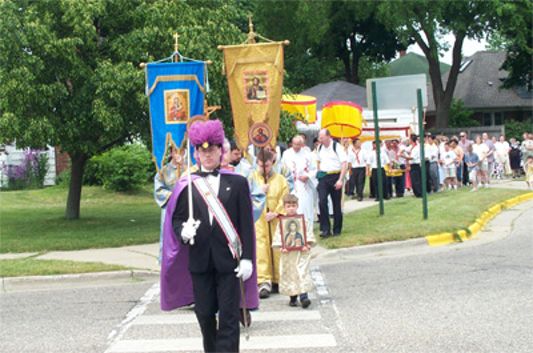
"My child, what has happened to the processions in honor of your God and the memory of the suffering of My Son? We do not see any down upon earth. Can this not be restored for the glory of Heaven?" - Our Lady, September 13, 1974
 Processions,
an element in all ceremonial, are to be found, as we should expect, in almost
every form of religious worship. The example of the processions with the Ark in
the Old Testament (cf. espec., II Kings, vi, and III Kings, viii) and the
triumphant entry of our Saviour into Jerusalem in the New were probably not
without influence upon the ritual of later ages. Even before the age of
Constantine, the funeral processions of the
Christians seem to have
been carried out with a certain amount of solemnity, and the use of the word by
Tertullian (De
Praescriptio, xliii) may possibly have reference to some formal progress or
movement of the faithful churchwards, which led afterwards to the assembly
itself or the service being called processio as well as synaxis
and collecta (Probst, "Sakramentarien und Ord.", 205). About the time of
St. Gregory the Great,
and possibly earlier, two forms of procession played a great part in papal
ceremonial. The one was the procession to the "Station", the other the solemn
entry of the celebrant from the secretarium, or sacristy, to the altar. A
good description of the stational procession is given in the St. Amand Ordo, n.
6 (Duchesne, "Christian Worship", 474). The pontiff, the clergy, and the people
assembled in the appointed church, where the clergy vested and the office was
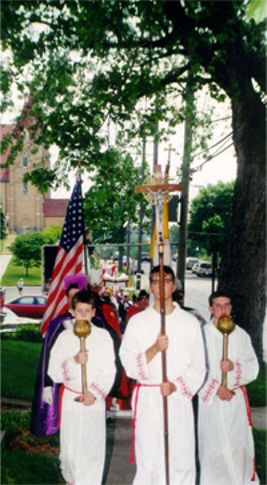
begun. The poor people of the hospital went first with a painted wooden cross;
the seven stationary crosses, with three candles each and a retinue, followed,
and then the bishops, priests, and subdeacons; finally came the pope surrounded
by his deacons, with two crosses borne before him and the schola cantorum
or choir following behind him. As the procession moved along to the stational
church where the Mass was to be offered the Kyrie Eleison and the litanies were
sung, from which the procession itself was often called litania. The
solemn entrance of the celebrant as he proceeded from the sacristy to the altar
was of course a procession on a smaller scale, but this also is minutely
described in the first "Ordo". The pontiff was again surrounded by his deacons
and preceded by the subdeacons, one of whom swung a thurible, and a conspicuous
feature was the group of seven acolytes carrying tapers, which make us think of
the seven candles now lighted on the altar at a pontifical High Mass. In this
procession to the altar the antiphon of the introit was sung. On certain special
occasions, notably St. Mark's Day (25 April), which coincided with the old Roman
festival of the Robigalia, and in Gaul on the three Rogation Days before
the feast of the Ascension,
there were processions of exceptional solemnity (see Litany).
Processions,
an element in all ceremonial, are to be found, as we should expect, in almost
every form of religious worship. The example of the processions with the Ark in
the Old Testament (cf. espec., II Kings, vi, and III Kings, viii) and the
triumphant entry of our Saviour into Jerusalem in the New were probably not
without influence upon the ritual of later ages. Even before the age of
Constantine, the funeral processions of the
Christians seem to have
been carried out with a certain amount of solemnity, and the use of the word by
Tertullian (De
Praescriptio, xliii) may possibly have reference to some formal progress or
movement of the faithful churchwards, which led afterwards to the assembly
itself or the service being called processio as well as synaxis
and collecta (Probst, "Sakramentarien und Ord.", 205). About the time of
St. Gregory the Great,
and possibly earlier, two forms of procession played a great part in papal
ceremonial. The one was the procession to the "Station", the other the solemn
entry of the celebrant from the secretarium, or sacristy, to the altar. A
good description of the stational procession is given in the St. Amand Ordo, n.
6 (Duchesne, "Christian Worship", 474). The pontiff, the clergy, and the people
assembled in the appointed church, where the clergy vested and the office was
begun. The poor people of the hospital went first with a painted wooden cross;
the seven stationary crosses, with three candles each and a retinue, followed,
and then the bishops, priests, and subdeacons; finally came the pope surrounded
by his deacons, with two crosses borne before him and the schola cantorum
or choir following behind him. As the procession moved along to the stational
church where the Mass was to be offered the Kyrie Eleison and the litanies were
sung, from which the procession itself was often called litania. The
solemn entrance of the celebrant as he proceeded from the sacristy to the altar
was of course a procession on a smaller scale, but this also is minutely
described in the first "Ordo". The pontiff was again surrounded by his deacons
and preceded by the subdeacons, one of whom swung a thurible, and a conspicuous
feature was the group of seven acolytes carrying tapers, which make us think of
the seven candles now lighted on the altar at a pontifical High Mass. In this
procession to the altar the antiphon of the introit was sung. On certain special
occasions, notably St. Mark's Day (25 April), which coincided with the old Roman
festival of the Robigalia, and in Gaul on the three Rogation Days before
the feast of the Ascension,
there were processions of exceptional solemnity (see Litany).
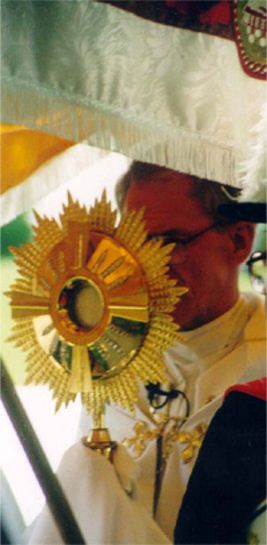
Although not now formally recognized as a procession in the liturgical books, we may say that the sprinkling of the congregation with holy water at the beginning of the parochial Mass on Sundays preserves for us the memory of the most familiar procession of the early Middle Ages. The rite is prescribed in the Capitularies of Charlemagne and of Louis the Pious, as well as in other ninth-century documents. For example a Council of Nantes before the year 900 enjoins that "every Sunday before Mass, each priest is to bless water in a vessel which is clean and suitable for so great a mystery, for the people to be sprinkled with when they enter the church, and let him make the round of the yard [atrium] of the said church with the [processional] crosses, sprinkling it with the holy water, and let him pray for the souls of them that rest therein" (Mansi, "Concilia", XVIII, 173). In the monastic ceremonials of the same period this holy water procession on the Sunday morning was usually described in much detail. After the sprinkling of the high altar and of the other altars of the church in order, the whole body of the monks, after being sprinkled themselves, went in procession through the cloister, making stations there, while the celebrant assisted by two lay brothers blessed the different portions of the monastery (see Martène, "De antiq. eccles. rit.", IV, 46-9). At the present day the Roman Missal, which is the primary liturgical authority for this "Blessing of the people with holy water to be imparted on Sundays" (Benedictio populi cum aqua benedicta diebus dominicis impertienda), says nothing about a procession, though some such progress of the celebrant and assistant clerks around the church very commonly takes place. The rubric only directs that the priest having intoned the antiphon "Asperges me" is to sprinkle the altar and then himself and his assistants. After which he is to sprinkle the clergy and the people, while he recites the Miserere with his assistants in a low voice. The other ordinary processions, as opposed to the extraordinary processions, which the bishop may enjoin or permit as circumstances may call for such a form of public supplication, are specified in the Roman Ritual to be the Procession of Candles on the Purification of our Lady (2 February), that of Palms on Palm Sunday, the greater litanies on the feast of St. Mark (25 April), the Rogation processions on the three days before the Ascension, and the procession of the Blessed Sacrament on the feast of Corpus Christi. The prescriptions to be observed on all these occasions are duly set down in the Roman Ritual. For their history etc., see Candlemas; Corpus Christi; Holy Week; Litany, etc. We might also add to these "ordinary" processions the carrying of the Blessed Sacrament to the altar of repose on Maundy Thursday and the return on Good Friday, as well as the visit to the font on Holy Saturday and the procession which forms part of the rite of the consecration of the holy oils in cathedral churches on Maundy Thursday. This latter function is described in full in the Roman Pontifical. In earlier times a series of processions were usually made to the font after Vespers upon every day of Easter week (Morin in "Rev. benedict.", VI, 150). Traces of this rite lingered on in many local churches down to the eighteenth and ninteenth centuries, but it finds no official recognition in the Roman service books.
 Under
the heading of "extraordinary" processions the Roman Ritual makes provision for
the following emergencies: a procession to ask for rain, another to beg for fine
weather, a third to drive away storms, three others assigned respectively to
seasons of famine, plague, and war, one more general on occasion of any calamity
(pro quacunque tribulatione), one rather lengthy form (in which a number
of the Jubilate and Laudate psalms are indicated for recitation) by way of
solemn thanksgiving, and finally a form for the translation of important
relics (reliquiarum
insignium). In the majority of these extraordinary processions it is
directed that the Litany of the Saints be chanted as in the Rogation
processions, a supplication special to the occasion being usually added and
repeated, for example in the procession "to ask for rain" the petition is
inserted: "Ut congruentem pluviam fidelibus tuis concedere digneris. Te rogamus
audi nos [That thou wouldst vouchsafe to grant suitable rain unto thy faithful,
we beseech thee hear us]". In the
medieval rituals and
processionals a large variety of such exceptional forms may be found, connected
especially with supplications for the produce of the earth. A common feature in
many of these was to make a station towards the four points of the compass and
to read at each the beginning of one of the four Gospels with other prayers. The
practice of carrying the Blessed Sacrament upon such occasions is frequently
condemned in medieval
synods. In England the perambulation of the parishes on the "Gang days", as the
Rogation days were called, lasted far into the seventeenth century. Aubrey, for
example, in a pencil note to his "Remaines": "On Rogation Days the Gospells were
read in the cornfields here in England untill the Civill wars" (Hazlitt, "Faiths
and Folklore", II, 478). The custom of making these processions was kept up
seemingly with a view to its utility in impressing upon the memory the
boundaries of the parish, and in some places boys were flogged at the boundaries
that they might remember the spot in old age. In the Greek and some other
Oriental liturgies the two processions known as the great and little entrances
form a very imposing feature of the rite. At the "little entrance" the Book of
the Gospels is carried in by the deacon accompanied by acolytes bearing torches
and two fans. The "great entrance" takes place when the holy gifts, i.e. the
bread and wine, are solemnly brought to the altar while the choir sing the
famous "cherubic hymn". Similar features seem to have existed in the
early Gallican Liturgy; even in the Roman high Mass the procession which heralds
the singing of the Gospel is probably the survival of a more imposing ceremony
of earlier date.
Under
the heading of "extraordinary" processions the Roman Ritual makes provision for
the following emergencies: a procession to ask for rain, another to beg for fine
weather, a third to drive away storms, three others assigned respectively to
seasons of famine, plague, and war, one more general on occasion of any calamity
(pro quacunque tribulatione), one rather lengthy form (in which a number
of the Jubilate and Laudate psalms are indicated for recitation) by way of
solemn thanksgiving, and finally a form for the translation of important
relics (reliquiarum
insignium). In the majority of these extraordinary processions it is
directed that the Litany of the Saints be chanted as in the Rogation
processions, a supplication special to the occasion being usually added and
repeated, for example in the procession "to ask for rain" the petition is
inserted: "Ut congruentem pluviam fidelibus tuis concedere digneris. Te rogamus
audi nos [That thou wouldst vouchsafe to grant suitable rain unto thy faithful,
we beseech thee hear us]". In the
medieval rituals and
processionals a large variety of such exceptional forms may be found, connected
especially with supplications for the produce of the earth. A common feature in
many of these was to make a station towards the four points of the compass and
to read at each the beginning of one of the four Gospels with other prayers. The
practice of carrying the Blessed Sacrament upon such occasions is frequently
condemned in medieval
synods. In England the perambulation of the parishes on the "Gang days", as the
Rogation days were called, lasted far into the seventeenth century. Aubrey, for
example, in a pencil note to his "Remaines": "On Rogation Days the Gospells were
read in the cornfields here in England untill the Civill wars" (Hazlitt, "Faiths
and Folklore", II, 478). The custom of making these processions was kept up
seemingly with a view to its utility in impressing upon the memory the
boundaries of the parish, and in some places boys were flogged at the boundaries
that they might remember the spot in old age. In the Greek and some other
Oriental liturgies the two processions known as the great and little entrances
form a very imposing feature of the rite. At the "little entrance" the Book of
the Gospels is carried in by the deacon accompanied by acolytes bearing torches
and two fans. The "great entrance" takes place when the holy gifts, i.e. the
bread and wine, are solemnly brought to the altar while the choir sing the
famous "cherubic hymn". Similar features seem to have existed in the
early Gallican Liturgy; even in the Roman high Mass the procession which heralds
the singing of the Gospel is probably the survival of a more imposing ceremony
of earlier date.
The amazing Bayside prophecies... http://www.tldm.org/Bayside/default.htm
STOP CHANGES
"Pastors, those who have in their care Our sheep, you must stop now these
changes that you seek in novelty, for they are destroying the young souls and
scattering Our sheep.
"I repeat, My children, the great Council in Rome of Vatican II, the
promises were great, but satan sat among you and he played you like the
chessboard.
"You were given a foundation of Faith based on Tradition and knowledge of
the prophets. You cannot start this new religion, for it will lead you to one
religion that is not of My Son, that will not have His true foundation, and you
will take My Son's Body and defame it, no longer giving the knowledge of His
Divinity. What manner of foul escapades are you planning, O you of little faith?
Whatever shall become of you? The Red Hats have fallen and the Purple Hats are
being misled. Woe, woe, woe to the inhabitants of the earth!" - Our Lady,
August 5, 1976
REBELLING AGAINST POPE
"Many clergy have given themselves over to pleasures of the flesh. Many have
fallen into sin and heresy, and have cast aside the truth of their vocations.
Many now rebel against their leader, their God-given leader, your Vicar. In
matters of Faith and Morals, man must not change the God-given laws, coming from
the Seat of Peter, and established through Tradition upon earth through My Son's
Church." - Our Lady, October 6, 1979
ROTTEN EXAMPLE
"The vocation are nil, and why? Because the example is rotten! Tradition has
been cast aside for modernism and humanism." - Jesus, December 31, 1977
MOCK THE PAST
"Recognize the signs of your times. Come out of your darkness. You are asleep.
My pastors! I have sent many warnings to mankind. I have allowed satan his time
to ravage the earth, as it is a measure of separation of the sheep from the
goats. You who have given yourselves to satan, you plunge faster into the pit!
"The plan for your salvation was given. It was a simple plan of faith, faith
in what has been given to you in the past! You mock the past in Tradition! You
set yourselves to build a new church. The gates of hell shall never prevail
against My Church!" - Jesus, May 15, 1976
SAFEGUARD
"My child and My children, I need not repeat to you the necessity to retain
tradition. It was like a valve, a safeguard from the eruption of My Son's
Church, a schism, a division within My Son's House upon earth. I cry unto you,
your Mother, as I hasten back and forth bringing you the Message, the counsel
from Heaven. You must recognize--bishops, cardinals and pastors, you must
recognize what is happening now in My Son's House. There is being rebuilt before
your very eyes another religion, another church of man. No angels are helping in
this building." - Our Lady, September 7, 1978
Directives from Heaven... http://www.tldm.org/directives/directives.htm
D79 -
Restore My Church
D85 -
Tradition
| Home | Introduction | Prophecies | Directives | Order Form | Testimonies | Veronica | News | Photos | Bible | Magazine | Newsletters | Radio Show |
We encourage everyone to print or email copies of this web page to all the Bishops and all the clergy. Also, send this page to as many people as possible.
The electronic form of this document is copyrighted.
http://www.tldm.org
Copyright © These Last Days Ministries, Inc. 1998 - 2003 All rights
reserved.
P.O. Box 40
Lowell, MI 49331-0040
Revised:
July 30, 2018

