 These Last Days News - March 23, 2026
We
encourage everyone to share this web page with others, especially bishops
and clergy.
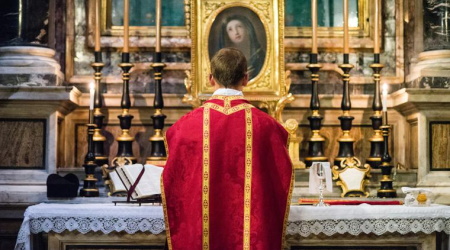
Ad Orientem Sacrifice Over Versus Populum Banquet: Bishop Schneider On The Urgent Need To Reorient Worship...
REVERENCE
"My children, you must join your hands in
reverence at the Sacrifice of My Son. It is an expression of love, gratitude,
and respect. Reverence and respect and holiness must be returned to My Son's
Houses, churches, throughout the world, reverence, holiness, and respect from
the beginning to the end of the sacred service!"
- Our Lady of the Roses, September 6, 1975
ALL HONOR MUST BE GIVEN
“All honor must be given to
My Son in the Eucharist. Man must kneel. My Son’s House is the House of God and
a house of prayer, and it must not be turned into a meeting hall.”
- Our Lady of the Roses, July 25, 1979
The above Messages from Our Lady were given to Veronica Lueken at Bayside, New York. Read more
OnePeterFive.com reported on March 19, 2026:
By Bishop Athanasius Schneider
In one of his addresses in July 2016, Cardinal Robert Sarah said, “It is very important that we return as soon as possible to a common orientation, of priests and the faithful turned together in the same direction—eastwards or at least toward the apse—to the Lord who comes. I think it is a very important step in ensuring that in our celebrations the Lord is truly at the center.” This is a constant thread in his speeches, interviews and books. As the famous liturgist Klaus Gamber and Cardinal Joseph Ratzinger have shown in detail, the current way of celebrating Mass facing the people has no roots in the transmitted, immutable Tradition. The versus populum orientation is something entirely new, unfamiliar to earlier generations of Catholics, and in that sense it repre-sents a clear break with the Church’s liturgical tradition. Therefore, Cardinal Sarah has been calling for some time now for a return to this ancient, authentic practice. Why has this general return to the old practice still not been successful?
The proponents of the liturgical reform, who, unfortunately, were vic-torious, wanted a liturgy more suited to the mentality and customs of the world. Cunningly, they made appeals to history. They would say, we must return to the ancient Church, to the Church of the first centuries, we must restore the original practice of the first Christians.
But in re-establishing this “original” practice, they used an arbitrary and selective method, underpinned by certain ideological prejudices. Their approach was shaped by anthropocentrism and naturalism. They wanted to introduce prayer and liturgy that would correspond to this anthropocentric approach. Liturgy was to be stripped of what distinguished it most: theocentrism and Christocentrism.
The story of a return to antiquity turned out to be mostly a ruse. True science turns to facts and forms theories based on the facts. In the case of the study of ancient liturgy, the opposite was true. Inconvenient facts were ignored or, as a last resort, interpreted to fit preconceived, anthropocentric ideas.
Let me give you an example. In some ancient basilicas, the altar was separated from the wall of the apse. Archaeological research conducted since the nineteenth century shows that this is the case. Instead of examining the various possible explanations for the altar being separated from the wall, these liturgical ideologues immediately concluded that the priest celebrated the Mass facing the faithful. This conclusion was already in their heads before they began their research, so it’s not surprising that it immediately occurred to them as soon as the information about the altars being separated from the wall reached them.
They didn’t notice that this conclusion was impossible to accept, because it was contradicted by the unambiguous statements of the Church Fathers. It was also contradicted by more thorough archaeological research. This is clearly shown in a monograph by the German archaeologist Joseph Braun, The Christian Altar in Its Historical Development. He proved, using all the archaeological excavations known and performed up till that point, that over 90 percent of the churches and chapels of the first millennium of Christianity were oriented toward the east, and thus the sanctuary with the main altar was directed toward the east. The direction toward the east was marked in churches by the apse.
The only exceptions can be found in Rome, but those were determined by particular circumstances. For example, when it comes to St. Peter’s Basilica, its original purpose was to commemorate and venerate the tomb of St. Peter. The altar was built over the tomb, and the basilica was formed in such a way as to take into account the characteristics of the terrain, that is, the fact that it was located on a hill. For this reason, the apse is on the west side, and there is a door on the east side, so the pope, when celebrating Mass, stood behind the altar and looked toward the east, where the front door was. Not toward the people, but toward the east.
Moreover, the papal altar was covered during the liturgy until the early Middle Ages, more or less until the ninth century. Curtains separated the pope and the altar from the gaze of the people in the basilica. When the pope would begin to recite the Canon of the Mass, the deacons would draw the curtains so that people could not see the pope’s face during the Eucharistic Prayer. Also later, when the use of curtains was abandoned, a large crucifix and candlesticks were placed on the altar, which served the same function as the curtains. This can be seen in the photographs from the pre-conciliar era: although the pope is celebrating Mass in the basilica nominally facing the people, in fact he can’t actually be seen because of the crucifix and the candlesticks. The papal Masses were not about people looking at each other, but about people looking together toward the crucifix. However, let me emphasize it again, St. Peter’s Basilica is an exception. You can’t use a unique architectural situation, which was atypical and resulted from the topography, as an argument in favor of a celebration toward the people.
These liturgical ideologues also ignored and disregarded all the testimonies of the Fathers of the Church, who as early as the second century stated that Christians always turn to the east when praying. And the Eucharist was after all the most solemn Christian prayer. From this, it follows clearly that the priest and the faithful would turn together in prayer to face the east. The priest stood on the same side of the altar, regardless of whether it was separated from the wall or not, as the faithful behind him.
This is exactly the practice in all Eastern-rite churches and Orthodox churches where the altar is not adjacent to the wall. Whether we’re talking about the Byzantine or other Eastern rites, the altar is located in the middle of the sanctuary, but the liturgical action is directed toward the east. St. Basil mentioned that this orientation toward the east was handed down to the Church by the apostles. That means that already in the fourth century after Christ there was a strong conviction that the orientation toward the east, the common orientation of the prayer of the priest and the faithful, has its source in the apostolic tradition.
To support their new ideology, the liturgical reformers tried to invoke later depictions without reflecting on their meaning. And so they pointed, for example, to Leonardo da Vinci’s famous painting The Last Supper, in which Christ is seated behind a rectangular table with His disciples. However, this painting, regardless of its artistic value, historically misrepresents reality. This is caused by ignorance. Leonardo da Vinci assumed that people at the time of Christ sat at the table just as they did in his time, in the fifteenth and sixteenth centuries. However, as archaeological research has shown, the earliest reliefs and depictions of the Last Supper from the first centuries show not the rectangular table that we know, but a sigma-shaped table, like a semi-circle. People would not sit at it as we do, but would recline.
Moreover, according to Jewish custom, the most important, most dignified place wasn’t in the middle of the table, among the others, but at the head of the table, at its right side or right corner. There, at the right corner of the table, sat the most important, most honored guest. It was therefore the place that Jesus certainly occupied during the Last Supper. That is why John, and not Peter, was seated next to Him, and why when Peter wanted to understand who Jesus was referring to as the traitor, he addressed the question not directly to Jesus, but rather through John, since the latter reclined upon the bosom of the Lord. If Jesus had been sitting in the middle of the table, then John and Peter would have been sitting on either side of Him and Peter would not have had to ask through John. However, Holy Scripture says that John was Jesus’ beloved disciple and rested on His bosom, so Peter had to relay the question through John. There was no one on the other side of Jesus—Jesus was sitting at the right side of the sigma-shaped table.
In the same way, during supper everyone was looking in the same direction—they were not looking at each other. In one of the targums (a targum is an early Aramaic translation dating back to the first century after Christ, provided along with a commentary on the words of Scripture) it’s written that the Messiah will come during the Passover feast. Therefore, all participants in the Passover must look in the direction from which He is to come. So it’s assumed here that the participants in the Passover are looking in the same direction.
This is also the case with the Holy Mass: we should all be looking in the same direction, toward the east, whence the Lord will come to us. He Himself speaks of this clearly, “For as lightning cometh out of the east, and appeareth even into the west: so shall the coming of the Son of man be” (Matt. 24:27). The lightning from the east heralds the coming of the Son of Man from the east. Similar symbolism can be found in the Canticle of Zechariah, “through the bowels of the mercy of our God, in which the Orient from on high hath visited us: to enlighten them that sit in darkness, and in the shadow of death: to direct our feet into the way of peace” (Luke 1:78–79).
Oriens ex alto: Jesus is that rising Sun (Oriens) coming from on high (ex alto). The Lord Himself is the rising of the Sun. The east, then, is the eschatological direction of prayer for Christians. From there, Christians await the coming of the Lord. This refers not only to the literal, geographical east (for a variety of reasons not all churches could be oriented in this direction, especially in later eras), but also to the east understood symbolically. As a rule, it was the apse in churches. The name itself comes from the Greek apsis, axis. The apse therefore became the symbolically understood east, which was further reinforced by the fact that a cross was placed in it. In the apse there was an altar, on which the cross was also placed. Thus, regardless of the literal geographic direction, for Christians the “spiritual east” was marked out by the apse, the altar, and the cross, usually placed on the altar; prayers and liturgies were addressed in this direction.
We must remember that the direction of prayer was never neutral for the ancients. Space wasn’t symbolically abstract or indifferent. This is also perfectly evident in the behavior of the Jews and in Jewish customs from that period, from the time of the Old Testament. During prayer, everyone turned toward the place where the Ark of the Covenant was kept. If the priest were to turn his back on it, it would be considered a sacrilege. And yet we in the Church have something greater than the Ark of the Covenant. The Ark of the Covenant was only a symbol, while Jesus clearly said that His Body is the temple, the living temple (see John 2:21)….
Even today in synagogues there are niches where the scrolls of the Torah are kept, and this is the direction the Jews face during prayer. It is unthinkable to pray with your back to the Torah. Jesus and the apostles, when they went to the synagogue, faced the same direction together when they prayed.
Now if we gather all these accounts: the common customs of antiquity, the manner of sitting at the table during a banquet, accounts of early Fathers of the Church—it’s undeniable that from the beginning Christians prayed together with the priest, always facing the same direction, toward the Lord. For me, the current form of celebration, in which the priest continuously faces the people, is nothing other than a manifestation of anthropocentrism. It’s a confirmation of those assertions found in the conciliar texts we have already mentioned, such as the assertion in Gaudium et Spes that man is the center and crown of all things.
Admittedly, Sacrosanctum Concilium, the constitution on the liturgy, teaches beautifully that “the human is directed and subordinated to the divine, the visible likewise to the invisible, action to contemplation, and this present world to that city yet to come, which we seek.” It’s obvious that the celebration versus populum contravenes the principles outlined in the Council’s constitution on the liturgy.
A recent book Altar and Church, a major monograph by Stefan Heid (one of the foremost experts on Christian antiquity) describing in detail the earliest Christian places of worship, makes it abundantly clear that Paul VI’s reforms of the Mass and liturgy were based on faulty premises. Heid described this erroneous approach as follows: “Today’s scholars almost unanimously and ecumenically claim that the earliest Christians knew neither altars nor sacred places; moreover, that these early Christians rejected both altars and sacred places.” But this claim, which led to the introduction of tables instead of altars in Catholic churches, has no historical foundation. On the contrary, Heid proves that all early Christian testimonies point to the reverence shown to the altar on which Christ’s sacrifice was celebrated. The Eucharist was sacrificial from the beginning and was celebrated on an altar, not on a plain secular table. You just spoke about the direction of prayer. From all this it follows that the changes made to the liturgy under Paul VI are a complete novelty; they have no basis in Tradition, but rather amount to a rupture with it.
With regard to the direction of the celebration, it’s obvious. So it is also with the tables. Some might say: but what does it really matter? For sure, God is present everywhere. However, we Christians are not Gnostics; we profess the religion of the God who became man. We believe in the Incarnation. God revealed Himself concretely, in history. That is why concrete, palpable, tangible signs are so important. The Ark of the Covenant was such a sign, a symbol for the Jews. Similarly, we turn to Christ, who is present in the Eucharist, we worship His Cross, we venerate the altar on which transubstantiation takes place. Catholicism is an acceptance of the Incarnation, not a set of abstract ideas.
I think it would be wonderful if, as a sign of our return to the Faith, all priests in the whole Catholic Church would return to authentic liturgical practice and begin to celebrate the Masses in the new rite also toward the east, toward the altar, toward Christ. We must turn again to God. Conversio signifies precisely such a turning. Although the priest is another Christ, alter Christus, he is not God. He is neither a monstrance nor a tabernacle. He is merely an instrument of God. Therefore, people shouldn’t keep looking at his face—he must disappear and Christ should appear before the eyes of the faithful. The priest must point to Christ, refer to Him. The attention of the faithful should be directed not to the face of the priest, but to the Cross: the cross on the chasuble, the crucifix on the altar, or the cross in the apse.
I have also sometimes heard this argument: the altar is a symbol of Christ, so the faithful together with the priest, looking at each other, gather around the altar. But this is not serious. It goes against everything we know about human psychology. After all, such a closed circle doesn’t communicate this message. The altar is not a real point of reference for those standing around it. It doesn’t serve as an object of contemplation for them—no, their attention is directed to themselves, to their faces, and to the face of the priest. Only when the priest turns toward the altar does the attention of the faithful turn, as does his, toward the altar, the cross, and the apse. From a purely visual point of view, the closed circle suggests anthropocentrism. It has nothing dynamic, nothing eschatological about it.
The same is true of the tables that have replaced the altars. Even St. Paul wrote, “Know you not, that they who work in the holy place, eat the things that are of the holy place; and they that serve the altar, partake with the altar? So also the Lord ordained that they who preach the gospel, should live by the gospel” (1 Cor. 9:13–14). For him, the gospel is the same as serving at the altar. He clarifies it even further:
Behold Israel according to the flesh: are not they, that eat of the sacrifices, partakers of the altar? What then? Do I say, that what is offered in sacrifice to idols, is any thing? Or, that the idol is any thing? But the things which the heathens sacrifice, they sacrifice to devils, and not to God. And I would not that you should be made partakers with devils. You cannot drink the chalice of the Lord, and the chalice of devils: you cannot be partakers of the table of the Lord, and of the table of devils. (1 Cor. 10:18–21)
For Paul, the table on which the Eucharist is offered to the Lord and the altar are two interchangeable terms. In pagan temples, the table of demons was simply the altar on which pagans offered sacrifices. Here, then, we have indirect evidence that, in the eyes of the early Christians, the table on which they offered the Eucharistic sacrifice was to them what the altar was to the pagans. Except that for pagans, the altar was a place of demon worship, whereas for Christians, the altar was a place of true worship.
The widespread introduction of tables into Catholic churches shows how strong the Protestant tendency was. For it is Protestants who understand the Mass as a supper, as a meal and a banquet. While an altar is necessary for sacrifice, a table is sufficient for the banquet. The essence of the Mass is the sacrifice. Therefore, if altars disappear and tables appear in their place, this essence is obviously called into question. At the table you don’t offer a sacrifice, you feast.
The Mass is a sacramental reenactment, a re-presentation of the sacrifice of the Cross on Golgotha, not primarily a sacramental re-presentation of the Last Supper. The memory of the supper, of the banquet, only comes from and is subordinate to the sacramental sacrifice. The principle and foundation of the Mass is the sacramental re-presentation of Christ’s sacrifice on Golgotha. The aspect of the banquet appears at the moment of Communion, but the Mass as such is not a meal or primarily a banquet.
The meal is an integral aspect of the Holy Mass, but it’s not the key aspect. Only at the reception of Communion is a table needed. For this purpose the Church used altar rails, which in some languages are called the “table of Holy Communion.” These are openwork partitions separating the sanctuary from the nave. Usually they take the form of a balustrade. They are made of precious material: marble, stone, wood, or metal. They serve as kneelers for the faithful during the reception of the Eucharist. Often, they are covered with a white tablecloth. The faithful approach and receive the Body of the Lord from the hands of the priest with a devout posture, kneeling at the altar rails.
Be sure to email this page to all your friends.
"The judgment of your God is not akin to the judgment of man. The Eternal Father will only judge by the heart. Your rank, your accumulation of worldly goods does not set you up before another. Many have sold their souls within the holy House of God. Better that you strip yourself and remove all worldly interests now while you have the time to make amends to your God, for many mitres will fall into hell." - St. Thomas Aquinas, August 21, 1972
 The
Virgin Mary's Bayside Prophecy Books are Now Available in E-book Version.
Click Here Now!
The
Virgin Mary's Bayside Prophecy Books are Now Available in E-book Version.
Click Here Now!
When you pray the Holy Rosary, you have Our Lady's hand in yours. When you pray the Holy Rosary, you have the power of God in your hands. Start now! Click here...
Our Lady of the Roses Awesome Bayside Prophecies... https://www.tldm.org/Bayside/ These prophecies came from Jesus, Mary, and the saints to Veronica Lueken at Bayside, NY, from 1968 to 1995.
Directives from Heaven... https://www.tldm.org/directives/directives.htm
D36 - Bishops (Part 1)
D37 - Bishops (Part 2)
D38 - Priests (Part 1)
D39 - Priests (Part 2)
D40 - Infiltrators

| Home - Latest News | Introduction | Bayside Prophecies | Directives from Heaven | Shopping Cart | Miracles & Cures | Veronica Lueken | Miraculous Photos | Bible | Radio Program | Bayside Videos |
The electronic form of this document is copyrighted.
Quotations are permissible as long as this web site is acknowledged with a
hyperlink to:
http://www.tldm.org
Copyright © These Last Days Ministries, Inc. 1996 - 2025 All rights
reserved.
P.O. Box 40
616-698-6448
Lowell, MI 49331-0040
Revised: March 23, 2026

