 These Last Days News - December 23, 2025
We
encourage everyone to share this web page with others, especially bishops
and clergy.
‘Away In a Manger’: The Fascinating History of the Creche...
DO NOT TAKE AWAY
“Do not, My dedicated, take away
the pictures and statues, for then the children will cast their eyes on things
of the world. We will be just a memory, a legend, to them. “
- Our Lady of the Roses, November 21, 1970
RETURN THE STATUES
"Clergy in My Son's House, His
Church upon earth, will you not return for the children the statues, the
monuments of faith? The children must have a firm foundation. Their minds are
not matured enough to know, in feeling within the heart, the existence of
peoples in Heaven. These statues, monuments, must be returned to My Son's
churches.” - Our Lady of the Roses, July 14,
1979
The above Messages from Our Lady were given to Veronica Lueken at Bayside, New York. Read more
CatholicVote.org reported on December 23, 2025:
By Grace Porto
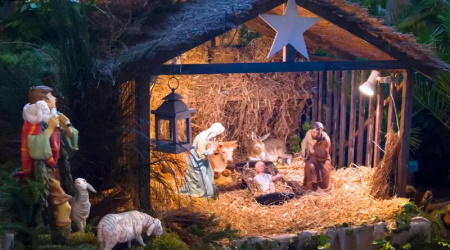
The manger scene, the mainstay of every Christian family’s Christmas décor, has a long history in Church art and decoration. Although St. Francis of Assisi is popularly credited with creating the first Nativity scene, the Church has been depicting versions of the birth of Christ since the third century.
One of the earliest depictions of a Nativity scene is from the late third- or early fourth-century, according to the Smithsonian Magazine. It is a wall painting of the Adoration of the Magi in the Catacomb of Priscilla in Rome, showing an image of Our Lady holding the Child Jesus while the three wise men bring gifts.
The Adoration of the Magi is also depicted on a fourth-century marble sarcophagus at the cemetery of St. Agnes in Rome. In it, the three Wise Men each lead a camel, and the Star of Bethlehem appears above the Blessed Virgin, who is holding the Infant Jesus.
Throughout the fifth and sixth centuries, elaborate mosaics were created depicting the Adoration of the Magi. One such image is in the St. Mary Major Basilica in Rome.
By 1075, St. Mary Major Basilica was displaying Nativity scenes during Christmas Masses. That year, Pope Gregory VII celebrated Mass at the basilica while “a Nativity scene [had] been constructed near the main altar so that all [could] contemplate the event in salvation history being commemorated,” according to historian Maureen C. Miller’s book Clothing the Clergy: Virtue and Power in Medieval Europe, c. 800-1200.
Pope Gregory VII was kidnapped by armed men when celebrating this Christmas Mass.
St. Francis of Assisi is often credited with being the first person to create a live Nativity scene in 1233, where a miraculous apparition took place. In St. Bonaventure’s biography of St. Francis, he tells readers that St. Francis first asked the Pope’s permission for the live depiction, “that this might not seem an innovation.”
The saint set up a manger full of hay in a cave, and had an ox and donkey lie near it. Apparently no humans were part of the arrangement, and Mass was said over the scene.
St. Bonaventure wrote, “The man of God [St. Francis], filled with tender love, stood before the manger, bathed in tears, and overflowing with joy.”
St. Francis “preached unto the folk standing round of the Birth of the King in poverty, calling Him, when he wished to name Him, the Child of Bethlehem, by reason of his tender love for Him.”
Then St. Bonaventure explained how a knight saw an apparition of the Child Jesus in the manger.
“A certain knight, valorous and true, Messer John of Greccio, who for the love of Christ had left the secular army, and was bound by closest friendship unto the man of God [St. Francis], declared that he beheld a little Child right fair to see sleeping in that manger. Who [the Child Jesus] seemed to be awakened from sleep when the blessed Father Francis embraced Him in both arms.”
St. Bonaventure thinks that this vision was credible because the hay from the manger later miraculously healed livestock of various illnesses.
According to the Smithsonian, by the late 1400s, the artists Pietro and Giovanni Alamanno created life-size Nativity figures covered in gold leaf.
Another Catholic saint, St. Cajetan of Thiene, was responsible for an innovation in Nativity scenes. He designed a Nativity with figures dressed like contemporary Neopolitans, inspiring the tradition of the “presepio,” which is Italian for crib. These presepi are huge panoramas depicting the birth of Christ taking place in a Neapolitan scene. They became popular in the 18th and 19th centuries, according to the Carnegie Museum of Art.
In the 1700s, many Protestant denominations rejected Nativity scenes, deeming them as idolatrous, according to the Smithsonian. However, the Czech Moravian Christians who settled in Bethlehem, Pennsylvania, continued the tradition when they emigrated to the U.S. in the 1800s.
To this day, Pennsylvania’s Bethlehem is famed for its Christkindlmart, which is a Christmas market that began in Germany.
The Outdoor Nativity Store states that as Catholic immigrants from Ireland, Poland, Italy, and Germany came to the U.S. in the 19th century, Nativity scenes became more mainstream in American culture. By the 20th century, Nativity scenes in public places became commonplace . However, some have taken issue with these displays, even though they are protected under the First Amendment.
December 2024 marked the first time a Nativity scene was displayed at the U.S. Capitol building in Washington, D.C.
Be sure to email this page to all your friends.
"The judgment of your God is not akin to the judgment of man. The Eternal Father will only judge by the heart. Your rank, your accumulation of worldly goods does not set you up before another. Many have sold their souls within the holy House of God. Better that you strip yourself and remove all worldly interests now while you have the time to make amends to your God, for many mitres will fall into hell." - St. Thomas Aquinas, August 21, 1972
 The
Virgin Mary's Bayside Prophecy Books are Now Available in E-book Version.
Click Here Now!
The
Virgin Mary's Bayside Prophecy Books are Now Available in E-book Version.
Click Here Now!
When you pray the Holy Rosary, you have Our Lady's hand in yours. When you pray the Holy Rosary, you have the power of God in your hands. Start now! Click here...
Our Lady of the Roses Awesome Bayside Prophecies... https://www.tldm.org/Bayside/ These prophecies came from Jesus, Mary, and the saints to Veronica Lueken at Bayside, NY, from 1968 to 1995.
Directives from Heaven... https://www.tldm.org/directives/directives.htm
D36 - Bishops (Part 1)
D37 - Bishops (Part 2)
D38 - Priests (Part 1)
D39 - Priests (Part 2)
D40 - Infiltrators

| Home - Latest News | Introduction | Bayside Prophecies | Directives from Heaven | Shopping Cart | Miracles & Cures | Veronica Lueken | Miraculous Photos | Bible | Radio Program | Bayside Videos |
The electronic form of this document is copyrighted.
Quotations are permissible as long as this web site is acknowledged with a
hyperlink to:
http://www.tldm.org
Copyright © These Last Days Ministries, Inc. 1996 - 2025 All rights
reserved.
P.O. Box 40
616-698-6448
Lowell, MI 49331-0040
Revised: December 23, 2025

