 These Last Days News - July 20, 2026
We encourage everyone to share this web page with others, especially bishops and clergy.
Bishop Expands TLM Provision Ahead Of Illicit Consecration...
FIGHT
"My children, parents of the young, remember: you have nothing to gain but sorrow if you neglect the rearing of your children in sanctity and holiness. Do not expect to find this holiness in My House now, My children, but do not run away. Stay and fight! Retain My Church! The numbers will be reduced to the few, but better, My children, there be few with quality than quantity with nothing." - Jesus, May 14, 1977
RULING BODIES
"You must, My children, tell your brothers and sisters that they must not at this time separate themselves from your ruling bodies within your Church. Satan has set upon the world much confusion and error." - Our Lady of the Roses, March 18, 1976
The above Messages from Our Lady were given to Veronica Lueken at Bayside, New York. Read more
Pillarcatholic.com reported on July 20, 2026:
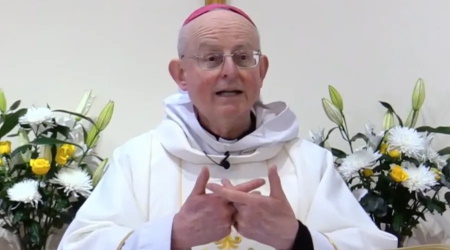
A Scottish bishop has expanded the availability of Traditional Latin Masses in his diocese, ahead of an illicit episcopal consecration by a local traditionalist group.
Bishop Hugh Gilbert, O.S.B., of Aberdeen, Scotland, approved the offering of Traditional Latin Masses every Sunday at the Church of Our Lady of the Garioch and St. John the Evangelist in Fetternear, a hamlet in Aberdeenshire.The Masses had been offered at the non-parochial church by members of the Congregation of the Sons of the Most Holy Redeemer (Transalpine Redemptorists), a traditionalist community based on Papa Stronsay, a remote island that falls within the Aberdeen diocese’s boundaries.But when the community’s leadership began to issue statements repudiating recent papal documents and suggesting that popes since Vatican Council II were illegitimate — a position known as sedevacantism — Gilbert asked a diocesan priest, Fr. Bruno Murphy, to offer the Masses instead.
The Traditional Latin Masses were previously offered once a month, but under the new arrangement they will be available every Sunday. The new celebrants will be Fr. Yousef Marie, F.SS.R., and Fr. Peter Mary, F.SS.R., who were members of the Papa Stronsay community but have dissociated themselves from its present direction.
Fr. Michael Mary, F.SS.R., the 72-year-old superior general and founder of the Transalpine Redemptorists, is expected to be consecrated illicitly as a bishop July 25. The Canadian sedevacantist Bishop Pierre Roy is scheduled to serve as principal consecrator at the ceremony on Papa Stronsay, which is located in the Orkney Islands, an archipelago off Scotland’s northeastern coast.
On the last weekend before the scheduled episcopal consecration, Gilbert asked priests across the Aberdeen diocese to celebrate Masses using prayers for the Unity of the Church, an option in the Roman Missal’s section for “Masses and Prayers for Various Needs and Occasions.”
In a pastoral letter read out in churches July 18-19, Gilbert lamented the impact of the Transalpine Redemptorist episcopal consecration on Church unity.
He wrote: “Recently, the Society of St. Pius X chose to ordain four new bishops without the permission (or mandate) of the pope. This constitutes an act of schism. Next Saturday, July 25, something similar is scheduled to occur in Orkney when the Superior of the Sons of the Most Holy Redeemer intends to be ordained bishop by three unauthorized bishops from the Americas. This likewise constitutes an act of schism and will place those engaged in it outside the Catholic Church.”
Alluding to the presence of an SSPX Mass center in Aberdeen, Gilbert commented: “Both of these actions, and especially the latter, touch our own diocese of Aberdeen, and not in a good way. Objectively, we are dealing with a break from the unity of the Church.”The pastoral letter reflected on the pope’s role in sustaining the unity of the Catholic Church, beginning with St. Peter the Apostle.
Gilbert wrote: “Some of this can seem remote from our daily preoccupations. But at another level, this gift of Christ — the Petrine ministry alive in the pope — is vital to our faith. It is not by chance that every Catholic Mass throughout the world names the current pope. It is a sign that every diocese, parish or community is not just a gathering of ‘chums,’ but part of something wider and greater.”“The papacy saves us from a Christianity in our own image, a Christianity merely reflecting our own pet ideas or the current cultural ‘take’ on things. The papacy connects our ‘here’ to everywhere the Gospel has taken root and will, and our ‘now’ with the lasting will of Christ for his Church.”
He added: “With the papacy we are spared the fate of becoming a merely national Church or a sect, or followers of some self-appointed authority. We are kept open to the fulness of the faith and the full breadth of the call to charity. With Peter the mission flourishes, without him it withers. And to refuse communion with him is spiritual suicide.
The Pillar asked the Transalpine Redemptorists for a response to Gilbert’s pastoral letter, but they had not responded by press time.
The Transalpine Redemptorists — who are distinct from the Redemptorists, the worldwide congregation established by St. Alphonsus Liguori in 1732 — emerged in 1988 from the SSPX’s orbit. Members combined a devotion to the Traditional Latin Mass with the spirituality of St. Alphonsus.
After Pope Benedict XVI expanded access to the Traditional Latin Mass, the Transalpine Redemptorists were reconciled with the Holy See in 2008. Gilbert erected the community as a clerical religious institute of diocesan right in 2012.
But in October 2025, the group issued an open letter declaring that it rejected several major documents issued under Pope Francis.
“We repudiate the Synodal Church as distinct from the Divinely constituted Catholic Church,” said the letter, which had 27 signatories, giving an indication of the community’s size.
On May 26, the community issued a declaration describing post-conciliar popes as “papal pretenders.”
The text expressed regret at the 2008 reconciliation, saying the Transalpine Redemptorists had still found themselves “forced by faith to resist the Conciliar authorities, although in a different manner.”
In response to the declaration, Gilbert said: “This ordination would be celebrated without a papal mandate, by a group of bishops who deny that Our Holy Father Pope Leo XIV is actually the pope.”
“Since this consecration is due to take place within the geographical boundaries of the Diocese of Aberdeen, I am obliged to make clear to the faithful of the diocese that any such episcopal ordination would be unlawful and a grave act of disobedience, separating those taking part from communion with the Catholic Church.”
Be sure to email this page to all your friends.
LONELY
"My Son is lonely. He has been abandoned in His tabernacles and His Home. The doors have been locked. He remains there, a prisoner of His own. My Son is very lonely in His House. Won't you come with compassion and ease His loneliness? You do not abandon those you love." - Our Lady of the Roses, March 18, 1973
 The Virgin Mary's Bayside Prophecy Books are Now Available in E-book Version. Click Here Now!
When you pray the Holy Rosary, you have Our Lady's hand in yours. When you pray the Holy Rosary, you have the power of God in your hands. Start now! Click here...
Our Lady of the Roses Awesome Bayside Prophecies... https://www.tldm.org/Bayside/ These prophecies came from Jesus, Mary, and the saints to Veronica Lueken at Bayside, NY, from 1968 to 1995.
Directives from Heaven... https://www.tldm.org/directives/directives.htm
 PDF
PDFD2 - The Holy Eucharist
PDFD11 - Remain in the Parish Church
PDF