 These Last Days News - June 30, 2026
We encourage everyone to share this web page with others, especially bishops and clergy.
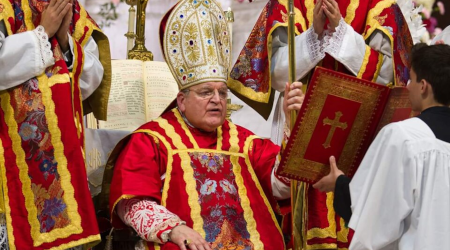
Cardinal Burke: SSPX Consecrations Incur Excommunication, Not All Are Schismatic
"REMAIN
"Do not judge My Son's Church by man. The foundation is My Son, Jesus. And though the walls may develop cracks, the foundation is solid. Will you not remain and patch these cracks, My children? We do not wish that you break apart into small groups of discord. No schisms must take place in My Son's Church. For all who are baptized a Roman Catholic must die Roman Catholics to enter Heaven." - Our Lady, November 20, 1979
"RECRUCIFYING
Veronica - Oh, my God. Oh. Now I see a crucifix, a very large crucifix with Jesus upon it. Oh, my goodness. Oh, there's blood all over. It looks like He's been torn to shreds! Oh, my. Oh.
Jesus - "See, My child, what sin has done to Me! Is there no one in My House who will stand forward and fight for Me? Who will place balm upon My tortured Body? You are recrucifying Me in My own House." - Jesus, August 21, 1974
The above Messages from Our Lady were given to Veronica Lueken at Bayside, New York. Read more
epistles.online reported on June 30, 2026:
by Jonel Esto
Cardinal Raymond Burke has stated that if the Society of St. Pius X (SSPX) proceeds with episcopal consecrations without a papal mandate, those directly involved would incur latae sententiae (automatic) excommunication under canon law.
In an exclusive interview with Michael Haynes of Per Mariam, Cardinal Burke said he does not expect the Holy See to make a last-minute intervention before the planned consecrations.
“It seems to me, at least the way I understand it, that the approach is to let them go ahead and do this. Ordaining bishops without a papal mandate will incur a latae sententiae excommunication, and that will have to be published by the Holy See,” he said.
The American cardinal, however, expressed hope that the Vatican would continue efforts toward reconciliation by appointing one or more cardinals to meet with members of the SSPX.
“I’m still hoping that the Holy See would designate a cardinal or two, or even three cardinals, to meet with any members of the Priestly Society of St. Pius X,” Burke said, adding that many within the Society themselves view the proposed consecrations as “a schismatic act” and could still be reconciled.
Addressing the canonical implications, Burke explained that automatic excommunication would apply to those who “actively, knowingly, and willingly” cooperate in the illicit episcopal consecrations, including both the consecrating bishops and those receiving episcopal ordination.
At the same time, Burke rejected speculation that all SSPX members could be declared excommunicated. He argued that many faithful and priests associated with the Society do not possess a schismatic mentality but are primarily attached to the Traditional Latin Mass.
He also cited recent research by Dr. Stephen Bullivant and Dr. Stephen Cranney, saying it indicates that most Catholics devoted to the Traditional Latin Mass do not reject the validity of the Second Vatican Council.
Burke also dismissed the SSPX’s long-standing claim that a “state of emergency” in the Church justifies episcopal consecrations without papal approval.
“Certainly the present situation does not constitute a state of emergency,” he said, emphasizing that Christ remains with His Church despite its present difficulties.
“Even if there are serious difficulties in the Church, and surely there are, we stay by our Lord and we fight and do our part to be faithful. The rest is in the hands of God.”
The cardinal concluded by stressing that no circumstances can justify actions contrary to the Church’s law and unity.
“No situation justifies doing something that is intrinsically evil,” he said.
Be sure to email this page to all your friends.
"HONOR
"I have asked you in the past, and I ask and continue to beg you, My children, not to abandon your Vicar in Rome, and not to abandon your parish church. You may have discord with your pastor, you may have discord with other priests in your parish, but you must remember this, My children, if it gives you any consolation in human nature, and for their human nature, you must understand: you must honor them for who they are, but not judge them for what they are or have become." - Our Lady, August 14, 1981
"ROUGH ROAD
"Remember, My child and My children, no matter how rough the road gets, you will stay within your parish church. And by good example and many prayers you will bring the priesthood back into the light." - Our Lady, June 17, 1989
 The Virgin Mary's Bayside Prophecy Books are Now Available in E-book Version. Click Here Now!
When you pray the Holy Rosary, you have Our Lady's hand in yours. When you pray the Holy Rosary, you have the power of God in your hands. Start now! Click here...
Our Lady of the Roses Awesome Bayside Prophecies... https://www.tldm.org/Bayside/ These prophecies came from Jesus, Mary, and the saints to Veronica Lueken at Bayside, NY, from 1968 to 1995.
Directives from Heaven... https://www.tldm.org/directives/directives.htm
 PDF
PDFD11 - Remain in the Parish Church
PDFD77 - Obedience
PDFD265 - The Papacy
PDFD267 - Rome, the Eternal City
PDFD406 - Led Astray, Part 1
PDFD407 - Led Astray, Part 2
PDF