 These Last Days News - July 16, 2026
We encourage everyone to share this web page with others, especially bishops and clergy.
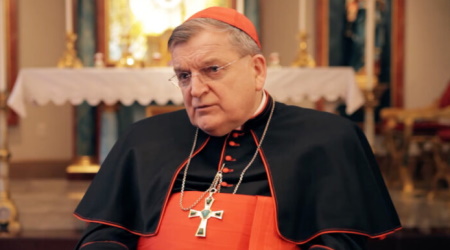
Cardinal Burke: ‘Synodality Has to Be Stopped’...
END EXPERIMENTATION AND NOVELTY
"How much more punishment shall the severity increase to awaken you from your slumber? We have asked Our pastors to put into action the direction given by My Mother to recover My sheep. Instead, My Mother has been received with doubt, laxity, apathy, and an absolute rejection by many. How many voice-boxes must We send among you to awaken you before it is too late?" - Jesus, May 26, 1976
"YOU MUST NOT SEEK NOVELTY
You must not seek novelty in My Son's House. Many abominations sadden My heart. There is great lack of respect during the Holy Service, My children. My Son's House, His houses throughout your earth, have become meeting places of demons." - Our Lady of the Roses, November 20, 1975
The above Messages from Our Lady were given to Veronica Lueken at Bayside, New York. Read more
Cardinalnews.Substack.com reported on July 15, 2026:
Cardinal Raymond Burke has raised serious concerns about the use of “synodality” in a recent consistory of cardinals, warning that the current methodology risks undermining open debate within the Sacred College and obscuring critical issues facing the Church.
Speaking to The College of Cardinals Report on June 28, following the June 26–27 consistory convened by Pope Leo, Cardinal Burke welcomed the renewed gathering of cardinals, something he noted had not occurred for many years under Pope Francis, and described the opportunity for greater fraternal exchange as a “very great fruit.”
But he also expressed concern that the structure of the meeting limited meaningful discussion as it had adopted a format modeled on “synodal” processes, with cardinals divided into small groups and guided by preset questions.
He argued that this approach prevented in-depth engagement and reduced feedback to consensus-based summaries, potentially excluding dissenting but important viewpoints from reaching the Pope.
“The reports are only reports of what every cardinal agreed upon,” Cardinal Burke said, adding that perspectives not shared by a majority may be omitted despite their significance.
He described a final session conducted in the traditional open-debate format as the most productive part of the gathering, although limited by time. The free discussion, in the presence of the Pope, was how past consistories of cardinals were undertaken.
Overall, he said the consistory was a “very controlled” process, including the apparent pre-selection of discussion leaders and limited opportunities for free intervention. In his view, this risked diminishing the role of cardinals as advisors to the Pope.
Turning to the growing use of “synodality” in the Church, Cardinal Burke firmly questioned its theological and historical grounding, describing it as a concept without clear definition or precedent in Church tradition. While synods have long existed as occasional consultative gatherings, he emphasized that they are not constitutive elements of the Church’s nature.
“There is no definition of synodality, there’s no history of it in the Church,” he said, expressing concern at the merging of established structures, such as consistories, with what he regards as an undefined concept.
Citing St. Paul’s teaching on the transmission of the faith — “I hand on to you what I first received” — Burke argued that continuity is essential and absent from current formulations of synodality.
“So we have to insist that this whole synodality business stop, and there be a very serious study done of the whole matter, because we’re talking about the very life of the Church, and we’re talking about the salvation of souls,” he said.
The cardinal also cautioned against reshaping established ecclesial structures around what he characterized as a contemporary and insufficiently examined idea. “The Church does not have paradigm shifts,” he said, rejecting language used in synodal and other discussions that suggested a radical change in direction for the Church’s teaching or mission.
The cardinal also warned that an excessive focus on contemporary concerns risks conforming the Church to secular ways of thinking, rather than addressing the modern world from within her own doctrinal and historical continuity.
“I’m confident our Lord will protect the Church,” he said, “but we have to do our part to say, ‘No, this concept of synodality, while it may have a good motive in the sense of wanting to address the faith of the contemporary time, is fundamentally flawed.”
The Cardinal’s Intervention
A significant portion of Cardinal Burke’s own intervention during the consistory’s free discussion focused on Synod Study Group 9 — a report submitted last month to the Synod Secretariat that observers criticized as an attempt to undermine Church teaching by normalizing homosexual relations in the Church.
“The truth is about the nature of things and their proper ends,” Cardinal Burke said in his June 28 interview. “It is not about inclinations that I have, or desires or projects that I have, that are very subjective, and so I conform the teaching of the Church to suit my desires or my inclinations.”
Human beings, he added, find their happiness “the more we understand the truth about ourselves and about the world and about our proper finality.”
Cardinal Burke also criticized the report in his intervention for calumniating the apostolate Courage, which supports Catholics experiencing same-sex attraction in living chaste lives. He said claims made about Courage in the report were inaccurate and insufficiently verified.
“How in the world could the Church, in a report given out throughout the Church, not check to see if what that witness, or whoever he was, said about Courage was true? But they didn’t,” Cardinal Burke said. He observed that it was therefore unsurprising that now certain bishops are “encouraging the LGBTQ agenda, saying, look, the Church is changing its teaching, be of good courage, go forward.”
He also noted in his intervention that an archbishop wrote a letter saying it was clear that Pope Leo shared such a view on the grounds that Leo “doesn’t talk about sexual morality.” “Well that’s completely irresponsible to say or write something like that,” the cardinal said.
Reacting to the news that the Synod Group 9 study report will be sent back to dioceses during the implementation phases of the Synod on Synodality, he said: “That’s iniquitous; that should not happen.” He said he told the cardinals that the synodal process “has to be stopped,” adding that “whatever it is, it has to be completely faithful to what the Church teaches, and to the holiness of the Church’s life.”
The cardinal, who was speaking to The College of Cardinals Report just ahead of the illicit consecrations of four bishops of the Society of St. Pius X, also highlighted the absence of discussion on that issue, one he views as a serious schismatic act, and other pressing matters, including the status of the Traditional Latin Mass.
He criticized restrictions imposed by Traditionis Custodes, describing them as a “persecution” of those who are spiritually nourished by worship according to the More Ancient Usage (Usus Antiquior) of the Roman Rite. “There can be no question in anybody’s mind, and Pope Benedict XVI made it so clear: [the vetus ordo] is an eternal good in the Church,” he said, and suggested that Pope Leo could revisit or modify the legislation, noting that papal documents can be revised by successors.
“It is a form of the Roman rite that was celebrated for more than fifteen centuries,” he stressed. “It’s simply so beautiful and the faithful have been nourished spiritually by this form of the Latin rite. This should be allowed freely.”
“It’s been a great enrichment to me as a priest and bishop,” he said. “The greater part of the faithful are just devout Catholics who are trying to live their faith at as intense a level as possible and hand it on. One of the marks of the traditional Latin Mass community is that there are many children, and the parents are very concerned to hand on to their children the Catholic faith.”
As a potential remedy, he called for the establishment of a dedicated Vatican body to support Catholics attached to the older form of the Roman Rite. “We need a dicastery,” he said, so that Catholics who desire to worship according to the extraordinary form “can receive all the sacraments” according to prior liturgical forms.
Although critical of synodality and the consistory, Cardinal Burke concluded with a note of cautious optimism, expressing confidence in Divine Providence and the enduring guidance of Christ over the Church.
“Our Lord is always head of His Church. We stay with him. We don’t go off in other directions because we’re unhappy with the way things are in the Church,” he said. “We have to, first of all, apply wisdom to the situation and then have the courage to speak to these matters and get to the truth of it.”
Be sure to email this page to all your friends.
"THERE IS NO NEED TO CHANGE
My child, you must find a good soul who will continue to print and send out to the world the true prayers of your Faith. Experimentation by your pastors has led to much soul corruption. There is no novelty in Heaven. There is no need to change, for when man becomes discontented he seeks a change, and it is most often not for the better." - Our Lady of the Roses, December 27, 1975
 The Virgin Mary's Bayside Prophecy Books are Now Available in E-book Version. Click Here Now!
When you pray the Holy Rosary, you have Our Lady's hand in yours. When you pray the Holy Rosary, you have the power of God in your hands. Start now! Click here...
Our Lady of the Roses Awesome Bayside Prophecies... https://www.tldm.org/Bayside/ These prophecies came from Jesus, Mary, and the saints to Veronica Lueken at Bayside, NY, from 1968 to 1995.
Directives from Heaven... https://www.tldm.org/directives/directives.htm
 PDF
PDFD542 - Lack of Holiness, Part 2
PDFD543 - Much is Expected, Part 1
PDFD544 - Much is Expected, Part 2
PDFD545 - Novelty & Experimentation, Part 1
PDFD546 - Novelty & Experimentation, Part 2
PDF