 These Last Days News - March 10, 2026
We
encourage everyone to share this web page with others, especially bishops
and clergy.
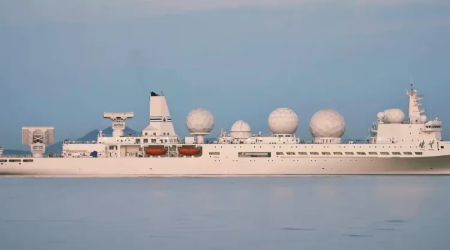
China Deploys 30,000-Ton Liaowang-1 “Floating Supercomputer” to Gulf of Oman — PLAN Intelligence Ship Now Watching U.S.–Israel–Iran War from 6,000km Sensor Bubble...
ONE PLAN IN MIND
"There is now a plan in
the national and international seat of satan . . . . It is a group, My
child, that is united with other groups throughout the world. They have one
plan in mind: to bring about the fall of all nations and the introduction of
communism to all nations, by destroying the young with drugs and all manners
of debasity." - Our Lady, June 18,
1987
HAND ON THE BUTTON
"And, My children, it does not take much
knowledge or a learned being to understand that Heaven alerts you now to the
dangers of the onslaught of communism. Satan, being at the controls, will
soon have one who is possessed, and of, also, a major rank in the world
today, to press that one little technical, technological wizard, not in
human form but in mechanical form. Like a robot, this will go forth among
the nations, and nations shall disappear from the earth in the short time of
three to five minutes." - Our Lady, July 1, 1985
The above Messages from Our Lady were given to Veronica Lueken at Bayside, New York. Read more
DefenceSecurityAsia.com reported on March 9, 2026:
In the geopolitically volatile waters of the Gulf of Oman, where global energy corridors intersect with one of the world’s most militarised maritime theatres, China has quietly inserted a 30,000-ton maritime intelligence platform capable of observing the unfolding U.S.–Israel–Iran confrontation without firing a single missile.
The arrival of the Liaowang-1, a next-generation signals intelligence and space-tracking vessel commissioned in 2025, represents a powerful shift in the conflict’s information geometry because the ship’s advanced sensor architecture allows Beijing to watch the entire theatre through a surveillance envelope stretching approximately 6,000 kilometres.
The deployment becomes strategically significant because the vessel is escorted by the People’s Liberation Army Navy’s Type 055 cruiser and Type 052D destroyer, an operational formation that signals China’s determination to protect a high-value intelligence asset positioned within observational range of a live Middle Eastern battlespace.
An anonymous analyst from a prominent American think tank described the platform’s analytical capacity with blunt clarity, stating that “the Liaowang-1 isn’t just a ship; it’s a floating supercomputer processing petabytes of data to map the invisible battlefield.”
That observation captures the central strategic question surrounding the vessel’s presence: not whether it is capable of collecting intelligence, but how the information harvested by its sensors might influence the balance of situational awareness across a theatre already defined by high-tempo missile, air and naval operations.
China publicly frames ships like Liaowang-1 as instruments supporting its expanding space program through satellite tracking and rocket telemetry monitoring, yet the vessel’s sensor suite, positioning and timing inevitably raise questions about whether its real strategic value lies in monitoring military activity across the wider Middle Eastern battlespace.
The vessel’s long-range electromagnetic intelligence sensors could theoretically provide early detection of U.S. and Israeli aircraft movements across the theatre, allowing Iranian commanders—if such information were ever relayed—to extend reaction timelines and reposition surviving surface-to-air missile batteries before incoming strike packages penetrate remaining defensive envelopes.
Its ability to monitor radar emissions, aerial refuelling corridors and carrier strike group manoeuvres could also expose the operational rhythm of long-range strike operations, potentially enabling Iranian planners to anticipate launch windows or adjust air-defence deployments around vulnerable phases of Western power-projection cycles.
Equally significant is the platform’s capacity to track missile trajectories and electronic warfare signatures, meaning any shared analytical output could theoretically improve Iranian understanding of cruise-missile approach corridors, interception timelines and the electronic countermeasure environment shaping modern precision-strike campaigns.
Even without confirmed intelligence transfer, the mere presence of a persistent Chinese ISR node observing the conflict could indirectly strengthen Iranian strategic awareness by generating high-resolution datasets on Western operational patterns, thereby reducing uncertainty in Tehran’s defensive planning during periods of intense military escalation.
A 30,000-Ton Maritime Intelligence Architecture
At its core, Liaowang-1 represents one of the most sophisticated maritime intelligence platforms ever constructed, engineered to dominate the electromagnetic spectrum from the open sea by intercepting, analysing and classifying radar emissions, communications signals and missile telemetry across vast distances.
Displacing roughly 30,000 tons, the ship’s massive hull provides the physical infrastructure required to support a dense array of surveillance systems, including at least five large radar domes and multiple high-gain antennas that collectively form the backbone of a powerful electronic intelligence architecture.
These sensors enable the vessel to track up to 1,200 air and missile targets simultaneously, a capability that transforms the ship from a passive observation platform into an operational surveillance hub capable of constructing a detailed electronic picture of regional air and missile activity.
The technological edge underpinning this capability lies in the integration of deep neural-network algorithms capable of analysing electromagnetic signatures with an identification accuracy exceeding 95 percent, enabling the system to distinguish between ballistic missiles, stealth aircraft and conventional aerial platforms.
Such computational precision allows the ship to process enormous quantities of intercepted signals in real time, converting raw electromagnetic emissions into structured intelligence capable of revealing operational patterns across a complex battlespace.
This analytical capacity effectively turns the vessel into a floating intelligence centre capable of identifying emerging threats, mapping aircraft sortie patterns and tracking missile trajectories across a region stretching from the Arabian Sea to the Middle Eastern mainland.
Defence observers emphasise that the technological foundations of these systems originate in China’s space and missile programs, where similar tracking technologies are used to monitor orbital satellites and ballistic missile reentry vehicles.
However, the dual-use nature of those technologies means that the same sensors capable of monitoring satellites thousands of kilometres above Earth can also detect the electronic signatures of aircraft carrier strike groups operating far beyond the horizon.
The result is a surveillance platform whose operational reach is limited less by geography than by the physics of electromagnetic propagation, enabling it to observe a vast region while remaining anchored in legally permissible international waters.
PLAN Escort Signals Strategic Importance
The decision to deploy Liaowang-1 under the protective umbrella of two advanced PLAN surface combatants highlights the strategic value Beijing places on the intelligence mission unfolding in the Gulf of Oman.
The Type 055 cruiser, frequently described by analysts as China’s equivalent of the Aegis-equipped cruiser concept, provides powerful layered air-defence capabilities designed to intercept incoming aircraft and missile threats that could jeopardise the intelligence vessel.
Operating alongside it, the Type 052D destroyer contributes additional defensive depth through its advanced anti-submarine warfare capabilities, ensuring that underwater threats cannot approach the surveillance platform undetected.
Together these escort vessels create a protective maritime perimeter that allows Liaowang-1 to focus on its intelligence mission while the accompanying warships manage air, surface and subsurface security.
This escort arrangement reveals that the deployment is not merely symbolic but represents a structured naval operation designed to ensure the uninterrupted functioning of a high-value electronic intelligence node.
By protecting the intelligence vessel with modern warships, China effectively ensures that its maritime surveillance capability remains operational even within a region experiencing heightened military volatility.
The convoy’s adherence to international maritime law further reinforces Beijing’s strategy of projecting intelligence presence without crossing legal thresholds associated with direct participation in the conflict.
Operating entirely within international waters allows China to maintain that its activities fall under freedom-of-navigation principles recognised by global maritime law.
Yet the visibility of the escort formation simultaneously communicates that China is prepared to defend its strategic surveillance assets if necessary.
This balance between legal compliance and operational signalling illustrates the subtle power projection inherent in modern intelligence deployments.
Plausible Deniability and Dual-Use Sensors
China’s official explanation for ships like Liaowang-1 emphasises their contribution to national space missions, including satellite launch monitoring, orbital trajectory tracking and rocket telemetry analysis.
These tasks are indeed essential for any country operating complex space infrastructure because ocean-based tracking stations extend monitoring coverage beyond the range of terrestrial facilities.
China’s space agency has highlighted the role of such vessels in supporting ambitious programs including the Chang’e lunar exploration missions and the Tiangong space station.
This narrative provides Beijing with a layer of plausible deniability that helps shield the deployment from accusations of overt military involvement.
However, defence analysts have pointed out that the technological overlap between space tracking and military surveillance is substantial.
A sensor capable of tracking a Chinese satellite in geosynchronous orbit possesses the sensitivity and computational capability required to detect the radar emissions of an American aircraft carrier group.
Likewise, algorithms developed to identify ballistic missile reentry vehicles during rocket tests can also classify stealth aircraft launching from a carrier deck.
This technological duality is not accidental but reflects a deliberate design philosophy aimed at maximising operational flexibility.
By embedding dual-use capabilities into the vessel’s architecture, China can deploy powerful intelligence platforms without openly declaring them as instruments of military surveillance.
Such ambiguity reduces diplomatic friction while preserving the strategic benefits of advanced electronic intelligence collection.
Strategic Surveillance Over a War Theatre
Anchored in international waters near Oman, Liaowang-1 occupies a geographic position that offers an exceptional vantage point over one of the world’s most strategically sensitive maritime corridors.
The Gulf of Oman sits at the gateway to the Strait of Hormuz, a chokepoint through which a large portion of the world’s oil exports transit each day.
From this location the ship’s 6,000-kilometre sensor envelope extends across a vast operational theatre encompassing the Arabian Sea, the Persian Gulf and large areas of the Middle East.
Such coverage allows the vessel to detect and analyse aircraft movements, missile launches and naval manoeuvres occurring far beyond its immediate surroundings.
Electronic intelligence systems aboard the ship can intercept radar emissions, communications transmissions and electronic warfare signatures produced by advanced military platforms.
By analysing these signals the vessel can construct a comprehensive operational picture including fleet movements, aerial refuelling tracks and missile launch corridors.
This intelligence can reveal how frequently aircraft conduct sorties, how naval task forces manoeuvre and how electronic countermeasures are employed during combat operations.
Even without sharing the collected data with any external actor, the information provides valuable insights into the operational behaviour of some of the world’s most advanced military forces.
The presence of such a platform therefore transforms the surrounding maritime domain into a theatre of observation as much as a theatre of conflict.
Could the Liaowang-1 Influence Iran’s Defensive Picture?
The potential operational consequences of the Liaowang-1’s presence become clearer when viewed from Tehran’s perspective amid an evolving regional confrontation.
Reports from the Israeli Defense Forces indicate that Iranian air-defence infrastructure has suffered severe degradation, with roughly 80 percent of fixed sites reportedly destroyed through precision strikes.
The loss of those radar installations has fragmented Iran’s early-warning network, leaving gaps in detection coverage across large sections of its airspace.
Mobile systems such as the Russian-supplied S-300 and domestically produced Bavar-373 remain operational but lack the redundancy required to maintain a comprehensive defensive picture.
Iran’s reconnaissance satellites provide only intermittent coverage, limiting the country’s ability to monitor military movements in real time.
Electronic warfare operations conducted by U.S. and Israeli forces have further disrupted remaining sensors, creating additional blind spots in Iran’s defensive architecture.
In such an environment, an external surveillance node positioned beyond the reach of Iranian airspace becomes strategically significant.
With its long-range radar systems and high-gain antennas, Liaowang-1 could theoretically observe aircraft movements across the theatre, including stealth fighters, bombers and unmanned aerial vehicles.
Deep neural-network algorithms capable of identifying electromagnetic signatures with more than 95 percent accuracy could distinguish between different aircraft types based on their electronic footprints.
Such intelligence could reveal flight paths, altitudes and operational formations used during strike missions.
If such data were ever relayed through diplomatic channels, encrypted communications or third-party intermediaries, it could extend Iran’s reaction time against incoming raids.
This possibility remains speculative, as no confirmed evidence exists that China is transferring operational intelligence to Iranian forces.
Nevertheless, the vessel’s positioning and capabilities inevitably fuel debate within intelligence communities regarding the potential strategic value of the data it collects.
Echoes of the Cold War Intelligence Battles
The deployment of Liaowang-1 inevitably evokes historical parallels with Cold War maritime intelligence operations.
During that era the Soviet Union frequently deployed Auxiliary General Intelligence ships to shadow American carrier battle groups across international waters.
Those vessels intercepted radio transmissions, radar signals and electronic emissions in order to build detailed profiles of Western military operations.
Although technologically sophisticated for their time, Soviet intelligence ships relied primarily on analogue systems and human analysts.
Liaowang-1 represents a dramatic evolution of that concept through the integration of artificial intelligence and high-speed data processing.
Deep-learning algorithms onboard the ship enable rapid pattern recognition across massive datasets of intercepted electromagnetic signals.
This analytical capability allows the vessel to detect anomalies such as stealth aircraft signatures or encrypted communication bursts.
The result is a maritime intelligence platform capable of converting raw signals into structured operational insights in real time.
Defence historians often summarise this transformation by noting that Cold War surveillance concepts have been revived with twenty-first-century technology.
The difference lies not in the mission but in the scale and speed at which modern intelligence platforms can process information.
The Emergence of a New Maritime Intelligence Order
The appearance of Liaowang-1 in the Gulf of Oman reflects a broader transformation in global maritime competition.
Modern naval power is increasingly defined not only by firepower but by the ability to collect, process and exploit data generated across the electromagnetic spectrum.
Ships like Liaowang-1 represent the vanguard of this transformation, functioning as floating intelligence nodes capable of observing entire regions from international waters.
By positioning such a platform near an active conflict zone, China gains the ability to study real-world combat operations conducted by technologically advanced militaries.
The intelligence collected may inform future military planning, technological development and operational doctrine.
The deployment also demonstrates Beijing’s willingness to project specialised naval assets far beyond traditional operating areas.
For the broader Asia-Pacific region, the move suggests that similar intelligence deployments could occur in other contested maritime theatres.
From Washington’s perspective the presence of a Chinese surveillance vessel observing a live conflict inevitably raises strategic questions.
Although no hostile act has occurred and international law has not been violated, the mere presence of such a platform alters the informational dynamics of the conflict.
In modern warfare, situational awareness can be as decisive as missiles or aircraft.
Watching the War Without Firing a Shot
As the Liaowang-1 remains anchored in the Gulf of Oman, its radar domes scanning the skies and its neural-network processors analysing streams of electromagnetic data, the vessel symbolises a new form of strategic competition unfolding across the world’s oceans.
China has not fired a weapon, entered territorial waters or declared allegiance to any combatant in the confrontation surrounding Iran.
Yet the presence of a 30,000-ton intelligence platform capable of observing vast portions of the Middle Eastern battlespace inevitably influences how the conflict is perceived and understood.
Information harvested by the vessel’s sensors may reveal operational patterns, electronic vulnerabilities and logistical rhythms invisible to conventional observers.
Whether that information remains solely within Beijing’s analytical systems or eventually finds its way into broader strategic calculations remains uncertain.
What is clear is that the Liaowang-1 represents a powerful reminder that in contemporary warfare the most consequential weapons may not always be missiles or bombs.
Sometimes the most decisive advantage lies in the ability to see everything while remaining unseen, transforming oceans into silent arenas of intelligence competition where information itself becomes the ultimate strategic currency.
Be sure to email this page to all your friends.
I HAVE BEGGED
"In the past years of your earth's
time, I have begged for the conversion of Russia. My words have been taken
lightly then, as they are now by many. You must pray for the conversion of
Russia, for she will send her errors throughout the world."
- Our Lady,
July 25, 1975
THE APOCALYPSE
Veronica-I'm looking up, and the sky's
becoming very lighted. And I am seeing thousands and thousands of people
marching. But they look like Chinese, or Mongolian. No, they're-I believe
they're Chinese; they're Asiatic. They're marching across the land, and
they're boarding some kind of transport. They're going onto the water. Oh,
it's a great War. Oh! Oh!
Now Michael is coming over to the
left side of the flagpole, and he's looking down.
St.
Michael-"My child, we have asked you to send the word to mankind that they
will read in the Book of life, the Bible, the words given to them that will
fulfill the prophecy of the latter days, Apocalypse. You are living the days
of the Revelations. Read them and be knowledgeable, and you will not be
caught without the light." - St. Michael, June 8, 1974
 The
Virgin Mary's Bayside Prophecy Books are Now Available in E-book Version.
Click Here Now!
The
Virgin Mary's Bayside Prophecy Books are Now Available in E-book Version.
Click Here Now!
When you pray the Holy Rosary, you have Our Lady's hand in yours. When you pray the Holy Rosary, you have the power of God in your hands. Start now! Click here...
Our Lady of the Roses Awesome Bayside Prophecies... https://www.tldm.org/Bayside/ These prophecies came from Jesus, Mary, and the saints to Veronica Lueken at Bayside, NY, from 1968 to 1995.
Directives from Heaven... https://www.tldm.org/directives/directives.htm
D10 - Consecrate Russia
D101 - Russia and China, Part 1
D102 - Russia and China, Part 2
D103 - Communism
D104 - Invasion
D136 - Visions of the Great War: The Mideast
D137 - Visions of the Great War: Russia and China
D156 - Terrorism
D283 - The Deceit of Russia

| Home - Latest News | Introduction | Bayside Prophecies | Directives from Heaven | Shopping Cart | Miracles & Cures | Veronica Lueken | Miraculous Photos | Bible | Radio Program | Bayside Videos |
The electronic form of this document is copyrighted.
Quotations are permissible as long as this web site is acknowledged with a
hyperlink to:
http://www.tldm.org
Copyright © These Last Days Ministries, Inc. 1996 - 2026 All rights
reserved.
P.O. Box 40
616-698-6448
Lowell, MI 49331-0040
Revised: March 10, 2026

