 These Last Days News - March 17, 2026
We
encourage everyone to share this web page with others, especially bishops
and clergy.
Ditch The Leprechauns And Read The Real Story Of St. Patrick’s Day...
LEARN THEIR EXAMPLE
"My child, you will make it
known that Our children upon earth must speak often in the spirit with the good
souls who are waiting to join them. Ask and they shall receive guidance.
"In
human understanding, My child, it must be made known to mankind that your saints
who are now in the heavens, in the Kingdom of your Father, they have full
knowledge of the trials of earth and mankind, and therefore will be of great
solace to you. Learn by their example. They did not seek the treasures of the
world, but they truly sought to store these graces of treasures in the Kingdom.”
– Our Lady of the Roses, November 1, 1975
LIVES OF THE SAINTS
"The greatest trials are given,
My children, to those who are on the narrow road to the Kingdom. You must all
learn the value of suffering. The Eternal Father allows this for reason. If you
will study the past lives of your saints, My children, you will understand why I
say that penance and suffering are truly the way of the cross.”
– Our Lady of the Roses, October 2, 1976
The above Messages from Our Lady were given to Veronica Lueken at Bayside, New York. Read more
TheFederalist.com reported on March 17, 2026:
By J. Antonio Juarez
Today thousands of Americans will be donning themselves in the loudest green attire as they celebrate St. Patrick’s Day. Major cities such as New York, Chicago (where the city traditionally pours green dye into the Chicago River), and, of course, Boston will host parades and other festivities such as music, dancing, and ample opportunities to enjoy soda bread, corned beef and cabbage, and perhaps some green beer.
The earliest recorded celebration of St. Patrick’s Day in the New World was in 1600 at the behest of an Irish chaplain named Father Richard Arthur, who was the parish priest in St. Augustine, Florida. A cannon salute marked the feast day on March 17 of that year, but Father Arthur organized the first St. Patrick’s Day parade the following year. However, for whatever reason the tradition did not last. In 1737 a group of Irish settlers in Boston formed an Irish mutual aid society and celebrated the feast day of their homeland’s most prominent saint with a social and dinner. This tradition marked the beginning of the annual public celebration of the saint’s feast day, which has continued right up until today.
In the 1760s New York saw the beginnings of the annual parades in honor of St. Patrick. At the time New York was garrisoned by British soldiers, which included some Irish units who wished to celebrate their patron saint’s feast day, despite Catholicism being illegal in Puritan New York. The Irish soldiers rose early and marched through Lower Manhattan before ending at a pub for a “kegs and eggs” feast day breakfast. The tradition of the parade caught on and was repeated each year after that. The celebration of the feast day and the parades were eventually carried to other parts of the 13 colonies by Irish settlers, and were later picked up by the waves of Irish immigrants who arrived in the mid-19th century.
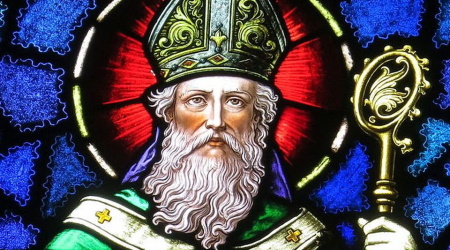
However, unless you are an observant Catholic, Orthodox, or belong to certain Anglican and Lutheran churches, there is usually one thing missing from all of these celebrations: any substantial recounting of the life and deeds of St. Patrick. You might see pictures of him or hear about him driving the snakes out of Ireland or how he used a shamrock to explain the Trinity. But otherwise not much else. This is a lamentable sign of our times because his life is an incredible story of faith and resilience — the kind of story our culture so desperately needs today.
From Slave to Saint
Most of what we know about Saint Patrick comes to us from Church records, Irish annals, hagiographical legends, and from an autobiographical work called Confessio. Patrick (which was not his birth name) was born around 387 A.D. during the waning years of the Western Roman Empire in Gaul and Britannia. He was raised in a Christian Roman family whose father, Calphurnius, was a decurio (or member of the local senate). When he was 16 years old, he was captured by Irish marauders and sold into slavery to an Irish druidical priest named Milchu.
For the next six years, Patrick was a shepherd to his master’s herds, and during this time he fervently prayed to God. Then one day he relates that he heard the voice of an angel, which told him to escape his enslavement and flee west to a place called Killala, where he encountered and boarded a ship for Britain. Wishing to strengthen his faith, he sought out ministerial training at St. Martin’s monastery in Tours and later at an abbey on the island of Lérins, where he was later ordained a priest and labored as a missionary countering the Pelagian heresy in Britain.
Eventually, Patrick and another priest were sent to visit Pope Celestine, and it was there that Patrick was given the name “Patricius” (meaning “patrician” or “nobleman”). As a result of his captivity, Patrick knew the Celtic language and was familiar with the religious traditions of the people of Ireland, so the pope appointed him as a missionary to Ireland.
In the summer of 433 he arrived in Ireland, and despite resistance from local druids and chieftains, he journeyed toward his old master, intending to pay him for his freedom (though his old master reportedly killed himself before Patrick arrived). Over the course of his ministry, Patrick faced insults, beatings, and even captivity (according to his Confessio, he was re-enslaved multiple times times) as he preached the gospel.
In time his preaching and the working of numerous miracles won him the day as druids and local warlords (and their children) gave up their old ways and were baptized into the Christian faith. By the time Patrick died in 493 A.D. (460 or 461 according to some sources), he had traversed the entire island and consecrated 350 bishops. Within 200 years of his death, Christianity was the dominant religion on the island.
A Contemporary Holiday Without the “Holy”
Today, St. Patrick’s Day is much like the holidays of Cinco de Mayo or Oktoberfest, where the original intent of the holiday has mostly been forgotten. At its best, the day is a shared holiday that celebrates the parts of Irish culture America has made its own. At its worst, it is a public holiday where people are given permission to engage in drunkenness, carousing, and other godless behavior — the same kind of behavior St. Patrick preached against.
This is precisely why it is unfortunate that today so little attention is paid to St. Patrick’s life. Even from a historic point of view, his story of enslavement, flight to freedom, and returning to convert the same people who had enslaved him is the kind of underdog success story that any freedom-loving American should find appealing. From a Christian point of view, his story is an epic tale of persevering in one’s faith and the power of God’s grace to indelibly change the hearts of an entire island.
The story of St. Patrick driving out the snakes was never meant to be taken literally. Instead it is a symbolic portrayal of the spiritual warfare St. Patrick engaged in as he, with the power of the cross and the gospel, conquered all of the monsters, ghosts, leprechauns (which were not seen as the cute and lovable figures they are portrayed as today) and blood-thirsty gods like Crom Cruach, which inhabited a world where barbarism, slavery, warfare, and human sacrifice were the norm. His victory is something those of us living in a culture that is the product of 2,000 years of Christianization can easily take for granted.
Now more than ever we need to put the Saint back into St. Patrick’s Day! So if you really wish to honor the saint and his feast day, and are so inclined, perhaps take a moment (before you head out to the parade or other festivities) to recite the prayer St. Patrick’s Breastplate, which is much longer than the part of it most people are familiar with:
Christ protect me today;
Christ with me, Christ before me,
Christ behind me, Christ within me,
Christ beneath me, Christ above me,
Christ at my right, Christ at my left.
Be sure to email this page to all your friends.
"The judgment of your God is not akin to the judgment of man. The Eternal Father will only judge by the heart. Your rank, your accumulation of worldly goods does not set you up before another. Many have sold their souls within the holy House of God. Better that you strip yourself and remove all worldly interests now while you have the time to make amends to your God, for many mitres will fall into hell." - St. Thomas Aquinas, August 21, 1972
 The
Virgin Mary's Bayside Prophecy Books are Now Available in E-book Version.
Click Here Now!
The
Virgin Mary's Bayside Prophecy Books are Now Available in E-book Version.
Click Here Now!
When you pray the Holy Rosary, you have Our Lady's hand in yours. When you pray the Holy Rosary, you have the power of God in your hands. Start now! Click here...
Our Lady of the Roses Awesome Bayside Prophecies... https://www.tldm.org/Bayside/ These prophecies came from Jesus, Mary, and the saints to Veronica Lueken at Bayside, NY, from 1968 to 1995.
Directives from Heaven... https://www.tldm.org/directives/directives.htm
D36 - Bishops (Part 1)
D37 - Bishops (Part 2)
D38 - Priests (Part 1)
D39 - Priests (Part 2)
D40 - Infiltrators

| Home - Latest News | Introduction | Bayside Prophecies | Directives from Heaven | Shopping Cart | Miracles & Cures | Veronica Lueken | Miraculous Photos | Bible | Radio Program | Bayside Videos |
The electronic form of this document is copyrighted.
Quotations are permissible as long as this web site is acknowledged with a
hyperlink to:
http://www.tldm.org
Copyright © These Last Days Ministries, Inc. 1996 - 2025 All rights
reserved.
P.O. Box 40
616-698-6448
Lowell, MI 49331-0040
Revised: March 17, 2026

