 These Last Days News - January 28, 2026
We
encourage everyone to share this web page with others, especially bishops
and clergy.
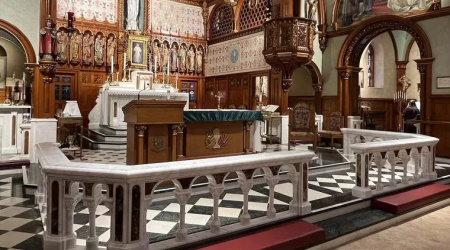
How the Charlotte ‘Dubia’ May Impact Liturgy Disputes Beyond North Carolina...
HONOR YOUR GOD
"I stress, I repeat the way given by
the Father for you in the days ahead: prayer, atonement, and sacrifice. Much is
needed. You must bend your knees to honor your God.”
- Our Lady of the Roses, July 15, 1974
MAN MUST KNEEL
“All honor must be given to My Son in
the Eucharist. Man must kneel. My Son’s House is the House of God and a house of
prayer, and it must not be turned into a meeting hall.”
- Our Lady of the Roses, July 25, 1979
The above Messages from Our Lady were given to Veronica Lueken at Bayside, New York. Read more
NCRegister.com reported on January 26, 2026:
By Jonathan Liedl
When a group of Charlotte priests asked the Vatican earlier this month to weigh in on their bishop’s prohibition of altar rails and kneelers during Communion, it marked the latest development in the ongoing controversy surrounding Bishop Michael Martin’s leadership of the diocese.
But the Charlotte dubia could also have implications for liturgical disputes well beyond western North Carolina.
At the heart of the matter is a local bishop’s authority to restrict or prohibit liturgical practices that are otherwise permitted by the Church’s universal law. Some argue that there are unanswered questions in this area and see the Charlotte dubia as an important “test case.”
“The precise extent of the diocesan bishop’s authority with respect to the liturgy has not been fully clarified by the Holy See, and hopefully this will provide an opportunity for them to do so,” said Dominican Father Pius Pietrzyk, a canon law professor affiliated with the Pontifical University of St. Thomas in Rome.
From this perspective, a response from the Vatican could have implications not only for Bishop Martin’s specific prohibitions in Charlotte, but possibly for bans on practices like the ad orientem posture in the liturgy in other dioceses.
Catholic commentator Phil Lawler has described the Charlotte case as “a crucial test of how the Vatican balances the rights of the faithful against the prerogatives of prelates.”
But not every expert sees the dubia the same. Some contend that a possible response from the Vatican would have only limited implications beyond Charlotte and would apply less to bishops’ liturgical authority than to how they implement it.
“There are not really open canonical questions surrounding liturgical law,” said David Long, a canon law professor at The Catholic University of America in Washington, D.C., emphasizing that Church law is clear that bishops have significant authority to regulate the liturgy in their dioceses.
The differing perspectives among canonists and commentators suggest that a potential response from the Vatican will be keenly awaited, as it may give a sense of how Pope Leo XIV, a canon lawyer himself, understands the matter.
‘Unusual’ Dubia
The Charlotte dubia, or requests for clarification, were sent to the Vatican’s Dicastery for Legislative Texts (DLT) on Jan. 5, according to a report by The Pillar that the Register has independently confirmed. According to the report, 31 priests, or roughly a quarter of the priests in the Diocese of Charlotte, signed a letter accompanying the dubia.
The letter asked for formal clarification on a number of liturgical norms issued by Bishop Martin in a Dec. 17 pastoral letter, such as one norm that states that “the use of altar rails, kneelers, and prie-dieus are not to be utilized for the reception of Communion in public celebration.”
In one of their dubia, the Charlotte priests cited passages in the General Instruction of the Roman Missal (GIRM), the Vatican-issued guide for celebrating the Mass, that speak of both marking off the sanctuary from the body of the church and giving attention to the “traditional practice” of the Roman Rite.
“Since an altar rail is a common and traditional ‘structure and ornamentation’ that marks off the sanctuary from the body of the Church within the Roman Rite, it is asked whether a diocesan bishop has the legitimate authority to prohibit the erection of altar rails within churches or other sacred places in his diocese.”
Submitting dubia is a common practice for seeking clarity from Rome on matters of Church law or teaching, but the practice is usually employed by bishops themselves.
“Having a group of priests within a diocese sending dubia to address the authority of their ordinary to make decisions on liturgical matters is already unusual,” said Long, adding that the submission is “significant and atypical in itself.”
‘Clarifying’ Open Questions?
Although the reported dubia touch on liturgical matters, Father Pietrzyk said it seemed that they were sent to the Dicastery for Legislative Texts, rather than the Dicastery for Divine Worship, because they raise issues that are “fundamentally questions of the proper legal authority of the bishop.”
The Dominican canonist said that while a bishop has “the right and duty” to ensure that the Church’s liturgical laws are followed, “the question is whether he has the right to establish, by particular law, limitations or requirements that liturgical law does not explicitly permit him to make.”
Father Pietrzyk thinks there are reasons to think not. For one, he said that the Second Vatican Council “was clear that the regulation of the liturgy is primarily the duty of the Supreme Pontiff.” Therefore, he said, options for celebrating the liturgy that are included in papally approved liturgical texts should be generally “left to the pastoral discretion of the priest celebrant.”
From this perspective, liturgical norms issued by a bishop should aim to reinforce existing law or address particularly challenging pastoral situations, rather than impose blanket bans on licit practices.
The Dominican canonist noted that the Holy See has previously indicated that there are limits to a local ordinary’s authority to mandate how the liturgy is celebrated, such as a 2001 ruling that a bishop cannot require a priest to include female altar servers.
Furthermore, Father Pietrzyk said that the GIRM was revised in 2000 to emphasize that what is liturgically permitted should be understood in the context of “the traditional practice of the Roman Rite,” rather than “private inclination or arbitrary choice.” He said the revision corrected a prior understanding that, following the liturgical reforms of Vatican II, any element of the pre-conciliar liturgy not explicitly mentioned in documents governing the reform ought to be discontinued.
Given the timing of Bishop Martin’s formation, Father Pietrzyk speculated that the Charlotte bishop might be beholden to the pre-2000 revision understanding of liturgical reform. For example, in his May 2025 letter, the Charlotte bishop justified banning altar rails and kneelers for Communion on the grounds that “there is no mention” of them “in the conciliar documents, the reform of the liturgy, or current liturgical documents.”
Regarding celebrating the liturgy ad orientem, which has been banned in sees like the Archdiocese of Detroit and Diocese of Boise, Father Pietrzyk thinks there is a reasonable argument to be made that a local ordinary “does not have the authority to forbid it in his diocese, as it is explicitly provided for in the rubrics.”
“It would be helpful for the Holy See to clarify that,” he said.
Only ‘Informal’ Implications?
Long, however, argues such clarifications about a bishop’s liturgical authority are not needed.
“The bishop is the supreme moderator, promoter and guardian of the liturgical life of his diocese ‘within the limits of his competence,’” said Long, referring to Canon 835, “and he sets forth liturgical norms that are binding on all in the Church entrusted to his care.”
Pointing to the GIRM, Long said current Church law clearly allows a diocesan bishop to issue “norms for concelebration, service at the altar, the reception of Holy Communion, the construction and renovation of church buildings, posture, and the setting of days of prayer in his diocese.”
For instance, while some have argued that Bishop Martin’s prohibition of intinction, or receiving the Host dipped in the Precious Blood, is in conflict with Church law because the GIRM lists intinction as licit, Long points to other language in the GIRM that states that “the diocesan bishop may establish norms for Communion under both kinds for his own diocese.”
However, while Long does not believe there are open questions pertaining to a diocesan bishop’s liturgical authority, he says the Charlotte dubia seem to raise questions over whether Bishop Martin exercised this authority in the right way.
For instance, he pointed out that the 2004 Vatican instruction Redemptionis Sacramentum stresses that bishops should allow for a degree of liberty in how their priests adapt the liturgical texts and should “take care to ensure that the whole body of the Church is able to grow in the same understanding, in the unity of charity, in the diocese, in the nation and in the world.”
“What may be most unclear in this matter from Charlotte is whether the priests believe the bishop has respected liberty for adaptation and followed what they considered adequate consultation, as reflected in the claims of ‘arbitrary micromanagement’ and ‘autocratic’ leadership,” he said, referring to the priests’ letter.
Concerns over Bishop Martin’s leadership have colored his time in Charlotte, which he has led since May 2024. According to a Pillar report, he has previously been called before the Dicastery for Bishops to address concerns that he was implementing changes too quickly, and a leaked draft of his plans to dramatically restrict traditional liturgical practices sent shockwaves through Charlotte and beyond.
If the DLT issues a public response that seems to indicate Bishop Martin has exercised his authority improperly, Long said it could have a ripple effect in other dioceses.
“It could informally affect how diocesan bishops implement changes, such as increasing collaboration with their diocesan presbyterate in decision-making or adopting a different implementation method to avoid having their authority questioned,” he said.
However, the CUA professor stressed that the response would have no direct implications for other dioceses or bishops and would not establish some sort of widely applicable legal principle.
“The only way the Church would receive a ‘Supreme Court’-type ruling would be an instruction from the Dicastery for Divine Worship or a papal document specifically establishing universally binding liturgical law,” he said. “Even if the DLT made their response public, it has no effect other than to answer the specific questions posed to them in this diocese and in this situation.”
Next Steps for Charlotte
Father Pietrzyk agrees that a response from the DLT would not have “the force of law.” However, given the importance of the dicastery, he thinks a responsum that addresses a bishop’s liturgical authority could provide “an answer to the question that would be widely cited and followed” beyond Charlotte.
Other Vatican responses to dubia, such as a 2021 response to a dubium about blessing same-sex couples that originated in Germany, have been similarly appealed to.
Of course, there is no guarantee that the DLT will respond to the Charlotte priests’ dubia, let alone publicly. The dicastery could choose to answer only some or none of the dubia, or transfer them to a different dicastery.
But Father Pietrzyk believes that the situation in Charlotte calls for some kind of intervention from Rome.
“I think when a quarter of the priests of a diocese express doubts about the way in which their bishop is exercising his authority, Rome certainly ought to take notice,” he said. “Even if the bishop is in the right, it at least demonstrates a disconnect that needs to be addressed for the good of the diocese.”
Some, such as Charlotte-based traditionalist author Brian Williams, have been advocating for an “apostolic visitation” to the diocese. Vatican-initiated investigations have taken place, for instance, in the Dioceses of Memphis, Tennessee, and Tyler, Texas. Shortly thereafter, the respective bishops, Bishop Martin Holley and Bishop Joseph Strickland, were removed. Father Pietrzyk added that the canonical provision that a bishop can remove a pastor whose ministry “becomes harmful or at least ineffective for any cause, even through no grave personal negligence,” could also be applied to a diocesan bishop, noting that Pope Francis seemed to appeal to this analysis in his removal of several bishops.
“Whether that requires an apostolic visitation depends on many facts that I do not have,” said Father Pietrzyk, “but it is certainly a possibility.”
Kansas City Chiefs kicker Harrison Butker called out a Chicago Cardinal who led the invocation at the Democratic National Convention with his cross hidden under his jacket and failed to mention Jesus Christ’s name.
Be sure to email this page to all your friends.
"The judgment of your God is not akin to the judgment of man. The Eternal Father will only judge by the heart. Your rank, your accumulation of worldly goods does not set you up before another. Many have sold their souls within the holy House of God. Better that you strip yourself and remove all worldly interests now while you have the time to make amends to your God, for many mitres will fall into hell." - St. Thomas Aquinas, August 21, 1972
 The
Virgin Mary's Bayside Prophecy Books are Now Available in E-book Version.
Click Here Now!
The
Virgin Mary's Bayside Prophecy Books are Now Available in E-book Version.
Click Here Now!
When you pray the Holy Rosary, you have Our Lady's hand in yours. When you pray the Holy Rosary, you have the power of God in your hands. Start now! Click here...
Our Lady of the Roses Awesome Bayside Prophecies... https://www.tldm.org/Bayside/ These prophecies came from Jesus, Mary, and the saints to Veronica Lueken at Bayside, NY, from 1968 to 1995.
Directives from Heaven... https://www.tldm.org/directives/directives.htm
D36 - Bishops (Part 1)
D37 - Bishops (Part 2)
D38 - Priests (Part 1)
D39 - Priests (Part 2)
D40 - Infiltrators

| Home - Latest News | Introduction | Bayside Prophecies | Directives from Heaven | Shopping Cart | Miracles & Cures | Veronica Lueken | Miraculous Photos | Bible | Radio Program | Bayside Videos |
The electronic form of this document is copyrighted.
Quotations are permissible as long as this web site is acknowledged with a
hyperlink to:
http://www.tldm.org
Copyright © These Last Days Ministries, Inc. 1996 - 2025 All rights
reserved.
P.O. Box 40
616-698-6448
Lowell, MI 49331-0040
Revised: January 28, 2026

