These Last Days News - May 20, 2026 We
encourage everyone to share this web page with others, especially bishops
and clergy.
If The SSPX Consecrations Happen, Who Exactly Is Excommunicated?
MUST DIE WITHIN THE FOLD "We do not want division
within the Church. That will solve nothing. You cannot separate yourself from
the Holy Father in Rome. And once you are baptized as a Roman Catholic, you must
die within the fold; you cannot reject it. There are many false prophets going
throughout the world now seeking to take your soul to satan. They come as angels
of light." - Our Lady of the Roses, September
27, 1986
STAY AND FIGHT "My children, parents of the young,
remember: you have nothing to gain but sorrow if you neglect the rearing of your
children in sanctity and holiness. Do not expect to find this holiness in My
House now, My children, but do not run away. Stay and fight! Retain My Church!
The numbers will be reduced to the few, but better, My children, there be few
with quality than quantity with nothing." -
Jesus, May 14, 1977
The above Messages from Our Lady were given to Veronica Lueken at Bayside, New York.
Read more
The Dicastery for the Doctrine of the Faith reiterated Wednesday that if
the traditionalist Society of St. Pius X carries out plans to illicitly
consecrate bishops in July, those involved will commit an act of schism and
be subject to the canonical penalty of excommunication.
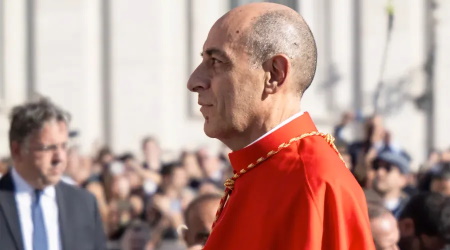
“We reiterate what has already been communicated,” wrote DDF prefect
Cardinal Victor Manuel Fernandez, “the episcopal ordinations announced by
the Priestly Fraternity of Saint Pius X do not have the requisite papal
mandate.”
“This act will constitute ‘a schismatic act’ (John Paul II, Ecclesia Dei,
no. 3) and ‘formal adherence to the schism constitutes a grave offence
against God and entails the excommunication established under Church law’
(ibid., 5c; cf. Pontifical Council for Legislative Texts, Explanatory Note,
24 August 1996).”
The canonical crimes and consequences of the SSPX’s planned episcopal
consecrations have already been made clear, and explained for those directly
involved — that is to say those who impart or receive ordination as a bishop
without a papal mandate.
But as the date of the proposed schismatic act draws near, some Catholics
have begun to ask what the effects will be for the priests and laypeople who
have joined the SSPX, or who regularly attend its liturgies.
So who, exactly, is going to be excommunicated? What is the nature of the
impending schism? And who, exactly, becomes a “schismatic” if it all goes
ahead as planned?
The Pillar explains.
Remind me again, what exactly is the SSPX planning to do, and
why is it a crime?
Episcopal consecration without a papal mandate — a bishop ordaining a man
as a bishop without the explicit permission or instruction of the Bishop of
Rome — is a specific crime in canon law, which carries the penalty of a
latae sententiae excommunication.
This means the bishop who does the consecrating and the one who is
consecrated are both excommunicated by the act itself.
The SSPX superior has repeatedly made it clear in recent months that he
knows this, and is going to do it anyway.
So consecrating a bishop without a papal mandate is what canon
law means by ‘schism?’
In 1988, Pope St. John Paul II stated directly that SSPX founder
Archbishop Marcel Lefebvre’s plan to consecrate bishops without a papal
mandate would constitute an act of schism.
John Paul wrote that “this act was one of disobedience to the Roman
Pontiff in a very grave matter and of supreme importance for the unity of
the Church, such as is the ordination of bishops whereby the apostolic
succession is sacramentally perpetuated. Hence such disobedience - which
implies in practice the rejection of the Roman primacy - constitutes a
schismatic act.”
He also wrote that “the root of this schismatic act can be discerned in
an incomplete and contradictory notion of Tradition. Especially
contradictory is a notion of Tradition which opposes the universal
Magisterium of the Church possessed by the Bishop of Rome and the Body of
Bishops.”
After illicit episcopal consecrations, a penalty of excommunication was
formally declared by John Paul II against SSPX bishops, and then remitted by
Benedict XVI, who hoped that lifting the penalty would be part of an effort
to reunite the group with the Church’s hierarchy.
And as Cardinal Fernandez made clear on Wednesday, if the consecrations
go ahead in July, the SSPX will be committing the same act their previous
leaders did in 1988, for the same reasons, and will incur the same
consequences.
If the SSPX consecrations happen, who actually commits the
schism — the bishop consecrating, the bishops being consecrated, or everyone
in the room?
Well, according to the norms of canon 1387, those who perform and receive
the consecration are excommunicated because of the illicit consecration
itself.
As for who commits the schism, the same men are obviously and directly
committing an act of schism as described and defined by the Holy See, both
by St. John Paul II and by recent warnings and clarifications issued by the
DDF.
But Cardinal Fernandez made a very important point on Wednesday — one not
noticed by every reader.
The DDF’s statement said two things.
First, that the episcopal consecrations are an act of schism.
Second, that “formal adherence to the schism constitutes a grave offence
against God and entails the excommunication established under Church law.”
That means something in canon law: That those who formally associate
themselves to the schism of the organization’s leadership can incur their
own excommunication. It’s a broad and significant statement — and one worth
diving into.
Well, what does ‘formal adherence to the
schism’ mean — how does a person formally or informally adhere?
Now we’re getting into the canonical nitty-gritty of this situation.
While the term “formal adherence” might seem very vague, it was actually
defined back in 1996 by the Pontifical Council for Legislative Texts, now
the Dicastery for Legislative Texts, in reference to the schismatic nature
of the SSPX.
The explanation said that “such adherence must imply two complementary
elements:
one [element] of an internal nature, consisting in freely and
consciously sharing the substance of the schism, that is, in opting in
such a way for the followers of Lefebvre that this option is placed
above obedience to the pope (at the root of this attitude there will
usually be positions contrary to the Magisterium of the Church);
another [element] of an external nature, consisting in the
externalization of that option, the most evident sign of which will be
the exclusive participation in the Lefebvrian ‘ecclesial’ acts, without
taking part in the acts of the Catholic Church (this is, however, a
non-univocal sign, since there is the possibility that some faithful may
take part in the liturgical functions of Lefebvre’s followers without
sharing their schismatic spirit).”
In other words, a person could share in the schism of SSPX’s leaders —
and be subject to the same excommunication — if he placed the SSPX and its
actions above obedience to the pope, and manifested that disposition by some
external action, which could include exclusive participation in SSPX
liturgies.
Does that mean everyone goes to an SSPX Mass after July 1 is
committing schism?
Not necessarily.
According to the Vatican’s statements, there is clearly some room
for at least some people to participate in SSPX liturgies either
without agreeing with the group’s schismatic actions, or without
sufficiently manifesting that agreement externally, even if they do go to
SSPX liturgies.
That’s among the reasons, for example, that attending Sunday Mass at an
SSPX chapel has not been ruled out as a way to meet the Sunday obligation.
In short, there is a grey area of connection to the SSPX.
But the Vatican has been clear that this grey area does not cover every
lay person, and does not seem to cover SSPX clergy at all.
“In the case of the Lefebvrian deacons and priests, it seems clear that
their ministerial activity within the schismatic movement is a more than
evident sign that the two requirements mentioned above (n. 5) are met and
that there is therefore a formal adherence,” the 1996 guidance says.
“In the case of other faithful, however, it is obvious that occasional
participation in liturgical acts or activities of the Lefebvrian movement,
without adopting the movement’s attitude of doctrinal and disciplinary
disunity, is not sufficient to constitute formal membership in the movement.
In pastoral practice, it may be more difficult to assess their situation.”
TL;DR: In 1996 the Vatican said that SSPX clergy would seem to meet the
requirements to be declared in schism — and be excommunicated — but that not
all laypeople who attend their chapels meet those requirements.
If this document was issued in 1996, does that mean SSPX clergy
have been excommunicated for schism all that time?
Well, here’s what can be said. The Pontifical Council for Legislative
Texts guidance indicated that SSPX priests and deacons meet the requirements
of “adhering to schism” — and thus to incur the penalty of excommunication.
But, even if actually incurred, the Apostolic See has not formally
declared those priests to be in schism, or declared their excommunication.
And in recent decades, the Vatican has used other language to describe
the SSPX’s status — using phrases like “imperfect communion.” At least some
experts view that rhetoric as an exercise in politely veiled language;
figuring that one is either in communion, or one is in schism, whether
material or formal.
For some, the status of the group has seemed a bit muddled since Pope
Benedict XVI lifted in 2009 declared excommunications on the surviving SSPX
bishops, leading some to claim a new status, or era, for the entire society.
But when he lifted those excommunications, the pope aimed to clarify that
his move was personal, not institutional, and changed nothing for the
society as a group.
Benedict explained that “The excommunication [and its lifting] affects
individuals, not institutions. An episcopal ordination lacking a pontifical
mandate raises the danger of a schism, since it jeopardizes the unity of the
College of Bishops with the Pope.”
“The remission of the excommunication was a measure taken in the field of
ecclesiastical discipline: the individuals were freed from the burden of
conscience constituted by the most serious of ecclesiastical penalties,”
Benedict wrote.
“In order to make this clear once again: until the doctrinal questions
are clarified, the Society has no canonical status in the Church, and its
ministers – even though they have been freed of the ecclesiastical penalty –
do not legitimately exercise any ministry in the Church.”
In other words, Pope Benedict was clear that he intended his act —
lifting excommunications — to be a personal act, for those particular
bishops, and not a kind of institutional approval.
After that, the matter got even more complex.
In the 2015 Year of Mercy during the pontificate of Francis, SSPX clerics
were given confessional faculties, and also delegation to witness marriages.
And while that was framed as an act of mercy toward the laypeople who attend
SSPX chapels, it indicated a solicitous Vatican approach to the SSPX.
That’s why the statement from Fernandez this week has been taken as such
a strong statement.
The language Fernandez used this week — and the citations in his
statement — would seem to suggest a return to a more exacting legal standard
for the treatment of SSPX priests and deacons — a move away from the
conciliation of Benedict and Francis, toward the hardline stance to the
group of Pope St. John Paul II.
OK, but if SSPX priests are in schism, does that mean their
sacraments are invalid?
You might reasonably expect that, but actually no, not according to the
law.
Excommunicated clergy are, among other sanctions, prohibited from
“exercising any ecclesiastical offices, duties, ministries or functions,”
from “celebrating the Sacrifice of the Eucharist and the other sacraments,”
and “from administering sacramentals and from celebrating the other
ceremonies of liturgical worship.”
But being prohibited from doing a thing is not the same as being
incapable of doing it — if they were the same, then the episcopal
consecrations in July could just be declared invalid and there would be a
lot fewer headaches for the Vatican.
There is no question that priests of the SSPX can celebrate Mass validly.
And since 2015, priests of the SSPX have had the faculty to hear
confessions validly in all circumstances, not only in danger of death.
Regardless of what happens in July — and even if an excommunication were
declared against the priests of the SSPX — that faculty would have to be
explicitly revoked to render their confessions invalid.
But while sacraments administered by SSPX clergy would still be valid —
even if there was a return to the general state of schism and
excommunication — there is still the legal expectation that the Church’s
proper authorities would take steps to stop them from offering sacramental
ministry.
In fact, canon 1331 states that if an excommunicated cleric is attempting
to offer a sacrament, he “is to be removed, or else the liturgical action is
to be suspended, unless there is a grave reason to the contrary.”
The reason for this is that medical penalities like excommunication —
called censures — have as their primary aims the reform of the offender and
the avoidance or mitigation of scandal to the wider community. That is why
there is also a significant canonical difference between the external
effects of a penalty like excommunication, depending on whether it has been
publicly declared by a competent authority, or simply incurred automatically
but not yet declared.
The law presumes that the excommunicated cleric would be in a place where
the liturgy could be suspended by Church officials — imagine an
excommunicated cleric trying to offer Mass in an ordinary diocesan parish
church, for example.
But because the SSPX have their own buildings, it seems unlikely that
diocesan bishops would have much success suspending their liturgical
celebrations.
Still, the law articulates an expectation that the illicit celebration of
sacraments will be stopped by competent ecclesiastical authorities — and
leaves to individual bishops the discernment about the degree to which that
is possible for them.
So what about ordinary laypeople who go to SSPX liturgies?
What’s their status?
Well, here things get a little complicated.
In order for a crime like schism to be committed, it is necessary that
there be both an internal disposition and intention to commit the crime (as
defined by the competent ecclesiastical authority) and an external
manifestation of the internal disposition — a clear and unambiguous act
which allows the Church to judge acted on the internal intention.
As we have seen, the Vatican has made it clear that just occasionally
attending SSPX liturgies doesn’t qualify as a sufficient external
manifestation of “adhering” to the society’s schism.
But the 1996 PCLT text cited by Cardinal Fernandez does say that “the
most evident sign [of adhering to schism] will be the exclusive
participation in the Lefebvrian ‘ecclesial’ acts, without taking part in the
acts of the Catholic Church.”
That means it is at least possible for the Church to consider as
schismatic — and subject to excommunication — a person who chooses to attend
only SSPX liturgies, especially if schism is formally declared for leaders
after the planned July episcopal consecrations.
The PCLT cautioned that possibility would have to be considered on a
“case-by-case basis” — but it remains to be seen whether the Vatican will
continue emphasizing that possibility — as its statement’s citations did
this week — after the expected consecrations in July.
Moreover, diocesan bishops can legislate in their own dioceses to remove
any ambiguity about the question.
But the PCLT has emphasized that the moral questions about attending SSPX
liturgies are the ones most important for Catholics to consider.
In other words, Catholics might not be declared in schism for attending
SSPX liturgies.
But as the group’s communion with the Church becomes ever more fractured,
Catholics who want to be obedient to the Church — and avoid even an
undeclared-but-still-very-serious excommunication — have to consider
seriously their own obligation to maintain ecclesial communion.
"The judgment of your God is
not akin to the judgment of man. The Eternal Father will only judge by the
heart. Your rank, your accumulation of worldly goods does not set you up before
another. Many have sold their souls within the holy House of God. Better that
you strip yourself and remove all worldly interests now while you have the time
to make amends to your God, for many mitres will fall into hell."- St. Thomas Aquinas, August 21, 1972
When you
pray the Holy Rosary, you have Our Lady's hand in yours. When you pray the
Holy Rosary, you have the power of God in your hands. Start now! Click
here...
Our Lady of
the Roses Awesome Bayside Prophecies...https://www.tldm.org/Bayside/ These prophecies came from Jesus, Mary, and the saints to Veronica
Lueken at Bayside, NY, from 1968 to 1995.
 These Last Days News - May 20, 2026
 The
Virgin Mary's Bayside Prophecy Books are Now Available in E-book Version.
Click Here Now!
The
Virgin Mary's Bayside Prophecy Books are Now Available in E-book Version.
Click Here Now!

