 These Last Days News - April 8, 2026
Russia, China and the Middle East are theaters where Western strategic illusions tend to erode too slowly -- almost politely -- until reality forces its way through.
The rulers of the Middle East learned long ago -- from the United States falling for their Charlie Brown football routine every time -- how to outwit the West or outlast it.
With the Gaza Strip, US President Donald J. Trump sets up a "Board of Peace" ostensibly to oversee the permanent disarmament of Hamas, only to pack it with Islamists dedicated to waging war, who have no interest in seeing any kind of peace, and then turns his attention elsewhere while Hamas comfortably builds up its power base again.
In Syria, when Saudi Arabian Crown Prince Mohammed bin Salman strongly suggested in May 2025 that Trump recognize Ahmed al-Sharaa -- an al-Qaeda terrorist leader with a US $10 million bounty on his head -- as president of Syria, Trump replied, with a gratifying flash of skepticism:
"[A]fter discussing the situation in Syria with the Crown Prince, your Crown Prince, and also with President Erdogan of Turkey who called me the other day and asked for a very similar thing... I will be ordering the cessation of sanctions against Syria in order to give them a chance at greatness. Oh, what I'd do for the Crown Prince."
Meanwhile, to the presumed delight of both Erdogan and Mohammed bin Salman, al-Sharaa has been using his "chance at greatness" to unobstructedly massacre Christians, Druze, Kurds and Alawites throughout Syria.
Turkish journalist Uzay Bulut recently noted:
"Following al-Sharaa's December 2024 seizure of power in Syria, persecution of religious minorities, including Christians, Druze and Alawites, has skyrocketed as the country undergoes a process of radical Islamization....
"U.S. President Donald J. Trump should never have allowed HTS and al-Sharaa – who justifiably had a $10 million bounty placed on his head by the U.S. State Department – to use Syria to entrench Sunni Islam by jihad (holy war). Al-Sharaa should be replaced at once."
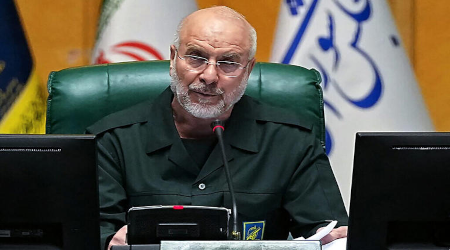
In Iran, it looks as if Trump might be about to repeat these catastrophes by allowing Mohammad Ghalibaf, speaker of Iran's Majlis (parliament) and a longtime hardline Islamist, to continue tormenting Iran's betrayed citizens. If "HELP IS ON ITS WAY," as Trump promised, this sure is not it.
Iran rarely bothers with subtlety. It operates through interlocking religious, military and political layers, yet the coherence of its system remains absolute. Once again, Washington risks misreading that coherence by projecting onto the regime internal factional distinctions that simply do not exist.
The latest case is almost textbook: The recurring suggestion, echoed in some of Trump's pronouncements and in certain Western analyses, that Ghalibaf represents a form of "moderation" within Iran's regime is not merely inaccurate; it is wildly misleading. It reflects the West's persistent error of confusing tactical variations with genuine ideological divergence, and mistaking longtime regime insiders for potential reformers.
Ghalibaf is not a moderate. Ghalibaf has never been a moderate. He is a product of the Islamic Republic of Iran in its purest form — a man forged inside the Islamic Revolutionary Guard Corps (IRGC), shaped by its doctrines, promoted through its networks, and sustained by its system of power. His entire career path runs directly in the opposite direction of anyone diverging from the regime. He is a military officer who entered politics as an extension of the regime's coercive apparatus.
Appointed by then Supreme Leader Ali Khamenei, Ghalibaf commanded the IRGC's Aerospace Force from 1997 to 2000. He then served as chief of Iran's national police (Law Enforcement Command) from 2000 to 2005, a period that included the brutal suppression of the 1999 student protests. From 2005 to 2017 he was mayor of Tehran. He was elected to the Majlis in 2020 and chosen as speaker on May 28, 2020 — an office to which he has been repeatedly re-elected, most recently in May 2024.
Each of these positions represents not a departure from hard power, but a different expression of it. In Iran, there is no clean separation between military and political authority — only continuity. Ghalibaf embodies exactly that.
The illusion of his "pragmatism," as with Syria's al-Sharaa, has been carefully cultivated, both domestically and abroad. Compared to more overtly ideological figures, Ghalibaf sometimes adopts the language of efficiency, governance and economic management. He speaks of fighting corruption, modernization and administrative reform. For Western observers eager to identify "moderates" inside the Iranian system, these "assurances" are often sufficient. Yet this is precisely where the misunderstanding begins.
In the Iranian political lexicon, "pragmatism" does not mean moderation in the Western sense or any willingness to compromise on the regime's core principles. It means the operational skill to manage power effectively while keeping the ideological core intact. Ghalibaf is not softening the regime — he is optimizing its operations. His record does not leave much ambiguity.
As a senior IRGC figure, he belonged to the institution responsible for projecting Iranian power abroad through proxy militias and asymmetric warfare. As police chief, he oversaw security forces during periods of domestic unrest, contributing to the machinery that suppresses dissent with efficiency and, when necessary, force. Allegations of corruption have dogged him for years — not as isolated scandals, but as symptoms of how power circulates in the system through patronage, loyalty and control of economic networks linked to the security apparatus.
None of this places him in the margins. It places him at the center. His role as Majlis speaker since 2020 only reinforces this reality. In Western parliamentary systems, legislative leadership may signal pluralism and institutional independence. In Iran, the Majlis operates within strict boundaries set by the Supreme Leader and enforced by the Guardian Council, which vets candidates for the Majlis and reviews legislation for compatibility with Islamic law and the constitution. The speaker is not a counterweight to the system. He is one of its key instruments — tasked with managing the legislative expression of strategic priorities, maintaining internal cohesion, and preserving the façade of "elected" governance.
Amid the conflict with Israel and the United States, Ghalibaf has emerged as a central figure in shaping the regime's internal and external messaging. On March 23, 2026, he publicly rejected any notion of direct negotiations with Washington, dismissing reports of talks as "fake news" intended "to manipulate the financial and oil markets and to escape the quagmire in which America and Israel are trapped."
These statements were not signs of independence so much as exquisitely aligned with the regime's strategic posture: resistance, denial of vulnerability, and refusal to appear to negotiate under pressure. That is not the language of a moderate seeking de-escalation. It is the calibrated response of a system that understands the value of controlled confrontation.
Trump's foreign policy often focuses on identifying points of leverage — figures within adversarial systems who might respond to pressure, incentives or transactional deals. In some contexts, this approach can produce results. It requires, however, accurately identifying who actually holds autonomous decision-making power.
In Iran, that power does not reside in the parliament or its speaker. It resides with the Supreme Leader – currently the son of Ali Khamenei, Mojtaba Khamenei, who is reportedly badly wounded -- or his inner circle and the security apparatus that supports the system. Figures such as Ghalibaf are not alternative centers of authority. They are extensions of the same core.
Treating Ghalibaf as a potential interlocutor and possible future leader — or worse, as a supposedly moderating influence — risks engaging with the regime in ways it has mastered for decades: presenting the appearance of diversity while preserving absolute unity. Tehran has long perfected this duality — showing multiple faces to the outside world while ensuring that all meaningful decisions converge on the same ideological objectives. The familiar Western narrative of "moderates versus hardliners" within the regime reflects Western hopes, not Iranian reality.
Internal differences certainly exist within the regime, but they concern methods, timing and priorities — not ultimate goals. The preservation of the Islamic Republic, its influence across the Middle East, its confrontation with Israel, and its long-term challenge to American presence in the region remain constants. Ghalibaf operates entirely within this framework. He does not question it; he advances it.
Misreading figures like Ghalibaf can lead to policy miscalculations: overestimating prospects for a diplomatic breakthrough, underestimating the regime's cohesion, and misinterpreting the signals it sends. When Tehran speaks through Ghalibaf, it is not testing moderation. It is carefully reinforcing its position, probing reactions, and preserving its future. Every statement is deliberate.
Europe, which has repeatedly sought to engage perceived "moderates" in Iran, should recognize this pattern from years of negotiations followed by repeated breakdowns. Changes in tone have rarely produced changes in behavior. For Washington, any analysis of exploitable internal divisions needs to be grounded in reality, not in wishful thinking.
This tendency extends beyond Iran. Western strategic culture often searches for "reasonable" counterparts inside adversarial systems — hoping that behind the rhetoric lie actors who "think like us" and can be persuaded or transformed. Sometimes this approach works. In Iran's current power structure, it is misplaced.
Ghalibaf is not a bridge to the West. He is not a reformer-in-waiting. He is not a pragmatic counterweight to ideological hardliners. He is one of them — more disciplined in his language and polished in presentation, but fully aligned in substance. Labeling him a moderate is not only wrong. It unintentionally lends credibility to the regime's own narrative.
Trump is right to approach Iran from a position of strength and to reject illusions of easy compromise. But strength demands being able, with clarity, to identify the nature of the actors involved. Ghalibaf, unfortunately, does not represent an opening. He represents continuity of the same system, the same objectives, and the same willingness to wield power, internally and externally, to ensure his own and the regime's survival.
The Islamic Republic of Iran does not produce moderates in the Western sense. It produces highly effective operatives. Ghalibaf is among its most accomplished. Mistaking expediency for moderation, however, is exactly the kind of Western error that regimes such as Iran's have learned to exploit with consistency – and the obliging complicity of the West.


