 These Last Days News - March 31, 2026
We
encourage everyone to share this web page with others, especially bishops
and clergy.
La Croix: Will France Be The Papal Setting For The End Of Restrictions To The Latin Mass?
SAFEGUARD
"My child and My children, I need not
repeat to you the necessity to retain tradition. It was like a valve, a
safeguard from the eruption of My Son's Church, a schism, a division within My
Son's House upon earth. I cry unto you, your Mother, as I hasten back and forth
bringing you the Message, the counsel from Heaven. You must recognize--bishops,
cardinals and pastors, you must recognize what is happening now in My Son's
House." - Our Lady of the Roses, September 7,
1978
THE FOUNDATION
"My Basilica, My child, will be built
on a firm foundation of Faith. Tradition cannot be placed aside from Faith.
Together they are the foundation." - Our Lady of
the Roses, December 6, 1974
The above Messages from Our Lady were given to Veronica Lueken at Bayside, New York. Read more
Rorate-Caeli.blogspot.com reported on March 30, 2026:
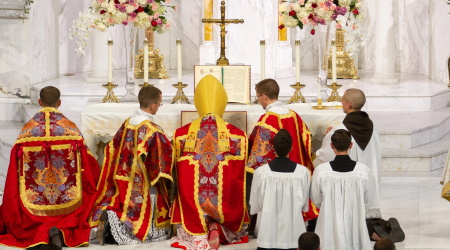
The semi-official daily of the Catholic Church in France, La Croix, published today a long piece developing some points about the papal message to the bishops of France on the Traditional Latin Mass.Will France, through Cardinal Aveline, be chosen by Pope Leo XIV as the training ground of how he plans to proceed with Traditionis custodes in the rest of the world?
Due to the relevance of the whole piece, we have tried to present it as faithfully as possible below:
Tridentine Mass: Will France Find the Solution to the "Traditional Question" in the Church?
La Croix
By Céline Hoyeau and Gonzague de Pontac, in Lourdes (Hautes-Pyrénées),
with Matthieu Lasserre
March 30, 2026
While liturgy may be on the agenda of the next consistory in Rome in June 2026, the bishops of France gathered in Lourdes in late March to discuss the position to adopt toward communities attached to the Tridentine Mass.
Will the solution to the "traditional question" come from France? Expectations from Rome seem clearly high: according to our sources, Pope Leo XIV personally expressed to Cardinal Jean-Marc Aveline, during the January consistory, his wish that the cardinal explore avenues for resolving the tensions surrounding the Tridentine liturgy — should the Motu Proprio of Francis, which drastically restricted the celebration of the Mass according to the old rite after the opening permitted by Benedict XVI in 2007, be upheld? Abolished? Or might a third way be proposed? "Leo XIV is concerned about unity. He is extremely interested in the question and asked us to think something through," confirms one bishop.
For while other countries — the United States chief among them — have significant traditionalist communities, France, where this movement was born, remains its epicenter, both by virtue of the vitality of its faithful — as illustrated by the success of the Chartres pilgrimage at Pentecost — and by the persistent tensions in dioceses. "For the Pope, what is done in France serves as a model," estimates another bishop who has spoken with Leo XIV about the matter.
Acceptance of Vatican II as the Underlying Issue
Entrusted with this mission, and as liturgy has been designated one of the cardinals' working priorities by Leo XIV — and may appear on the agenda of the June consistory — the bishops of France devoted a session to the theme "Liturgy and Tradition" during their Spring Assembly, on Thursday, March 26, in Lourdes. "There is a shared willingness to truly get to the bottom of things," reports Bishop Olivier de Cagny, Bishop of Évreux, who was in charge of the session along with others responsible for liturgical questions at the French Bishops' Conference. "It is the first time I have heard so clearly that the subject must be addressed at a theological level, and not merely in a pastoral and emotional way," he observes.
Indeed, all the bishops broadly share the same diagnosis: the Mass is not, in reality, the central issue. "Behind the liturgy lie problems of doctrine and ecclesiology — the question of acceptance of Vatican II," emphasizes one bishop who has several traditionalist communities in his diocese.
As several bishops note, the Church must also acknowledge certain excesses in the application of the liturgical reform and be attentive to what draws people today toward this liturgy: verticality, silence, a sense of the sacred… These are notions that are nonetheless ambivalent and sometimes idealized. "Behind the attraction to beauty and the sacred, there is an entire theological debate that some do not perceive: a God who remains distant versus a God who draws near — that encompasses an entire relationship to the world, to freedom of conscience, to interreligious dialogue," warns a bishop from the Southeast.
Tradition: A Word That Is "Loaded and Often Misunderstood"
Several bishops raised the need for substantive work on the concepts of "sacred," "sacrament," and above all "tradition" — a word described as "loaded and often misunderstood." "I would dream of being able to include representatives of traditionalist communities, including monasteries, in this reflection," suggests Bishop de Cagny.
As for the political dimension — which resurfaced with the death of Quentin Deranque, a young convert with neo-fascist ties who also frequented a traditionalist community in Lyon — "behind the liturgy, there can sometimes also be a political-religious ideology, which veers into antisemitism in certain traditionalist circles," notes one bishop. "The liturgy is a world unto itself, and it gives rise to a worldview," analyzes Bishop de Cagny. "It is impossible for it to have no connection to our political vision as well. Hence the need for vigilance regarding attachment to the liturgy and the way it is promoted."
Accommodations Under Conditions
While the majority of the Assembly showed itself determined to tackle the subject head-on, several positions emerged: some, aligned with the Motu Proprio of Francis, expect the same firmness from Leo XIV; others are open to accommodations, but only under certain conditions — a common lectionary and liturgical calendar, the celebration of the other sacraments (baptism, marriage, confirmation…) according to the new rite (possibly in Latin), a return to episcopal responsibility within each diocese, and above all, an end to "exclusivism" — that is, the strict refusal to celebrate according to the new missal, which the bishops consider "unacceptable" (and contrary to the spirit of Benedict XVI's Motu Proprio, which called for "mutual enrichment").
Several bishops expressed incomprehension at the refusal of priests of the Fraternity of Saint Peter, in particular, to join the diocesan bishop at the Chrism Mass (which is obligatory in the spirit of canon law, even if not formally spelled out), and weariness at what they perceive as "an unclear attitude," even "a double standard" — citing notably the threats that certain seminarians reportedly faced of being expelled from their seminary should they celebrate or concelebrate the Paul VI Mass.
"Many of these young priests have a great missionary zeal and could help us in our dioceses if they agreed to celebrate in both rites," laments another bishop. "The liturgy touches the deepest part of the human person — it is natural that it stirs passion and debate, but not to the point of forming communities that fight one another or ignore each other," observes Bishop de Cagny, who stresses the importance of a single rite — "which allows everyone, whatever their sensibility, to coexist in a common prayer." A unity that could well be prophetic: "In the years ahead, the Church may be the only place where very different people coexist. The Eucharist is at the heart of that, for it is the sacrament of charity and unity."
Whatever solution is chosen, Leo XIV "will not be able to avoid a clarification," one bishop underscores, recalling the exceptions granted by Pope Francis to certain traditionalist communities after Traditionis Custodes — which have rendered that Motu Proprio "difficult to apply.
Be sure to email this page to all your friends.
"The judgment of your God is not akin to the judgment of man. The Eternal Father will only judge by the heart. Your rank, your accumulation of worldly goods does not set you up before another. Many have sold their souls within the holy House of God. Better that you strip yourself and remove all worldly interests now while you have the time to make amends to your God, for many mitres will fall into hell." - St. Thomas Aquinas, August 21, 1972
 The
Virgin Mary's Bayside Prophecy Books are Now Available in E-book Version.
Click Here Now!
The
Virgin Mary's Bayside Prophecy Books are Now Available in E-book Version.
Click Here Now!
When you pray the Holy Rosary, you have Our Lady's hand in yours. When you pray the Holy Rosary, you have the power of God in your hands. Start now! Click here...
Our Lady of the Roses Awesome Bayside Prophecies... https://www.tldm.org/Bayside/ These prophecies came from Jesus, Mary, and the saints to Veronica Lueken at Bayside, NY, from 1968 to 1995.
Directives from Heaven... https://www.tldm.org/directives/directives.htm
D36 - Bishops (Part 1)
D37 - Bishops (Part 2)
D38 - Priests (Part 1)
D39 - Priests (Part 2)
D40 - Infiltrators

| Home - Latest News | Introduction | Bayside Prophecies | Directives from Heaven | Shopping Cart | Miracles & Cures | Veronica Lueken | Miraculous Photos | Bible | Radio Program | Bayside Videos |
The electronic form of this document is copyrighted.
Quotations are permissible as long as this web site is acknowledged with a
hyperlink to:
http://www.tldm.org
Copyright © These Last Days Ministries, Inc. 1996 - 2025 All rights
reserved.
P.O. Box 40
616-698-6448
Lowell, MI 49331-0040
Revised: March 31, 2026

