 These Last Days News - January 8, 2026
We
encourage everyone to share this web page with others, especially bishops
and clergy.
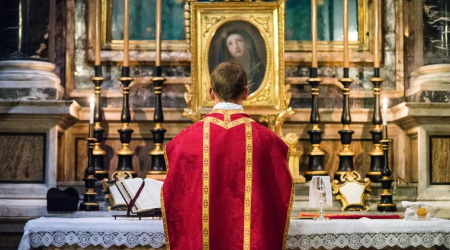
Minnesota Diocese Gives ‘Ad Orientem’ Worship a Shot...
BREAD OF LIFE
"I left with you the Bread of life; I
gave Myself to you. I am always among you in the tabernacles of your world. No
man shall enter the Kingdom unless he eats of the Bread of life."
- Jesus, May 26, 1976
REVERENCE
"My children, you must join your hands in
reverence at the Sacrifice of My Son. It is an expression of love, gratitude,
and respect. Reverence and respect and holiness must be returned to My Son's
Houses, Churches, throughout the world, reverence, holiness, and respect from
the beginning to the end of the sacred service!" -
Our Lady of the Roses, September 6, 1975
The above Messages from Our Lady were given to Veronica Lueken at Bayside, New York. Read more
NCRegister.com reported on January 7, 2026:
By Jonathan Liedl
At a time when traditional expressions of worship are being curtailed by some bishops, the leader of one diocese in northeastern Minnesota is taking a different approach: letting parish communities give it a go.
Over the past year, Bishop Daniel Felton of the Diocese of Duluth has provided guidance for nine diocesan parishes to regularly celebrate Mass ad orientem on a trial basis after local pastors made the request.
And at least in some of the parishes, the results seem to be bearing fruit.
“With proper teaching, it’s tremendous how much people have embraced it,” said Angie Gadacz, 47, a parishioner at St. Francis Catholic Church in Brainerd, who had limited exposure to ad orientem before it began to be used one Sunday a month throughout 2025.
Meaning “to the east,” the ad orientem posture involves both the priest and the lay faithful facing the same direction at Mass, especially during the Eucharistic consecration. Ad orientem emphasizes that all the faithful, through the mediation of the priest who acts in the person of Christ, participate in Jesus’ sacrificial offering to the Father, and was the norm before the reforms of the Second Vatican Council in the 1960s.
In an instruction Bishop Felton wrote to diocesan priests just before the start of 2025, he underscored that the post-conciliar practice of the priest facing the people (versus populum) has “been widely received,” and is aimed at enhancing participation by allowing the laity to see what takes place on the altar. At the same time, the Duluth bishop acknowledged that some Catholics believe that celebrating the Mass versus populum has resulted in the loss of “a certain ‘sense of transcendence,’” which they maintain is better conveyed ad orientem.
Bishop Felton stressed that “both postures merit mutual respect.”
“Priests who desire to implement the ‘ad orientem’ posture at Mass should agree not to denigrate a Mass celebrated facing the people, nor be dismissive of the priests or the people who have grown in holiness and love for the Mass facing the people,” wrote Bishop Felton. “Likewise, those priests who prefer the Mass facing the people should not be dismissive of the priests or people who find spiritual fruitfulness in a Mass celebrated using an ‘ad orientem’ posture and should be open and respectful to this.”
Duluth’s ad orientem trial period coincided with 2025’s Jubilee Year of Hope. And with the jubilee now complete, pastors of the communities where the ad orientem has been celebrated this past year will have to re-apply to Bishop Felton before continuing in 2026.
But already, Bishop Felton’s “come and see” approach strikes a notable contrast to how the ad orientem and other more traditional liturgical expressions have been dealt with in other parts of the country.
In Detroit, for example, Archbishop Edward Weisenburger banned the ad orientem from parish celebrations of Vatican II Mass in June 2025, just months after arriving to the archdiocese. Similarly, a leaked May 2025 memo from Bishop Michael Martin, leader of the Diocese of Charlotte since May 2024, expressed his desire to ban ad orientem from Novus Ordo Masses, though the measure has yet to be implemented.
“In order for the faithful to participate as the Council requires, visual engagement is necessary,” wrote Bishop Martin in the memo. “For this reason, the Church has been clear that ad orientem is not appropriate.”
In contrast, Bishop Felton, who has been the bishop of Duluth since 2021, seems open to discerning if the ad orientem posture can be spiritually beneficial, even if it hasn’t been a big part of his own liturgical experience.
“He has been able to see that this has value to people, and it’s a legitimate way in which we’re able to connect with our God,” said Father Jacob Toma, parochial vicar at St. Francis and All Saints in Baxter, regarding Bishop Felton’s approach. “He’s a good shepherd.”
Responding to a Desire
Unlike the Traditional Latin Mass, which refers to the form of the Roman Rite prior to the reforms of Vatican II, ad orientem is a posture that can be used in the celebration of the post-conciliar Mass. In fact, it has never been restricted at the universal level, and some theologians and liturgists maintain that the Missal issued after Vatican II and currently in effect even presumes that the Mass is being celebrated ad orientem.
But as Bishop Felton noted in his letter to Duluth priests, it is his apostolic mandate to supervise the sacred liturgy in his diocese for the good of the Church. His liturgical directives guiding the celebration of Mass ad orientem in Duluth’s parishes came with specific requirements that priests discuss their motivations with him, consult their parishioners ahead of time, and ensure that unity is preserved.
“If significant disunity in a parish, community, or region of the diocese occurs after adoption of this posture, and in weighing all of the evidence, the priest may be asked by the bishop in a desire to preserve unity to discontinue the posture for the celebration of the Mass,” wrote Bishop Felton.
In part, the movement toward ad orientem liturgy in Duluth reflects the diocese’s younger-than-average presbyterate. According to Father Toma, who himself is 28, the age of the average Duluth priest is a youthful 47, well below the national average. Like their Catholic lay peers, younger priests tend to be drawn to more traditional liturgical expressions.
At least among Duluth priests, Father Toma stressed that this turn toward tradition isn’t a rejection of Vatican II. Instead, it flows from younger priests’ desire to share what has been spiritually fruitful in their own lives.
“We love our parishioners,” he said. “And we love pastoral care.”
Father Toma added that the request for ad orientem in Duluth wasn’t a top-down clerical push. Instead, he says it was made by diocesan priests in order to meet an emerging desire in Duluth parishes—and pointed to data to back it up.
According to demographic data of the diocese collected by MissionInsite, 41% of people in the diocese said that “traditional worship experiences” were either very or somewhat important to them, with another 22% saying they were slightly important. The item ranked fourth highest on a list of 32 “program or ministry preferences,” and was considered more important than options like “spiritual discussion groups” and “involvement in social causes.”
Because the data also includes the responses of non-Catholics, Father Toma stressed that offering more traditional worship could be key for connecting with a wider culture searching for transcendence and an encounter with God.
“We can actually use this as a tool for evangelization, to give people an experience they’re actually wanting, something that could maybe tip the scale in conversion,” he said.
The Experience So Far
The nine parishes that celebrated Mass ad orientem in 2025 make up about 13% of Duluth’s 69 total parishes. Each participating parish offers the ad orientem differently, with St. Benedict’s in Duluth offering it every Sunday, while St. Joseph in Crosby and St. James in Aitkin have celebrated Mass ad orientem on the first Sunday of each month.
In the Brainerd area, one of the rural diocese’s population centers, the two pastors of four parishes have worked together to offer a cohesive ad orientem experience. Mass using the posture has been offered on the second Sunday of the month and the following Monday at all area parishes. On weekends when Mass is offered ad orientem, Mass celebrated versus populum is still offered at vigil on Saturday evening.
Father Toma stressed that during the introduction of the ad orientem, there has been a concerted effort to “avoid a whiplash effect, because disunity is not the language of the Holy Spirit.” Discernment and accompaniment have been major hallmarks at Brainerd Catholic parishes, with a dedicated webpage explaining ad orientem, bulletin inserts, and several teaching homilies on the posture at the start of the year.
“We wanted this to be a unified thing, where we didn’t allow people to be left behind,” explained Father Toma, who began 2025 as a parochial vicar at St. Mary Star of the Sea in Duluth, where ad orientem has also been introduced.
That doesn’t mean there haven’t been questions and raised eyebrows along the way. In particular, Father Toma says he has been asked if the change in posture means they’re “going back” to the Traditional Latin Mass.
“My response to this was always, ‘Look, everybody, Father Toma got a D in Latin, so that’s not possible.’ And that put people at ease,” he said with a laugh. The young priest stressed that the introduction of ad orientem isn’t about the TLM, but “is a question of how we worship together, and to focus on who is truly important, and that’s our Lord Jesus.”
Parishioners who spoke to the Register say they’ve appreciated the opportunity to experience Mass ad orientem.
“It is very important to me that my children grow up able to experience well-ordered worship that has transcendent meaning beyond just the visible,” said Kevin Ryan, a 33-year-old father of three who attends St. Francis. “I believe Mass celebrated ad orientem captures that reality in a much richer and evident way.”
Gadacz said that she doesn’t have a preference between ad orientem and versus populum, noting that both highlight different aspects of the mystery of the Eucharist. But she knows that others have found the introduction of the ad orientem helpful for “entering into the Mass,” including the priests that celebrate it.
“I know that priests that I have talked to personally say they can focus and pray the Mass better” ad orientem, she said. “And I think that helps a lot people, just to see the additional reverence.”
Both parishioners have also been impressed with the way the change has been introduced at St. Francis. Gadacz says she hasn’t heard a negative word about it, including from elder members of her parish ladies’ book group, who appreciate being given the “why” behind the liturgical posture that they experienced while growing up before Vatican II.
And Ryan added that while he would prefer that all parish Masses were celebrated ad orientem, the gradual, accompaniment-focused approach of St. Francis’s pastor, Father Michael Garry, has allowed more people to be on board with the change.
“I believe the way this was rolled out is an excellent model for any pastor looking to implement the ad orientem Mass at their own parish,” said Ryan.
Going Forward?
There is no word yet on what kind of guidance Bishop Felton will issue regarding Mass celebrated ad orientem in 2026. In his instruction for 2025, he stressed that participating pastors would need to have a “thorough discussion” with him “to evaluate continuing the practice moving forward.”
But Gadacz expressed her confidence in whatever Bishop Felton decides. Having gotten to know him during the diocesan stage Synod on Synodality, she’s convinced that his priority is building up the local Church, not taking a side in the ‘liturgy wars.’
“He doesn’t seem to have a preference one way or another,” she said. “He wants to listen to where the Holy Spirit leads.”
Be sure to email this page to all your friends.
"The judgment of your God is not akin to the judgment of man. The Eternal Father will only judge by the heart. Your rank, your accumulation of worldly goods does not set you up before another. Many have sold their souls within the holy House of God. Better that you strip yourself and remove all worldly interests now while you have the time to make amends to your God, for many mitres will fall into hell." - St. Thomas Aquinas, August 21, 1972
 The
Virgin Mary's Bayside Prophecy Books are Now Available in E-book Version.
Click Here Now!
The
Virgin Mary's Bayside Prophecy Books are Now Available in E-book Version.
Click Here Now!
When you pray the Holy Rosary, you have Our Lady's hand in yours. When you pray the Holy Rosary, you have the power of God in your hands. Start now! Click here...
Our Lady of the Roses Awesome Bayside Prophecies... https://www.tldm.org/Bayside/ These prophecies came from Jesus, Mary, and the saints to Veronica Lueken at Bayside, NY, from 1968 to 1995.
Directives from Heaven... https://www.tldm.org/directives/directives.htm
D36 - Bishops (Part 1)
D37 - Bishops (Part 2)
D38 - Priests (Part 1)
D39 - Priests (Part 2)
D40 - Infiltrators

| Home - Latest News | Introduction | Bayside Prophecies | Directives from Heaven | Shopping Cart | Miracles & Cures | Veronica Lueken | Miraculous Photos | Bible | Radio Program | Bayside Videos |
The electronic form of this document is copyrighted.
Quotations are permissible as long as this web site is acknowledged with a
hyperlink to:
http://www.tldm.org
Copyright © These Last Days Ministries, Inc. 1996 - 2025 All rights
reserved.
P.O. Box 40
616-698-6448
Lowell, MI 49331-0040
Revised: January 08, 2026

