 These Last Days News - July 21, 2026
We encourage everyone to share this web page with others, especially bishops and clergy.
NASA Issues Chilling Warning of Catastrophic Solar Storm Threat...
PROVISIONS
"How many shall be prepared? Do you have your candles? Do you have your water, your canned food, and your blankets? It will become an extremely cold day with the start of the tribulation, and you will welcome having these on hand, My children." - Jesus, November 1, 1985
OUR LADY'S PROMISE
"My children, you must all unite in prayer, link for link, using the sacramentals given to you from Heaven, the beads of prayer, your Rosary, the Scapular of life; for I promise you: All who wear the Brown Scapular shall never feel the fires of hell. Even the greatest of sinner will be converted and saved if he will wear the Brown Scapular when he passes over the veil, when he leaves, My child and My children, his body at the moment you call upon earth death. But I say unto you as your Mother, for My Son and all Heaven, there is no death! For you continue to live with full consciousness when you leave your body. Then, My child and My children, what will be your reaction if you have not used every means possible to store graces for a quick entrance into the Kingdom of your God?" - Our Lady of the Roses, August 14, 1979
The above Messages from Our Lady were given to Veronica Lueken at Bayside, New York. Read more
SlayNews.com reported on July 21, 2026:
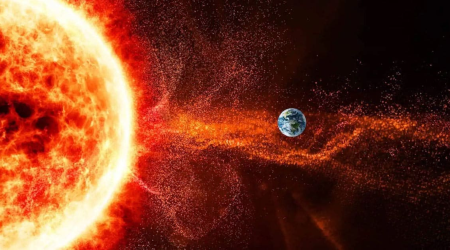
by Frank BergmanNASA researchers are warning that scientists may have dramatically underestimated the destructive potential of an extreme solar storm, raising concerns that a future event could cripple modern civilization on a scale far beyond previous forecasts.
A new study from researchers at NASA’s Goddard Space Flight Center challenges a long-standing assumption about how much energy Earth’s magnetic field can absorb from the Sun.
The findings of the study were published in the renowned Nature journal.
If the findings are correct, the consequences of a rare but powerful solar storm could be significantly worse than scientists have believed for decades.
Study Challenges Long-Held Theory
Solar storms occur when the Sun unleashes massive bursts of energy, charged particles, and magnetic fields through solar flares and coronal mass ejections (CMEs).
Those events can disrupt satellites, GPS systems, aircraft communications, electrical grids, telecommunications networks, and countless forms of modern infrastructure.
For years, researchers believed there was a natural upper limit to the amount of solar energy that could be transferred into Earth’s polar ionosphere.
The new NASA study casts serious doubt on that assumption.
After analyzing more than one million measurements of the solar wind collected by NASA spacecraft orbiting Earth, researchers found no statistical evidence that such a limit exists.
"There is currently no statistical evidence to suggest an upper limit to the energy transferred from the solar wind to the polar ionosphere," the researchers concluded.
That finding suggests Earth’s atmosphere may continue absorbing increasing amounts of energy during an extreme solar event rather than reaching a protective ceiling.
Experts Warn Extreme Events Could Be More Dangerous
Dr. Maria Walach of Lancaster University, a co-author of the study, said Earth’s magnetic field normally provides strong protection against space weather.
"Our planet’s magnetic field does a really great job of protecting us against many space weather effects," Walach said.
"There are, however, extreme cases where satellites unexpectedly fall back to Earth, or we lose communication and GPS signals…"
She warned that if there truly is no upper limit to Earth’s response to the solar wind, scientists will need to rethink how they model worst-case scenarios.
"If there is no upper limit to our planet’s response to the solar wind, modeling for extreme cases needs to take this into account, and we should be vigilant of space weather effects," Walach said.
"Fortunately, these very extreme cases are rare, but this also means we have limited data to work with and only time will tell what happens at the very extreme one-in-a-thousand-year kind of event."
Carrington Event Shows What Is Possible
The most powerful solar storm ever recorded remains the Carrington Event of 1859.
Scientists estimate it released energy equivalent to roughly 10 billion atomic bombs.
The storm caused widespread failures in telegraph systems across Europe and North America, with electrical currents surging through communication lines.
Even far less powerful solar storms have demonstrated the vulnerability of modern technology.
In 2003, a significant solar event disrupted Federal Aviation Administration navigation computers for more than 24 hours and prompted warnings that passengers and crews on high-altitude flights could receive elevated radiation exposure.
Modern Infrastructure Faces Greater Risk
Unlike the world of 1859, today’s society depends almost entirely on electricity, satellites, GPS navigation, internet communications, and interconnected power grids.
A major solar storm could simultaneously disrupt many of those systems.
A 2014 study conducted by Lloyd’s of London and Atmospheric and Environmental Research concluded that another Carrington-level event is "almost inevitable."
The study estimated that between 20 million and 40 million people could experience power outages lasting anywhere from 16 days to two years.
Groups such as the Foundation for Resilient Societies have long warned that America’s electrical grid remains dangerously exposed to severe space weather.
The organization has urged governments to harden transformers, transmission systems, and other critical infrastructure against electromagnetic disturbances, arguing that prolonged failures could cripple supply chains, medical services, communications, and other systems essential to maintaining public order.
NASA’s latest findings suggest the threat posed by an extreme solar storm may be even greater than previously understood, raising fresh questions about whether existing infrastructure is prepared for a once-in-a-generation, or even once-in-a-millennium, space weather event.
Be sure to email this page to all your friends.
PRAY YOUR LEADERS WILL RECOGNIZE THE SIGNS
"Pray, My children, a constant vigilance of prayer. Pray that your leaders will recognize the signs given by your God. Shall these increase in volume: the earthquakes, the pestilence, the fires, the floods, the great heat? My children, who holds the balance for this? You, My children, do! The merciful heart of the Father watches patiently, but I repeat: the sands are fast running out of the hourglass.
Shout the Message from Heaven from the rooftops! Do not slacken in your mission from Heaven. Remember, My children: there is no man or woman upon this earth that you must explain yourselves to in this mission, for you are directed by the Eternal Father in Heaven in My Son and the Holy Spirit." - Our Lady of the Roses, March 18, 1977
DISASTERS SHALL INCREASE
"Great elemental tragedies, disasters, man-made and God-sent upon mankind, shall increase in volume, shall increase in intensity and numbers. Remember, My children, you do not understand the supernatural, for there will be accidents that are not accidents.
Retain all of the knowledge of your Faith in the hearts of your children. Do not be lax, parents, for you will cry bitter tears of anguish if you are. The angel of death will approach the homes of many. Are you prepared now? Have you set your house in order? Do not be caught unawares, My children. My Mother has been among you for many years preparing you for these times. Recognize the signs about you. Act upon them and you will not be lost." - Jesus, May 26, 1979
 The Virgin Mary's Bayside Prophecy Books are Now Available in E-book Version. Click Here Now!
When you pray the Holy Rosary, you have Our Lady's hand in yours. When you pray the Holy Rosary, you have the power of God in your hands. Start now! Click here...
Our Lady of the Roses Awesome Bayside Prophecies... https://www.tldm.org/Bayside/ These prophecies came from Jesus, Mary, and the saints to Veronica Lueken at Bayside, NY, from 1968 to 1995.
Directives from Heaven... https://www.tldm.org/directives/directives.htm
 PDF
PDFD60 - The Great Comet Chastisement (Part 4)
PDFD61 - The Great Comet Chastisement (Part 5)
PDFD62 - The Great Comet Chastisement (Part 6)
PDFD139 - Preparations: Spiritual
PDFD140 - Preparations: Material
PDFD133 - The Apocalypse / Revelations
PDFD154 - Plague and Pestilence
PDFD417 - Bible Prophecies
PDFD578 - Natural Disasters
PDF