 These Last Days News - March 12, 2026
We
encourage everyone to share this web page with others, especially bishops
and clergy.
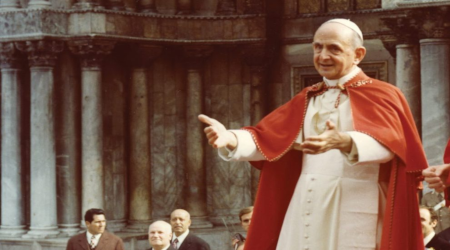
Paul VI and the Liturgical Reform: Documented Papal Interventions in the Novus Ordo...
POPE PAUL SIGNS DOCUMENT UNDER DURESS
Veronica - Now it's
growing dark. And Our Lady is pointing with Her finger over to the left side
of the flagpole. Oh, I see the inside of a large room. And sitting at a desk
I can see Pope Paul. He's signing a paper. Now he's placed the pen down and
he's going over to a kneeler; he has a kneeler before a very large statue of
Our Lady. Oh! He is . . . I don't understand his words.
Now Our Lady
is coming over, and She is saying:
Our Lady - "I will repeat them for
you, My child. The heart of your Vicar cries in anguish, 'Mother Immaculate,
give me the strength to persevere in the days ahead. You have made it known
to me the way of the cross. I shall accept the will of the Father.'"
Veronica - Now I can see the Holy Father bowing his head.
- May 22, 1974
DIRECTIONS TWISTED
"Many, because of the mistakes made issuing
forth from the good hearts of John XXIII, Pope Paul VI—many have taken the
messages and the directions given at the Vatican Council and twisted them to
suit themselves, reading in the Bible words of their own, or finding excuses
for their sinning, through the Bible." - Jesus, July 1, 1985
The above Messages from Our Lady were given to Veronica Lueken at Bayside, New York. Read more
OrderedWorship.com reported on January 14, 2026:
I often come across different stories of matters that Pope Paul VI intervened in regarding the reform of the liturgy to prevent certain traditional elements from being cut.
Dom Alcuin Reid asserts that Pope Paul VI personally intervened during the preparation of the 1969 Ordo Missae to insist on the retention of the sign of the cross at the beginning of Mass, a Confiteor, the Orate fratres, and the Roman Canon. Reid presents this as a corrective to the more radical “normative Mass” drafts circulating prior to the 1967 Synod of Bishops, though he does not cite specific documentary evidence for these interventions in his article.[i]
I wanted to start with Dom Reid’s list because it provides a short list that can be verified. Dom Reid is a serious liturgical scholar, and it is possible that he has access to schemata or archival materials not readily available. Nevertheless, his list provides a useful starting point for claims that can be tested against the published documentary record. In the course of examining these claims, I also identified additional instances of papal intervention or preference not mentioned by Reid but documented elsewhere in the contemporary sources; these are included here and categorized according to the same evidentiary standards. That said, I am going to approach this by grouping these claims into different categories. 1) Documented Papal Interventions, 2) Plausible but Inferential Interventions, 3) Requested but Not Retained, and while not tied to Dom Reid’s article, 4) Documented Papal Dissatisfaction.
1. Documented Papal Interventions
The Roman Canon — One of the best documented papal interventions is Pope Paul VI’s insistence that the Roman Canon remain untouched. The Consilium initially proposed revising the Canon because of what it described as its “complicated historical problems” and its perceived inferiority to contemporary prayers. [ii] Paul VI intervened directly during a private audience with Cardinal Lercaro on 20 July 1966. Bugnini records that “the Pope’s decision was brief and to the point: ‘The present anaphora is to be left unchanged; two or three anaphoras for use at particular specified times are to be composed or looked for.’” [iii] Following this intervention, any proposal for substantial revision of the Roman Canon ceased.
A Penitential Act – In the original schema of the Missa normativa, no penitential act was foreseen beyond the Kyrie eleison. Cardinal Ferdinando Antonelli, then Secretary of the Congregation of Rites, objected to this omission and argued that some penitential act should be retained. After presenting his case, Antonelli took the matter directly to Pope Paul VI, who agreed and personally intervened to ensure that a penitential rite was included, despite resistance within the Consilium.[iv]
Opening Sign of the Cross – The liturgical experts originally wanted to do away with the sign of the cross at the start of Mass. The experts believed that as Mass began with the entrance song, no sign of the cross was needed.[v] While the timing of Paul VI’s intervention is not clear, it must have occurred before the drafting of the Missa Normativa. By the time the of the drafting of the Missa Normativa, the question was not whether to include the sign of the cross, but rather where to place it.[vi]
Mysterium fidei – Pope Paul VI personally intervened to prevent the complete removal of the phrase from the Roman Eucharistic Prayer. Acting on his own initiative, he ordered that it be removed from the words of institution and reassigned as the introduction to a congregational acclamation, contrary to the Consilium’s earlier negative assessment of the text.[vii]
The Angus Dei – According to Yves Chiron, the traditional threefold Agnus Dei was retained following the intervention of Paul VI. Chiron does not provide a direct documentary citation or precise chronology for this intervention.[viii]
2. Plausible but Inferential Interventions
The Orate fratres was restored following iuxta modum objections raised by bishops at the 1967 Synod of Bishops and the personal intervention of Pope Paul VI, who opposed its omission and described it as an ancient and fitting dialogue whose loss would be “a gem lost.” While episcopal objections played a role, the Consilium routinely dismissed many such interventions as reflecting liturgical ignorance. In light of this pattern, it is reasonable to infer that, absent Paul VI’s explicit opposition, the Orate fratres would likely not have been retained in the Novus Ordo.[ix]
3. Requested but Not Retained
In this section there is only one source of information, Yves Chiron, but from two different books. According to Yves Chiron, Pope Paul VI asked that the following be retained, but were ultimately scrapped by the Consilium:
- The Minor Orders: “Canon Martimort reports that Paul VI wanted minor orders to be ‘entirely retained, but improved.’”[x] How Paul VI wanted the minor orders “improved” is not entirely clear, and they were already on the chopping block of the Consilium by 1965.
- The Last Gospel: Yves Chiron reports that Paul VI wished to retain the Last Gospel, though no source or documentation for this assertion is provided.[xi]
4. Documented Papal Dissatisfaction
If it is true, that Paul VI wished for certain elements to be retained and had to object over the Consilium, and not always with success. It is understandable that the idea that Paul VI regretted some aspects of the reform is plausible. Cardinal Noe, who was Pope Paul VI’s Master of Ceremonies from 1970-1978, kept a diary of everything that Paul VI said to him before and after each ceremony. This included thoughts of Paul VI on the reformed liturgy. Rather than summarize this, I will reproduce the relevant part of Sandro Magister’s article below:
[O]n June 3, 1971, after the Mass for the commemoration of the death of John XXIII, Paul VI commented:
“How on earth in the liturgy for the dead should there be no more mention of sin and expiation? There is a complete absence of imploring the Lord’s mercy. This morning too, for the Mass celebrated in the [Vatican] tombs, although the texts were beautiful they were still lacking in the sense of sin and the sense of mercy. But we need this! And when my final hour comes, ask for mercy for me from the Lord, because I have such need of it!”
And again in 1975, after another Mass in memory of John XXIII:
“Of course, in this liturgy are absent the great themes of death, of judgment….”[xii]
And again
[O]n April 10, 1971, at the end of the reformed Easter Vigil, Paul VI commented:
“Of course, the new liturgy has greatly streamlined the symbology. But the exaggerated simplification has removed elements that used to have quite a hold on the mindset of the faithful.”
And he asked his master of ceremonies: “Is this Easter Vigil liturgy definitive?”
To which Noè replied: “Yes, Holy Father, the liturgical books have already been printed.”
“But could a few things still be changed?” the pope insisted, evidently not satisfied.
Another time, on September 24, 1972, Paul VI replied to his personal secretary, Pasquale Macchi, who was complaining about how long it took to sing the “Credo”:
“But there must be some island on which everyone can be together: for example, the ‘Credo,’ the ‘Pater noster’ in Gregorian….”
On May 18, 1975, after noting more than once that during the distribution of communion, in the basilica or in Saint Peter’s Square, there were some who passed the consecrated host from hand to hand, Paul VI commented:
“The Eucharistic bread cannot be treated with such liberty! The faithful, in these cases, are behaving like.. infidels!”
Before every Mass, while he was putting on the sacred vestments, Paul VI continued to recite the prayers stipulated in the ancient missal “cum Sacerdos induitur sacerdotalibus paramentis,” even after they had been abolished. Andone day, September 24, 1972, he smiled and asked Noè: “Is it forbidden to recite these prayers while one puts on the vestments?”
“No, Holy Father, they may be recited, if desired,” the master of ceremonies replied.
And the pope: “But these prayers can no longer be found in any book: even in the sacristy the cards are no longer there… So they will be lost!”[xiii]
One gets the impression from these recorded conversations by Cardinal Noe that, despite the times that Paul VI is documented as intervening in the reform, he may not have been altogether satisfied with the results produced by the Consilium and ultimately promulgated by him.
As Leo XIV looks to discuss the liturgy with his Cardinals in the forthcoming year, and seeks to have an “in-depth theological, historical, and pastoral reflection ‘in order to retain sound tradition and yet remain open to legitimate progress,’” the documented interventions and concerns of Paul VI may serve as a useful point of reference. They suggest that continuity with tradition is not a new papal concern, but one already present during the reform itself.
[i] Dom Alcuin Reid, “Whither the Mass of Vatican II?”, Catholic Herald, 9 December 2025.
[ii] Christiaan W. Kappes, The “Missa Normativa” of 1967: Its History and Principles as Applied to the Liturgy of the Mass (PhD diss., Pontificium Institutum Liturgicum, Pontificium Athenaeum S. Anselmi de Urbe, Rome, 2012), 141.
[iii] Matthew S. Ernest, “The Post-Conciliar Reform of the Sign of the Cross and Imposition of Hands over the Gifts in the Roman Canon,” Ephemerides Liturgicae 127 (2013): 14, citing Annibale Bugnini, The Reform of the Liturgy (1948–1975) (Collegeville, MN: Liturgical Press, 1990), 450.
[iv] Kappes, “Missa Normativa” of 1967, 98–100; citing Consilium documentation.
[v] “The Order of Mass Is to Be Revised,” National Bulletin on Liturgy 36, no. 174 (Fall 2003): 134.
[vi] Kappes, “Missa Normativa” of 1967, 85-92.
[vii] Kappes, “Missa Normativa” of 1967, 171, citing Bugnini, La riforma liturgica, 367.
[viii] Yves Chiron, Between Rome and Rebellion: A History of Catholic Traditionalism, with Special Attention to France, trans. John Pepino (Brooklyn, NY: Angelico Press, 2024), 178.
[ix] Kappes, “Missa Normativa” of 1967, 171–72, citing Bugnini, La riforma liturgica, 376.
[x] Yves Chiron, Annibale Bugnini: Reformer of the Liturgy, trans. John Pepino (Brooklyn, NY: Angelico Press, 2019), 156.
[xi] Chiron, Between Rome and Rebellion, 178
[xii] Sandro Magister, “Paul VI and the Liturgical Reform. He Approved It, But Didn’t Like It Much,” Settimo Cielo (blog of L’Espresso), April 19, 2018, archived at archive.is.
[xiii] Ibid.
Be sure to email this page to all your friends.
TO DISCREDIT
"This impostor, who has been given the image of the
Pope, Our Vicar Paul VI, will pose and assume a role of compromise to the world.
It is the plan of the evil ones about him ... to discredit your Vicar by placing
him in print and photographs in a compromising position to destroy him." -
Our Lady, April 10, 1976
 The
Virgin Mary's Bayside Prophecy Books are Now Available in E-book Version.
Click Here Now!
The
Virgin Mary's Bayside Prophecy Books are Now Available in E-book Version.
Click Here Now!
When you pray the Holy Rosary, you have Our Lady's hand in yours. When you pray the Holy Rosary, you have the power of God in your hands. Start now! Click here...
Our Lady of the Roses Awesome Bayside Prophecies... https://www.tldm.org/Bayside/ These prophecies came from Jesus, Mary, and the saints to Veronica Lueken at Bayside, NY, from 1968 to 1995.
Directives from Heaven... https://www.tldm.org/directives/directives.htm
D1 - The Holy Sacrifice of the Mass
D49 - Pope Paul VI
D50 - The Impostor Pope
D63 - The Third Secret
D85 - Tradition
D127 - Vatican II
D184 - Church of Man, Part 1
D185 - Church of Man, Part 2
D186 - Excommunication
D193 - Turn back: You are on the wrong road

| Home - Latest News | Introduction | Bayside Prophecies | Directives from Heaven | Shopping Cart | Miracles & Cures | Veronica Lueken | Miraculous Photos | Bible | Radio Program | Bayside Videos |
The electronic form of this document is copyrighted.
Quotations are permissible as long as this web site is acknowledged with a
hyperlink to:
http://www.tldm.org
Copyright © These Last Days Ministries, Inc. 1996 - 2026 All rights
reserved.
P.O. Box 40
616-698-6448
Lowell, MI 49331-0040
Revised: March 12, 2026

