 These Last Days News - July 1, 2026
We encourage everyone to share this web page with others, especially bishops and clergy.
Why the Latin Mass Society Does not Support the SSPX Consecrations
REMAIN
"Do not judge My Son's Church by man. The foundation is My Son, Jesus. And though the walls may develop cracks, the foundation is solid. Will you not remain and patch these cracks, My children? We do not wish that you break apart into small groups of discord. No schisms must take place in My Son's Church. For all who are baptized a Roman Catholic must die Roman Catholics to enter Heaven." - Our Lady of the Roses, November 20, 1979
RULING BODIES
"You must, My children, tell your brothers and sisters that they must not at this time separate themselves from your ruling bodies within your Church. Satan has set upon the world much confusion and error." - Our Lady of the Roses, March 18, 1976
The above Messages from Our Lady were given to Veronica Lueken at Bayside, New York. Read more
TheCatholicHerald.com reported on June 29, 2026:
by Joseph Shaw
At the Latin Mass Society’s recent Annual General Meeting, I felt obliged to address the question, frequently put to us on social media, of why we do not support the Society of St Pius X and the episcopal consecrations they plan for July 1.
I explained that the work of the LMS depends on two conditions: first, not being absorbed by the official ecclesial establishment, and second, not being outside the Church. This is a delicate situation for us to maintain, and it is not for me to judge anyone who has chosen a different path. Nevertheless, it is the LMS’s historic position – and it has borne fruit. What follows is a lightly edited extract from my address to the AGM.
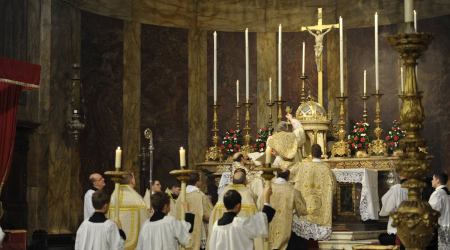
The Latin Mass Society is able to do our work for two reasons. First, we are not part of the Church’s establishment, and so not ensnared by the passing fads of officialdom. I do not mean to be rude: these fads seemed solid and convincing at the time, and the people following them are generally well meaning enough, but it is no longer controversial to say that a great deal of harm was done to church buildings, for example, between about 1964 and 1990 for no real gain. Our bishops clearly agree with this proposition because they have permitted and encouraged much restoration work in their dioceses, including some of their own cathedrals: in Birmingham most famously, and before that in Portsmouth, and more quietly in other sees. It is also evident that harm was done in the area of liturgy by banning public celebrations of the Traditional Mass, except in England and Wales, from 1971 to 1984, a ban which Pope St John Paul II reversed, and which has never been reimposed.
It can be painful to hear one’s favourite notions being criticised, and when an elite has become mesmerised by a set of exciting new ideas, the people who do not go along with this can become very unpopular. And yet such dissidents from intellectual fashions are immensely valuable: by demanding proper justifications and pointing out inconvenient facts they slow down destruction and speed up the return of sanity. No one today would say that the poet John Betjeman’s opposition to the post-war bulldozing of fine Victorian buildings was a waste of energy, or that he should have focused on something that had official approval at the time. On the contrary, there is a statue of him on one of the platforms of St Pancras Station, to show the nation’s gratitude for his saving of that extraordinary building, among many others, in the teeth of the planners’ insistence that it was redundant.
It would be nice to imagine a statue of the late Michael Davies being erected in front of Westminster Cathedral, in gratitude to a man who dedicated so much time and energy to pointing out things that the ecclesial establishment of the 1970s and 1980s would rather have ignored. That does not seem very likely, but it is a fact that he, and the movement he represented, has been vindicated in its most fundamental position: that the prohibition and persecution of the Traditional Mass was harmful to souls, and that this sacred edifice, this construction of symbolic action and sacramental forms, should continue to exist in the Church for the good of souls.
The second reason the Society has been able to do its work is a contrasting one. It is because, although not wedded to the ecclesial establishment, we are nevertheless inside the structures of the Church. By this I mean that we engage with parishes, shrines and bishops, and are answerable to canon law and the hierarchy. On the one hand, we are dissenters, not from the Faith, I hope, but from the fashionable ideas I was talking about, and a great many people would rather we simply disappeared somehow. On the other hand, we are not disappearing: our members and supporters are in parishes, and as an organisation we are writing to bishops, we are coming as pilgrims to shrines, and we are sometimes even officially listed as a Catholic organisation.
This positioning of the LMS makes our work possible. Our work is not about creating a parallel institution in which everything is the way we want it, but improving what is going on in the mainstream, above all making the Traditional Mass available to as many Catholics as possible.
I note this because of the very different attitude of Fr Davide Pagliarani, the Superior General of the Society of St Pius X. I do not normally comment on the SSPX, but in the current moment it is not unreasonable for people, and not just supporters of the SSPX, to ask us why we do not accept Fr Pagliarani’s arguments. Why do we remain under the authority of our bishops, whereas the SSPX carries on its work without reference to them?
Fr Pagliarani explains his decision to consecrate new bishops for the Society by reference to a “state of necessity”. In a recent interview, which has become widely circulated, he explains what he means in these terms:
“It is sad to acknowledge, but it is a fact that, in an ordinary parish, the faithful no longer find the means necessary to ensure their eternal salvation. Missing, in particular, are both the integral preaching of Catholic truth and morality, and the worthy administration of the sacraments as the Church has always done. This deprivation is what constitutes the state of necessity. In this critical context, our bishops are growing older, and, as the apostolate continues to expand, they are no longer sufficient to meet the demands of the faithful worldwide.”Let me break this paragraph down a bit.
Two categories of things are necessary, Fr Pagliarani tells us, to supply the “means of salvation”. One is “the integral preaching of Catholic truth and morality”. It is, of course, correct that preaching is a means by which the Church saves souls, but it is not as directly and proximately connected to salvation as the sacraments, and unlike the sacraments it is quite hard to pin down. How bad does preaching have to be for people to be deprived of the means of salvation?
This question matters less if we have a clearer justification for the state of necessity in the case of the sacraments, so let us consider Fr Pagliarani’s claim about those: “the worthy administration of the sacraments as the Church has always done” is, he says, “missing” from the “ordinary parish”. This is, at first sight, puzzling because, bad as things certainly are, it is not actually impossible to receive Baptism and Confession in the ordinary or typical Catholic parish, and if you are unlucky enough to be refused either of these in one parish you can not only report the priest to his bishop but receive them from the next parish down the road.
However, on closer examination I do not think Fr Pagliarani is denying that Baptism and Confession are widely available in Catholic parishes, but something slightly different: that they are offered in a “worthy” way, and “as the Church has always done”. I take it that “worthy administration” means administration by a good priest without liturgical abuses, and “as the Church has always done” means in the pre-Vatican II form.
Now these are both excellent things, but Fr Pagliarani does not say that the new Rite of Baptism or the post-Vatican II words of Absolution are invalid. It follows that he is not claiming that the means provided by the Church for reconciling us with God are absent from the ordinary parish. The state of necessity, then, on his view, is not a strict absence of the sacramental means of freeing oneself from Original Sin and mortal sin. The emergency is the lack of the traditional liturgical forms, alongside the lack of what we might call really good preaching.
The lack of these two things is certainly very regrettable, but you can decide for yourselves what kind of emergency this lack creates. I want to consider the next step in Fr Pagliarani’s argument. The SSPX’s actions are necessary, in this situation, because the SSPX is providing these things which are otherwise not available. To whom is it providing them? To those who frequent its chapels. We might ask: were the SSPX to be reconciled, were it to accept some vague statement about the legitimacy of the reformed Mass and the validity of Vatican II, such as other reconciled communities have accepted and that Pope Francis might have asked of it, would it have been prevented from ministering to the congregations of its chapels as it had done before? The answer is obviously “no”. Would it have found it impossible to find bishops to carry out ordinations and Confirmations for it? Well, there are other priestly institutes and religious communities who want the old Roman Pontifical for the ordination of their seminarians and the Confirmation of their faithful, and they have been able to obtain it consistently since the first of them were erected or reconciled in 1988.
I know how SSPX supporters respond to this observation. They claim that it is only because of the existence of the SSPX outside the structures of the Church that the traditional institutes and communities inside the structures of the Church have been allowed to operate in relative peace. If the SSPX were reconciled, the policy of the Holy See would change.
At this point we are moving into a new kind of argument, about what would happen in a hypothetical situation, or might have happened in a hypothetical situation in 1988 or at some subsequent date. I do not agree with this argument, but I am not going to be able to persuade anyone who thinks like that with anything I could say today, and my concern here and now is to clarify what is at stake rather than develop a knock-down argument. The lesson I want to take away from this dialogue is that the problem comes down to one of mutual trust and mutual respect. The problem of the SSPX’s canonical situation is a problem which will be solved, if it is ever solved, by a process of building up trust and respect between it and the Holy See, and this process will take time and sustained effort from both sides.
While, as I say, I do not accept the SSPX argument, it is inevitable that its supporters will look at the way traditionalists who do accept the authority of their bishops are treated, and draw conclusions from what they see. I think it would be fair to say that what they have been able to see over recent years has been pretty mixed. No doubt Pope Leo is aware of this. We must pray that he sees the value and urgency of reassuring Catholics attached to the Church’s traditions of his pastoral concern.
Be sure to email this page to all your friends.
LATIN
"Do not leave My Son's Church though, My children, because they have taken this language [Latin] from among you. You must wait and persevere and weep with My Son for this defilement by man." - Our Lady of the Roses, April 10, 1976
CLEANSING
"There must be a complete cleansing of My Son's Church. What do you do, My children, when your house has been infested by rodents or vermin? You clean out your house. You do not abandon it, for it has taken much love and much labor to build the walls. You do not abandon it, but you work and pray, and use every means to clean out My Son's House, His Church." - Our Lady of the Roses, November 20, 1979
 The Virgin Mary's Bayside Prophecy Books are Now Available in E-book Version. Click Here Now!
When you pray the Holy Rosary, you have Our Lady's hand in yours. When you pray the Holy Rosary, you have the power of God in your hands. Start now! Click here...
Our Lady of the Roses Awesome Bayside Prophecies... https://www.tldm.org/Bayside/ These prophecies came from Jesus, Mary, and the saints to Veronica Lueken at Bayside, NY, from 1968 to 1995.
Directives from Heaven... https://www.tldm.org/directives/directives.htm
 PDF
PDFD77 - Obedience
PDFD79 - Restore My Church
PDFD85 - Tradition
PDFD193 - Turn Back: You are on the Wrong Road
PDFD791 - The Lord is My Inheritance
PDF