 These Last Days News - November 10, 2026
We encourage everyone to share this web page with others, especially bishops and clergy.
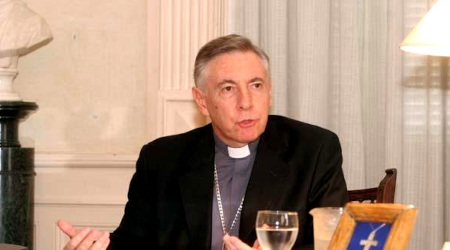
Archbishop Aguer on the Papal Visit to Argentina and the Legacy of Pope Francis...
RETURN TO YOUR TRADITIONAL RITES
"I send to My clergy, those whom I have given the grace to represent Heaven upon earth, this warning: You must now return to your traditional rites! You must restore My House from its crumbling exterior and rotting interior. You must rebuild what you seek to destroy" - -now!" - Jesus, November 22, 1975
TO THE BITTER END
"The state of the world at the present time has called down upon it a punishment that has been abated for a short time by the acts and sufferings of those who have given themselves as victim souls to the merciful heart of the Father. There are many, My child and My children, in the world who care for their fellow human beings. There are many who will fight to the bitter end in bringing justice to the world, in keeping the light of faith burning in the hearts of the children that can be reached by them." - Our Lady of the Roses, September 28, 1977
The above Messages from Our Lady were given to Veronica Lueken at Bayside, New York. Read more
Advaticanum.com reported on November 9, 2026:
[TLDM Editor's note: Sadly, Archbishop Aguer passed away today. Please keep his soul in your prayers.]
by Niwa Limbu
In an exclusive interview with AdVaticanum, Archbishop Héctor Aguer discusses Pope Leo XIV's visit to Argentina, the legacy of Pope Francis, the state of the Church in his country and the place of tradition in its future
Archbishop Héctor Rubén Aguer is the Archbishop Emeritus of La Plata, Argentina. Born in Buenos Aires on 24 May 1943, he was ordained a priest in 1972 and served as Auxiliary Bishop of Buenos Aires from 1992 to 1998 before being appointed Coadjutor Archbishop of La Plata. He governed the archdiocese as its seventh archbishop from 2000 until his retirement in 2018.
As Pope Leo XIV's apostolic journey to Argentina is now underway, Archbishop Aguer speaks with AdVaticanum about the meaning of the papal visit. His Grace offers a frank assessment of the state of the Church in Argentina after twelve years of Pope Francis, the impact of the "theology of the people", the crisis of vocations and seminary closures, and the growing interest among younger Catholics in orthodoxy and tradition. He also discusses the severe restrictions placed on the Traditional Latin Mass, the difference between authentic communion and the recent emphasis on "synodality", and the urgent need for liturgical and doctrinal peace under the new pontificate. Finally, he speaks of his own nearly twenty years in La Plata, the priests he ordained and the prayers and sufferings he offers for Pope Leo XIV and the Church.
AV: What is the deeper background of Pope Leo XIV’s visit to Argentina? Beyond the official itinerary, what does this trip represent for the Argentine Church and for the country’s faithful after so many years without a papal visit?
☨ HA: The visit of Pope Leo XIV, as Vicar of Jesus Christ and successor of Saint Peter, must serve to confirm us in the Faith in our one Lord. That is the irreplaceable mission of the Pontiff. Jesus Himself entrusted it to him: "Simon, Simon, behold, Satan has demanded to sift all of you like wheat, but I have prayed for you that your faith may not fail. And once you have turned back, strengthen your brothers" (Lk 22:31-32).
Nearly forty years ago, in April 1987, during his visit to our country, Pope Saint John Paul II made an urgent appeal to the Church in Argentina: "Arise and shine." That remains a pending task. In 1960, 90 per cent of Argentines declared themselves Catholic; today it is barely 57 per cent. And we continue in free fall. The lack of faith about which the Lord warned Peter has wreaked havoc in our society. Of course, one cannot expect magical results.
A papal visit is always welcome. What matters, in any case, is to renew, together with Peter, faith in Christ, and to fulfil what He commands us: "Go, therefore, and make disciples of all nations, baptising them in the name of the Father and of the Son and of the Holy Spirit, teaching them to observe all that I have commanded you" (Mt 28:19-20). That is why we exist: to baptise, to sanctify the children of God and to prepare them for Heaven. The salvation of souls is the supreme law of the Church. Therefore, without any kind of complexes or discounts, we must teach them to observe all that the Lord commands.
AV: Has there been any political controversy surrounding the decision to make this visit, due to the current climate between the Church hierarchy and the government of President Milei?
☨ HA: From various quarters, there is always an attempt to politicise papal journeys. This has happened with all the popes. As a Church, however, we cannot fall into that trap. The Pope comes to confirm his children in the faith, to seek out those who have drifted away and to call those who do not know Christ or His Church. That, then, is the principal mission. It is regrettable to see how, with various pettinesses, the image of the successor of Saint Peter is sought to be used. The Pope does not come to take sides with any leader or to disqualify anyone. He comes to show us that Jesus Christ is the one Lord of History. And that the true happiness of peoples, as the encyclical Quas primas (whose centenary was observed in 2025) so clearly recalls, lies in Christ being recognised and adored as King of the universe and of the nations. And that societies, consequently, be founded upon the Gospel.
AV: How would you assess the overall legacy of Pope Francis? Which aspects of his pontificate do you consider most significant or lasting, and which do you believe will continue to shape the Church in Argentina and beyond?
☨ HA: Pope Francis, formed in the "theology of the people" (the Argentine version of liberation theology) by the fellow Jesuit Juan Carlos Scannone, has filled the Argentine episcopate with progressivism. The cascade of appointments made for our country during his twelve years of pontificate, with, for example, very young auxiliary bishops, gravely conditions the coming decades. In Argentina, the Church has almost completely lost its presence in the cultural mainstream. Turned almost exclusively toward "the social", the clear, firm and unapologetic proclamation of Jesus Christ is conspicuous by its absence.
We thus have empty seminaries, empty convents and a dramatic shortage of priests. Entire congregations are dying for lack of vocations. Being accused of being "insufficiently synodal" or of not being open to the "culture of encounter" leads to suffering various forms of exile. Or is "encounter" being confused with a mere gathering? Are we not all believers, and priests all the more so, called to have a liberating and personal encounter with Christ, and to lead other brothers and sisters to Him?
During the years of Francis, the seminaries of San Rafael and San Luis were closed in Argentina; both were noted for the good formation received there by future priests. Other seminaries that also had sound doctrine now hover between insignificance and extinction. There are dioceses that have more bishops than seminarians. These are only a few examples of that free-fall decline I mentioned earlier.
We see as positive signs, nonetheless, the new generations of both laypeople and religious and priests: there is a growing interest in orthodoxy and tradition. Only from there can we imagine a different future.
AV: Why, in your view, did Pope Francis never visit Argentina during his twelve-year pontificate? What factor do you believe weighed most heavily in that decision?
☨ HA: It has been said repeatedly that Pope Francis did not wish to come to Argentina so as not to be "used" politically. This is a very weak argument. As I said, all papal visits to all countries are always sought to be politicised. But the Pope is not there to place himself on one side or the other, but in the centre and above. There, rooted beside the Lord, he must lead his children.
Pope John Paul II went to Poland shortly after his election, in the hardest years of communism. Benedict XVI did the same with Germany. I met Jorge Bergoglio in 1978, in the diocese of San Miguel. I dealt with him for more than four decades. I know very well how he thought and acted. I think he did not wish to come to Argentina out of fear of not being very well received, and of not having the sea of crowds that Saint John Paul II had in his two visits, in 1982 and 1987.
AV: Cardinal Víctor Manuel Fernández succeeded you as Archbishop of La Plata. There was obviously a massive shift in the archdiocese owing to polarising, differing views. How would you characterise his years in the archdiocese, considering that he won’t be coming to South America due to his recent health?
☨ HA: God will judge his actions, and also mine. I can only say that, during my nearly twenty years in the Archdiocese, I was able to ordain 49 priests. And that is the greatest thing a bishop can do: to share in the one Priesthood of Jesus Christ those called by the Lord, so that they may serve Him in the presbyterate. Several of them are young, fervent, virile and well formed in sound doctrine. And little by little they are taking on responsibilities in parishes and missions, especially in working-class neighbourhoods. Their apostolic spirit, their passion for Christ and for the health of souls is causing those communities to flourish in number and in holiness. This is one of the greatest satisfactions of this elderly bishop, who very soon must render an account to the Lord.
AV: What is the present situation of the Traditional Latin Mass in Argentina? What restrictions currently exist on its celebration, and why do you believe those restrictions should be lifted so that the older form of the Roman Rite can be freely celebrated for the good of the faithful who seek its beauty and reverence?
☨ HA: The Traditional Mass, given the overwhelmingly progressive composition of the Argentine episcopate, suffers every form of disdain and restriction. The cases in which, reluctantly, its celebration is authorised are extremely few.
On several occasions I have said that many Argentine bishops live in the stratosphere and thus they fail to perceive that the young people who return to or discover the Church do so, to a great extent, fascinated by the Mystery of Jesus Christ. They do not come to the Church seeking more of the world, but to sanctify themselves in the midst of a hostile world.
The fundamental solution is to return to Summorum Pontificum of Pope Benedict XVI, and thereby to repeal Traditionis Custodes and other draconian measures of the previous pontificate. The Mass of All Ages, of which Benedict XVI said that it was never abolished, is characterised by its theological depth and its literary beauty, which have their roots in the sixth century. The theology takes up the Creed of the Church, and as for the language, one must remember that it was not recited but simply sung; in this the Latin rite is identified with the various Eastern rites. An original advantage is Gregorian chant, with its free rhythms and its complex yet perfectly clear passages, suited to choral singing. The tragedy is that the ecclesiastical establishment has abandoned it to replace it with guitar music.
AV: How do you understand synodality as it has been proposed and practised in recent years? Do you think there is a difference between Argentinian, German and even the Roman interpretation of synodality?
☨ HA: From the beginning one has spoken of the Church as "Communion" and not of "synodality". The Synod of Bishops exists to serve that communion, and not to dilute or "democratise" hierarchical decisions, nor to call into question the faith, the morality and the discipline of the Church.
This "synodality" of recent years sought to export what was attempted for the Church of Buenos Aires when Cardinal Bergoglio was then archbishop, in the first decade of this century. One spoke then of a "Church in a state of assembly". There was no lack of parishes in which banners and placards were hung similar to those of the student assemblies taken over by the left in the universities.
An attempt was made to satisfy the German "synodals", and today it seems that here and there everything is under discussion. Pope Leo XIV will have to pacify the Church; and, together with liturgical peace, set limits on so many deviations.
AV: Do you expect to meet Pope Leo XIV during his visit? If the opportunity arises, what would you wish to say to His Holiness?
☨ HA: I am in very delicate health, and I will not be able to participate in any meeting with Pope Leo XIV. I pray for him, and I offer these sufferings, in this purification at the end of my life, for our Holy Mother Church. The Pope is a son of Saint Augustine, bishop and doctor of the Church, whom I have admired all my life and from whose teaching I have drawn much nourishment. He too lived in times of barbarians. May the Lord strengthen the Pope so that he may calm the waters in the Church. No one can stop her; the Barque sails on. "The gates of hell shall not prevail against her" (Mt 16:18).
Be sure to email this page to all your friends.
CHANGES MUST BE STOPPED AND REVERSED
"There is no excuse accepted now by the Eternal Father among the clergy, who now offend the Eternal Father by misleading the children of God upon earth. The experimentation and changes must be stopped and reversed! There is no other course." - Our Lady of the Roses, August 4, 1979
FAITH AND TRADITION
"In your misguided foolish way of finding the light, My pastors, you have given yourselves to delusion. Abominations are being committed now in My Son's Houses, churches, throughout the world. This brings much sorrow to the people of Heaven. This brings much sorrow to the Eternal Father and, in turn, this will bring much sorrow to the hearts of those who will struggle to retain the truth. Faith and tradition shall not be separated. Novelty is the creation of satan." - Our Lady of the Roses, November 1, 1975
DOGMAS
"My children, your doctrines of faith have been given to you, the dogmas of your religion, and you cannot change them without bringing destruction upon yourself and My Son's Church." - Our Lady of the Roses, May 27, 1978
 The Virgin Mary's Bayside Prophecy Books are Now Available in E-book Version. Click Here Now!
When you pray the Holy Rosary, you have Our Lady's hand in yours. When you pray the Holy Rosary, you have the power of God in your hands. Start now! Click here...
Our Lady of the Roses Awesome Bayside Prophecies... https://www.tldm.org/Bayside/ These prophecies came from Jesus, Mary, and the saints to Veronica Lueken at Bayside, NY, from 1968 to 1995.
Directives from Heaven... https://www.tldm.org/directives/directives.htm
 PDF
D81 - Faith
PDFD85 - Tradition
PDFD123 - Catholic Church, Part 1
PDFD124 - Catholic Church, Part 2
PDFD211 - Changes, Part 1
PDFD212 - Changes, Part 2
PDFD265 - The Papacy
PDFD311 - Pray for Your Clergy
PDF