 These Last Days News - October 12, 2026
We encourage everyone to share this web page with others, especially bishops and clergy.
Archbishop Cordileone: Church had Greater Unity under Summorum Pontificum...
THE FOUNDATION
"My Basilica, My child, will be built on a firm foundation of Faith. Tradition cannot be placed aside from Faith. Together they are the foundation." - Our Lady of the Roses, December 6, 1974
TURN BACK
"This evil has penetrated far into the very heart of My House. You must now turn back and restore My House. I, your God, give you this command for the salvation of your own soul." - Jesus, August 21, 1976
The above Messages from Our Lady were given to Veronica Lueken at Bayside, New York. Read more
Advaticanum.com reported on October 8, 2026:
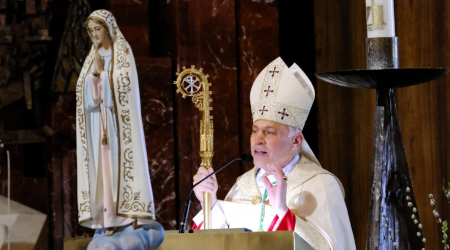
Archbishop Salvatore Cordileone has said the Church experienced greater unity under Pope Benedict XVI's Summorum Pontificum than it does under Pope Francis's Traditionis Custodes.
In an interview with French Catholic newspaper Tribune Chrétienne on October 8, the Archbishop of San Francisco said the restrictions placed on the traditional liturgy risk repeating wounds caused by the rapid liturgical changes that followed the Second Vatican Council.
"It's very clear to me that there was more unity in the Church when we were living under Summorum Pontificum than we are now under Traditionis Custodes," Archbishop Cordileone said.
He recalled the "liturgical wars" that followed the Council, when Catholics were judged and stereotyped according to their liturgical preferences. He said tensions continued into the 1990s before the situation began to "mellow" following the indult permitted under St John Paul II and then the publication of Summorum Pontificum.
Under Pope Benedict's approach, Archbishop Cordileone said, Catholics attached to traditional worship and those preferring more contemporary forms could coexist peacefully without harsh judgement.
The Archbishop said Pope Benedict recognised that the Church had suffered a "profound wound" through the rupture experienced after the Council, including cases in which rapid and radical liturgical changes had damaged, and sometimes destroyed, Catholics' faith.
Archbishop Cordileone also explained that Pope Benedict XVI's proposal to recognise the ordinary and extraordinary forms of the Roman Rite was intended to facilitate what the former Pope called an "internal reconciliation" within the Church's worship. His Grace said Benedict understood that genuine reconciliation could not be engineered by a committee of scholars drafting a new liturgy, but would have to develop organically through generations of Catholics worshipping according to both forms.
"It has to happen organically," Archbishop Cordileone said. "Pope Benedict understood that this would take a long time, generations, maybe even centuries, with people worshiping with both forms of the Mass to come to a unified worship in the Church."
His Grace said Benedict understood that the rapid changes which followed the Second Vatican Council had created a rupture that could not simply be resolved by imposing another reform from above.
"He understood the rupture that had taken place," Archbishop Cordileone said. "He lived through it. He saw how the faith of Catholics was very seriously challenged, damaged. I've heard of cases even destroyed because of very quick, radical changes in the way the liturgy was carried out."
Archbishop Cordileone warned that Catholics attached to the traditional form of worship had been "stigmatized and marginalized" within the Church, arguing that such treatment risked reopening the wounds Benedict had sought to heal.
"I think that foments division," His Grace said. "Some people felt alienated from the Church. I fear that that might begin to happen again."
The Archbishop's comments came as he reflected on the increasingly visible generational divide over Catholic worship and tradition. Archbishop Cordileone said younger Catholics are increasingly interested in recovering traditions which their elders had regarded as new and necessary after the Council.
"What looked new to my generation and feels new to us now does not look or feel new to young people," His Grace said. "It looks like something more to the past."
Archbishop Cordileone said the older generation needed to recognise that what still feels relatively recent to those who lived through the changes is historically distant for younger Catholics.
"The Second Vatican Council happened 60—well, now 60-plus years ago," His Grace said. He invited older Catholics to consider what the world had looked like 60 years before their own youth. For someone who was at university in the period after the Second World War, he said, looking back 60 years would have meant looking towards the early twentieth century.
"That's how old the Second Vatican Council looks to young people now," Archbishop Cordileone said. "It still feels new to us, but it looks like a bygone era of history to young people."
His Grace said this should lead the older generation to take seriously the desire of younger Catholics for something more enduring than the ideas associated with a particular historical period.
"We have to keep that in mind, and we have to understand their desire for something that is of eternal value, timeless value, rather than something that just pertains to one generation or two and then kind of fades away and becomes old-fashioned," Archbishop Cordileone said.
At the same time, His Grace cautioned younger Catholics against dismissing the experience of those who lived through the upheavals following the Council. The younger generation, Archbishop Cordileone said, had not experienced the "revolutions" and "turmoil" which shaped the lives of their elders.
"If they look to their elders in the faith, who are still serious practicing Catholics, they have withstood those times of revolution, of turmoil, and they kept their faith intact," His Grace said. "They haven't abandoned it."
The Archbishop said a better understanding between generations could enable Catholics to recover authentic tradition without treating it as something belonging exclusively to the past.
"I think if we can seek a better understanding between the generations, we can profit from the insights that each has to have," His Grace said. "We can recover our authentic tradition in a way that does speak to people of our own time, and we can learn from one another for the good of the mission of the Church."
Archbishop Cordileone connected this generational renewal with a prediction made by Joseph Ratzinger in 1969, when the future Pope Benedict XVI foresaw a Church that would lose much of its social influence and many of its institutions and members.
"What I believe we see playing out before our eyes now is the vision that then the Professor Joseph Ratzinger had, almost 60 years ago now, in the late '60s, 1969 it was," His Grace said.
Ratzinger, Archbishop Cordileone recalled, foresaw that "the Church would lose its social influence in the world, would even lose its institutions, it would lose members, it would be a smaller but more fervent and devout, and I would say intentional, Church".
"We see that happening now," His Grace said. "We see it certainly here in the United States."
Archbishop Cordileone argued that this meant rereading the Second Vatican Council in continuity with the tradition which preceded it, rather than interpreting the Council as a break with the Church's past. He pointed in particular to Sacrosanctum Concilium and the Council's teaching on Latin and Gregorian chant.
"We need active participation, but we also need—we do so in order to focus on Christ," His Grace said, explaining that the east has traditionally symbolised Christ as the "rising Son", the light of the world and the Christian's journey towards heaven.
Archbishop Cordileone's remarks continue a line he has taken since Pope Francis issued Traditionis Custodes in July 2021. In a statement on 5 August that year, he said he had been "grieved by certain disrespectful responses," some of them "slanderous attacks on the Pontiff," and that he supported the Pope's concern that those drawn to traditional worship also affirm the validity of the Novus Ordo and of the Second Vatican Council itself.
In a May 2025 essay in First Things, "Putting an End to the Liturgy Wars," the Archbishop returned to the years after the Council, which he is old enough to remember. His Grace distinguished the sixteen conciliar documents from the instructions that implemented them and from what actually happened in parishes, arguing that the sense of rupture came less from the texts themselves than from what happened in practice, which he described as "historically unprecedented".
That argument resurfaced after the Society of St Pius X consecrated four bishops without a papal mandate in July 2026. On 10 July, the Archbishop wrote that the consecrations showed "a growing lack of trust that has been simmering for a very long time," and asked that the faithful be given "easier access" to the traditional form of the Mass so they would not feel constrained "to seek spiritual nourishment outside of the family in union with Rome."
Speaking to Raymond Arroyo on EWTN on 30 July, he said that, "with some precautions," wider access to the older Missal could be granted "and maintain unity within the Church." The precaution he named was that those who attend it remain "in full communion in terms of their belief and their acceptance of the teachings of the Second Vatican Council," which he said had, "for the most part," been the case in the United States.
He described lasting restrictions as unrealistic and said younger Catholics "love the more classical way that the Church worships, the traditional Mass… the form of the Mass before it was changed after the Second Vatican Council," as well as the reformed rite celebrated ad orientem, with sacred music and solemnity.
Be sure to email this page to all your friends.
LATIN TO REMAIN
"It was the will of the Eternal Father that one universal language be used along with, in comparison with, together with the language of the land. This universal language, Latin, befit and was chosen by the Eternal Father as a universal language for the universal Church, the Roman Catholic Church under the leadership of Pope Paul VI, the successor of Peter...
Because of the fall in Babylon, many new languages were given because of the sin of Babylon. Therefore, as a member of one country, My children, with a universal language, you carried with you your own country's translation, and were you to visit abroad, you could enter upon any foreign edifice, Church of My Son, and feel comfortable and in one with the man, the priest, the one chosen by My Son to represent Him in His House.
If you were, My child, to go from your United States to France, could you understand the words in French? But, My child, you would recognize the words in Latin and you would have your book with you to read in your American language, just as those in France could read in their French language, bringing upon the world a beautiful and common bond of language among all who have been given the grace to be called to the Roman Catholic Church of My Son." - Our Lady of the Roses, April 10, 1976
 The Virgin Mary's Bayside Prophecy Books are Now Available in E-book Version. Click Here Now!
When you pray the Holy Rosary, you have Our Lady's hand in yours. When you pray the Holy Rosary, you have the power of God in your hands. Start now! Click here...
Our Lady of the Roses Awesome Bayside Prophecies... https://www.tldm.org/Bayside/ These prophecies came from Jesus, Mary, and the saints to Veronica Lueken at Bayside, NY, from 1968 to 1995.
Directives from Heaven... https://www.tldm.org/directives/directives.htm
 PDF
PDFD81 - Faith
PDFD85 - Tradition
PDFD123 - Catholic Church, Part 1
PDFD124 - Catholic Church, Part 2
PDFD125 - Ecumenism
PDFD211 - Changes, Part 1
PDFD212 - Changes, Part 2
PDFD265 - The Papacy
PDFD311 - Pray for Your Clergy
PDF