 These Last Days News - August 24, 2026
We encourage everyone to share this web page with others, especially bishops and clergy.
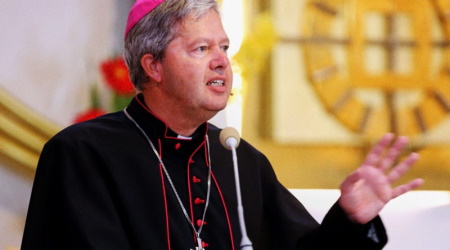
Bishop Rob Mutsaerts Says ‘The Missing Words in the Synod Are Repentance and Conversion’...
ALWAYS THERE TO FORGIVE
"Save yourselves and those you love in the Sacred Heart of My Son, ever merciful, always there to forgive. For when He forgives, He forgets. No sinner shall ever be turned away if he comes in heart with repentance." - Our Lady of the Roses, April 22, 1973
EITHER REPENTANCE OR PUNISHMENT
"My child and My children, We are very pleased at the manner in which you are getting out the Directives from Heaven. Do not slacken your pace. There are many souls to be reached. They must understand the signs of the times. The biggest threshold for the United States and other countries of the world is if they are willing to go forth and overcome the evil within their own countries. The morality has fallen in most nations of the world now, and this cries to Heaven for either repentance or punishment." - Our Lady of the Roses, June 18, 1992
The above Messages from Our Lady were given to Veronica Lueken at Bayside, New York. Read more
Advaticanum.com reported on August 22, 2026:
Bishop Rob Mutsaerts has served as the Auxiliary Bishop of the Diocese of ’s-Hertogenbosch since 2010. His ministry has been typified by a confidence in proclaiming the truth, notably through his criticism of the 2019 Amazon Synod and his concerns over the lack of evangelical wisdom behind Traditionis Custodes. He has also been a forceful […]
Bishop Rob Mutsaerts has served as the Auxiliary Bishop of the Diocese of ’s-Hertogenbosch since 2010. His ministry has been typified by a confidence in proclaiming the truth, notably through his criticism of the 2019 Amazon Synod and his concerns over the lack of evangelical wisdom behind Traditionis Custodes.
He has also been a forceful voice against the tides of Dutch secularism in a country that has experienced some of the more pernicious elements of the trend. In the Netherlands, the lives of newborns and children under 12 can be deliberately ended without an affirmative request from the child under strictly defined circumstances, while euthanasia can be administered to those aged 12 and over in cases of psychiatric suffering. Almost 60 per cent of the country reports no religious affiliation, while Islam is the fastest-growing major religion, with more than twice as many 15–17-year-olds identifying as Muslim (14.2 per cent) as Catholic (6.9 per cent). Against this backdrop, His Grace has worked tirelessly, writing numerous spiritual works and encouraging conversions, work that is bearing fruit in a country that saw a 40 per cent increase in adult baptisms in 2024.
In this exclusive interview, Bishop Mutsaerts shares with AdVaticanum his reflections on a recent open letter he wrote to Pope Leo XIV, his views on the synodal process and how he sees the Church in the Netherlands.
AV: In your recent open letter to Pope Leo XIV, you write that judging the synodal process by its own internal metrics (listening, participation, documents) can produce a positive narrative, but that the real tests are stronger faith, clearer proclamation of Christ, deeper Catholic identity, more conversions, higher Sunday Mass attendance, etc. Could you walk us through how you arrived at that list of criteria?
+RM: The final canon of the Code of Canon Law ends with the famous principle that "the salvation of souls … must always be the supreme law in the Church" (salus animarum … suprema semper lex esse debet, can. 1752). If one evaluates the synodal process, the decisive question is not whether consultations were extensive, people felt heard, committees functioned well, or documents were produced. The question is: has all this made it more likely that men and women will believe in Jesus Christ, repent, receive the sacraments, persevere in grace, and attain eternal life? On that criterion, there are serious grounds for criticism.
AV: You insist that synodality cannot be an end in itself. What do you mean by that, and how should we understand the relationship between the means (consultation, participation, structures) and the true end of the Church’s mission?
+RM: "Walking together" is valuable only if the Church knows where she is walking. The destination is not increased participation but Christ; not ecclesiastical dialogue but holiness; not inclusion as an abstract principle but incorporation into Christ and, ultimately, eternal salvation.
Consultation, participation, pastoral structures and synodal methods all have their place. Once the means start occupying more attention than the end, something has become inverted.
Interestingly, the synodal documents themselves repeatedly acknowledge that evangelisation is the mission of the Church. The European continental document states that the Church’s task is to "proclaim the Gospel" and invite people into communion, and calls for renewed missionary activity in Europe. The disagreement, therefore, is less about the official intention than about emphasis, method and measurable fruit.
AV: In the letter, you state: "Christus heeft geen discussiegroep opgericht. Hij riep apostelen. Hij gaf hun gezag" ("Christ did not found a discussion group. He called apostles. He gave them authority"), and you add that the faith does not arise from the Church first taking an inventory of what people believe and then distilling a common conviction from those experiences. How do you see this principle applying to the ongoing implementation phase of the synodal process, which continues towards an Ecclesial Assembly in Rome in October 2028? Where, in your view, does authentic listening end and the teaching office of the bishops begin?
+RM: A physician listens carefully to the patient, but listening is not the cure. And the Church possesses something unusual among institutions: she has received a Revelation which she did not invent and cannot rewrite. Consequently, there must always come a moment when listening gives way to proclamation of the Gospel. The missing words in the Synod are repentance and conversion.
AV: Is there a necessary contradiction between synodality and tradition? What would a synodality truly ordered towards salus animarum look like in practice?
+RM: There is no necessary contradiction between synodality and tradition. Imagine a synodal Church asking every parish: Why are your baptised teenagers disappearing? Why have confessions collapsed? Where are young families attending Mass? Why? Where are young adults requesting baptism? What brought them to Christ? That would be synodality ordered towards salus animarum. Listening would remain – but we would be listening partly because we desperately wanted to discover how to save souls. And suddenly the entire process would acquire focus.
AV: The Netherlands is widely regarded as one of the most secularised and liberal societies in the Western world. What do you identify as the roots of this crisis in the Dutch Church?
+RM: The Dutch reality provides a sobering test. The situation of Catholicism in the Netherlands is extraordinarily difficult to present as a pastoral success. Dutch statistics report that there were 3.448 million registered Catholics in 2024. Yet the sacramental statistics are even more depressing. From a Catholic perspective, this points towards a catastrophic failure to transmit the faith from one generation to another.
And this is precisely where salus animarum becomes uncomfortable. If millions remain nominally Catholic but only a tiny proportion regularly encounter the Eucharistic Christ; if baptised children disappear before Confirmation; if Catholic marriage becomes statistically exceptional; then it is insufficient to say that new consultative structures have been created.
AV: Do you believe the Synod on Synodality has contributed towards the decline of Dutch Catholicism?
+RM: The decline of Dutch Catholicism began many decades before the Synod. It would therefore be historically indefensible to blame Dutch secularisation on synodality. The synodal process did not create the Western European crisis. But after several years, there is little evidence that it has found an effective remedy for it. The medicine resembles the disease!
When ecclesiastical rhetoric begins to sound remarkably similar to secular language, the Church risks offering secular Europeans a religious version of something they already possess. But nobody needs Christianity in order to learn that meetings should be inclusive.
AV: Looking beyond the immediate controversies, what gives you hope for the future of the Catholic Church in the Netherlands?
+RM: There is a genuinely hopeful sign that my previous critique should not conceal. Adult reception into the Catholic Church in the Netherlands increased by nearly 40% in 2024: more than 500 adults were baptised and more than 100 others entered the Church without baptism because they had previously been baptised. That is remarkable. It would therefore be too sweeping to say simply, "Nothing is happening." Something clearly is happening among a small but significant group of seekers.
Indeed, this phenomenon may deserve much more attention than it currently receives. The crucial question is: what kind of Catholicism is attracting those converts? Are people seeking Christianity because they want more committees? Or because they have discovered Christ, prayer, Eucharistic adoration, confession, Catholic moral seriousness, beautiful liturgy, intellectual coherence, tradition, community and transcendence? It is clear to me that the latter is the case.
This makes the Dutch increase in adult conversions especially intriguing. Similar signs of renewed Christian interest among younger Europeans should make bishops extremely attentive. The future Catholic is not asking the Church: "Will you become more like the society I already inhabit?" He is asking: "Is any of this actually true?"
If someone in his twenties walks into a church because contemporary culture has left him spiritually hungry, giving him another discussion about institutional inclusion may completely misunderstand his predicament. He may want metaphysics, redemption, a demanding moral life, a priest who actually believes what he says, confession, the Eucharist. And above all, Christ. Here traditional Catholicism may possess an evangelising advantage precisely because it is unapologetically other.
AV: What concrete forms of holiness, conversion, and proclamation do you see as most urgently needed in the Church today, and how would a shift towards those priorities change the practical life of parishes, seminaries, and diocesan structures?
+RM: Catholic evangelisation traditionally assumes that something dramatic is at stake. Man is created for God. He is wounded by sin. Christ died for him. Grace is real. Mortal sin is real. Judgment is real. Heaven is real. Hell is real. Forgiveness is real. The Eucharist is really Christ. Confession really reconciles the sinner with God. Once these things are believed intensely, pastoral priorities change immediately. One becomes intensely interested in confessions, baptisms, conversions, Catholic marriages, Mass attendance, Eucharistic devotion, catechesis, family prayer, and holiness. A Church concerned with salvation inevitably wants to know whether more people are going to confession. A bureaucracy concerned with process wants to know whether more people participated in the consultation.
There is a wonderfully simple biblical criterion: "By their fruits you shall know them." Apply it without malice and without ideological prejudice. Above all: are people willing to become saints? This question is considerably more important than asking whether people experienced the synodal process positively.
Be sure to email this page to all your friends.
"ALL IS ON MAN'S DECISION
All the prophecies must come to pass. But the extent will depend on man's repentance. All messages given in prophecy from the sacred grounds must be carried forth. However, this can be lessened in degree to you. All is on man's decision. The Father is not an ogre, My children. He is not one to punish. He will do this only to bring you back to Us." - Our Lady of the Roses, August 14, 1972
 The Virgin Mary's Bayside Prophecy Books are Now Available in E-book Version. Click Here Now!
When you pray the Holy Rosary, you have Our Lady's hand in yours. When you pray the Holy Rosary, you have the power of God in your hands. Start now! Click here...
Our Lady of the Roses Awesome Bayside Prophecies... https://www.tldm.org/Bayside/ These prophecies came from Jesus, Mary, and the saints to Veronica Lueken at Bayside, NY, from 1968 to 1995.
Directives from Heaven... https://www.tldm.org/directives/directives.htm
 PDF
PDFD422 - "Listen to Me", Part 2
PDFD423 - Repentance, Part 1
PDFD424 - Repentance, Part 2
PDFD425 - Repentance, Part 3
PDFD426 - Nothing is Impossible with God
PDF