 These Last Days News - August 27, 2026
We encourage everyone to share this web page with others, especially bishops and clergy.
Cardinal Sarah: Opposition to the Traditional Latin Mass Will Die Out with the ’68 Generation...
RETURN TO YOUR TRADITIONAL RITES
"I send to My clergy, those whom I have given the grace to represent Heaven upon earth, this warning: You must now return to your traditional rites! You must restore My House from its crumbling exterior and rotting interior. You must rebuild what you seek to destroy--now!
Many who call themselves My chosen ones have set themselves to destroy from within. Your actions have not gone by unnoticed by the Eternal Father. Error, deception, deceit, in the guise of sanctity and piousness! You are unmasked before the Eternal Father. You shall start little by little and repair the foundation, or you shall be within and destroy.
I look upon all manner of abominations being committed in My House. Do you think you will go much longer without chastisement? Awaken from your slumber, My clergy! You deceive no one!" - Jesus, November 22, 1975
The above Messages from Our Lady were given to Veronica Lueken at Bayside, New York. Read more
Dianemontagna.Substack.com reported on August 27, 2026:
by Diane Montagna
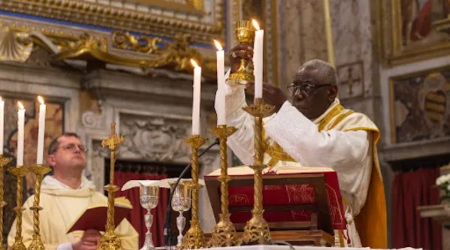
Cardinal Robert Sarah says the aversion to Latin and Gregorian chant among some in the Church will die out with the generation that created it.
In a new interview with Italian journalist Nico Spuntoni, published today in Il Giornale, the former prefect of the Dicastery for Divine Worship and the Discipline of the Sacraments argues that opposition to traditional liturgy is confined to "self-referential cultural circles" rooted more in psychology than substance. Once the ’68 generation passes from influence, he predicts, so too will the "baseless, one-sided positions" that have diminished the cultural stature of Latin Catholicism — a shift he sees coming for the Traditional Latin Mass and for tradition more broadly.
The Cardinal also delivers a sharp verdict on Pope Francis’ 2021 restrictions on the old rite. He calls Traditionis Custodesneither wise nor respectful toward Benedict XVI, who he says bore the decision with the meekness of a lamb even as it was imposed while he was still living. Access to ritual forms "recognized and in use for centuries," Cardinal Sarah insists, can never be legitimately restricted by decree. And he condemns hostility toward traditional-minded Catholics outright, calling it "shortsighted," "purely ideological," and ultimately "harmful, and destructive to the Church."
Here is an English translation of the full interview, published with the kind permission of the author.
"But the Old Mass is the one that helps priests celebrate better."
by Nico Spuntoni
Speaking out against excessive liturgical abuses is one of Cardinal Robert Sarah’s signature themes; he formerly served as prefect of the Dicastery for Divine Worship and the Discipline of the Sacraments. The Cardinal returns to the subject in his latest book, The Canticle of the Lamb: Sacred Music and Heavenly Liturgy, co-written with Peter Carter and published by Cantagalli.
Your Eminence, do you believe there is an aversion to Latin and Gregorian chant in certain parts of the Church?
It strikes me as an aversion confined to a few self-referential cultural circles — more a matter of psychology than of substance — and I think it’s simply a generational issue: once the ’68 generation has passed, these baseless, one-sided positions, which diminish the very cultural stature of Latin Catholicism, will pass with it.
Benedict XVI was convinced that the extraordinary form — the so-called Latin Mass — could positively influence celebrations in the ordinary form that lacked a sense of the sacred. Was he right?
Among the effects of liberalizing the extraordinary form was a positive influence — I would even call it a correction — on possible abuses in the celebration of the ordinary form. Such abuses are extremely serious acts, but they must never be conflated with the ordinary form itself. Many priests testify that discovering the extraordinary form helped them celebrate better. I believe Benedict XVI’s intention also reflected a deeply humble and democratic instinct: to ensure the widest possible access to it, so that over the decades the people of God could choose for themselves which form better embodied their lived faith. But all of that was cut off by Traditionis Custodes, while the Pope Emeritus was still living.
How do you judge that?
It didn’t strike me as a wise or respectful decision. But Benedict, meek as a lamb, allowed himself to be humbled, and in silence and prayer offered his suffering to God, the better to share in Christ’s own suffering for his Church and to purify it.
What do you make of calls to repeal the restrictions?
Access to ritual forms recognized and in use for centuries can never be artificially restricted by decree. If a rite ceased to serve the faith, it would die out on its own; but if it preserves and nurtures the faith, may we never limit it — because in doing so we would be restricting the preservation and spread of the faith itself.
What would you say to the many faithful drawn to the old liturgy who may have to drive miles just to attend a Mass?
I can only admire this profound expression of love for God. The phenomenon is spreading. If the hierarchy proves capable of truly reading the signs of the present age — rather than those of ’68, arriving late once again — then room can open for a fraternal and peaceful dialogue.
As a Church, we cannot wage war on those who devoutly attend Mass simply because they prefer one form over another. That is a shortsighted, purely ideological stance — not pastoral, not Christian. It is harmful, and destructive to the Church.
Be sure to email this page to all your friends.
CHANGES MUST BE STOPPED AND REVERSED
"There is no excuse accepted now by the Eternal Father among the clergy, who now offend the Eternal Father by misleading the children of God upon earth. The experimentation and changes must be stopped and reversed! There is no other course." - Our Lady, August 4, 1979
 The Virgin Mary's Bayside Prophecy Books are Now Available in E-book Version. Click Here Now!
When you pray the Holy Rosary, you have Our Lady's hand in yours. When you pray the Holy Rosary, you have the power of God in your hands. Start now! Click here...
Our Lady of the Roses Awesome Bayside Prophecies... https://www.tldm.org/Bayside/ These prophecies came from Jesus, Mary, and the saints to Veronica Lueken at Bayside, NY, from 1968 to 1995.
Directives from Heaven... https://www.tldm.org/directives/directives.htm
 PDF
PDFD85 - Tradition
PDFD123 - Catholic Church, Part 1
PDFD124 - Catholic Church, Part 2
PDFD125 - Ecumenism
PDFD211 - Changes, Part 1
PDFD212 - Changes, Part 2
PDFD265 - The Papacy
PDFD311 - Pray for Your Clergy
PDF