 These Last Days News - September 3, 2026
We encourage everyone to share this web page with others, especially bishops and clergy.
China Pressured a US Catholic Group to Censor Its Keynote Speaker. They Complied...
TO REMOVE CHRISTIANITY
"One arm of the octopus is communism, atheistic communism. This arm of the octopus will promote discontent, revolution, death. This arm of the octopus will seek to remove Christianity from the earth. O woe unto a man who joins this force!" - Our Lady of the Roses, June 10, 1978
COMPROMISE
"The red forces are gaining momentum in the Eternal City of Rome. Your country, the United States, and other countries of the world, in their measures of compromise to communism, shall fall to communism. You cannot choose a middle road. You must go either to the right or to the left.
Compromise will bring you nothing but despair and sorrow. Compromise, My children, will enslave you. Recognize what is happening within your country and many countries of your world. The Bear is plundering now and has plans to plunge forward throughout the world--the Red Bear, My children, known to you as the Red Brown Bear.
My Son has a plan. It is His manner to separate the sheep from the goats. Those men of great learning, who are ever searching but never coming to the truth, can they not recognize the signs of their times? Many minor catastrophes have entered upon your world, My children. They go by unnoticed as they build up into a greater catastrophe.
Why, My children, has it always been known as human nature to turn away from the truth until you are forced back upon your knees through suffering?
Many years have gone by, My children, since I tried to warn you at Fatima. My message was scorned then by many, discarded and hidden from the world, but My message now cannot be discarded or kept hidden, for you have reached now a point in your life, My children, your lifetime upon your earth, when your days are now being counted." - Our Lady of the Roses, February 10, 1977
The above Messages from Our Lady were given to Veronica Lueken at Bayside, New York. Read more
NCRegister.com reported on August 31, 2026:
by Zelda CaldwellA U.S.-based Catholic organization yielded to pressure from Chinese government officials to cancel a prominent professor’s invitation to speak at its conference, emails obtained by the Register show.
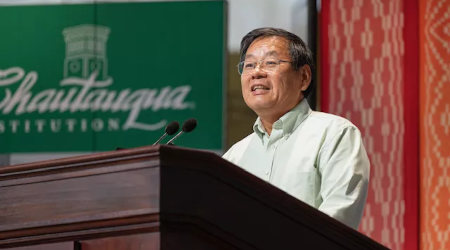
Fenggang Yang, a Chinese-born sociology professor at Purdue University and director of the Center on Religion and the Global East, was informed by the U.S.-China Catholic Association (USCCA) in June he would no longer be giving the keynote address at the organization’s biennial conference at the University of St. Thomas in Houston.
In correspondence sent to Yang, a Protestant scholar who has expressed support for religious groups not sanctioned by the Chinese government, several members of the USCCA’s board of directors and leadership explained that Chinese government officials requested his removal from the program and that organizers feared a backlash if they failed to disinvite him.
"We are afraid of being blacklisted and not allowed to visit China again. We also have two Board members in China. They could get into trouble," the chair of the USCCA’s board, Peter Tan, wrote in one of the emails, which Yang shared with the Register.
The USCCA was founded in 1989 by the U.S. bishops, the Jesuits and Maryknoll Missionaries to "promote mutual support and fraternal ties between the Church in China and the U.S. Church," according to its website.
The four-member board of directors includes Tan, two Catholic priests, and Anne Tsui, a professor with ties to U.S. and Chinese business schools. Cardinal Blaise Cupich, the archbishop of Chicago, is listed as the "local ordinary" on the USCCA web page listing the names of the board of directors for the Chicago-based organization.
In addition to hosting the biennial conference, the USCCA sponsors a ministry for Chinese students in the United States and conducts study tours in China, according to its website. According to its 2025 IRS nonprofit filing, the USCCA received $108,432 in contributions and paid just one staff member, who earned $18,300.
That Chinese officials would intervene to manipulate a relatively obscure academic conference on U.S. soil provides a dramatic example of the communist government’s hypersensitivity on religious matters — and its long political reach outside China.
The cancellation of Yang’s speech takes place amid an intensifying crackdown by the Chinese state on all religious activity and the Catholic Church in particular. The episode also comes at a delicate period in relations between the Holy See and China’s communist regime, which are tied to a controversial 2018 agreement over the appointment of bishops to government-sanctioned Chinese Catholic Patriotic Association (CCPA).
In the last year, the Chinese government has enacted three new laws and regulations to tighten control over Catholic clergy, restricting their speech and requiring that they promote communist values from the altar in the name of "Sinicization." At the same time, the "underground" Church has been the target of repressive actions, including the arrest and disappearance of underground bishops and priests, according to human-rights advocates.
What Happened and When
In September 2025, Yang accepted an invitation to speak at the USCCA’s conference to be held on July 31-Aug. 2 at the University of St. Thomas in Houston. The speech he had prepared to deliver, which he told the Register was "very non-political," was titled "Transforming Guanxi: Chinese Christian Transnational Ties and the Making of Social and Spiritual Capital."
On May 16, Yang was surprised to receive an email from Tan, whom he had never met or corresponded with before.
"I am Peter Tan, Chair of USCCA. I just returned from China. While I was in Shanghai, I was confronted by two government officials regarding your participation in our conference. I would like to talk to you about it. Can we talk on Monday? Thank you. Peter," read the email.
According to his biography on the USCCA website, Tan grew up in Singapore, graduated from the University of Hawaii, and is a Catholic convert.
In a subsequent Zoom meeting, Yang said, Tan asked him to consider withdrawing from the conference program. When asked, Tan could not identify the names of the "government officials" or explain the reason behind their request.
Three days later, Yang emailed Tan to tell him that he had decided not to withdraw from the conference. "After sleeping on it, I think we should proceed with the original plan — I give the keynote as scheduled on the topic in the program," he wrote.
Tan responded in an email telling him that the decision to cancel his keynote address had already been made and that the board had decided "to remove you as keynote speaker to protect the future of the USCCA."
Tan wrote that if Yang were to remain as speaker, the Archdiocese of Galveston-Houston and the University of St. Thomas would "most likely ask us to cancel the conference" because "I had to assure them that we will not be in conflict with the Vatican’s position on the PRC or jeopardize the Vatican."
The University of St. Thomas responded to the Register’s inquiry, saying, "UST did not participate in decisions regarding conference speakers, did not direct the USCCA’s programming decisions, and did not request the removal of any speaker."
The Archdiocese of Galveston-Houston did not respond to requests for comment in time for publication. Neither did the Archdiocese of Chicago where the USCCA is based.
On May 20, Tan sent Yang an email explaining the reasons why the USCCA leadership was eager to honor the Chinese officials’ wishes.
Tan noted that unlike in 2024, when several members of the CCPA attended the conference in Chicago, "no Chinese clergy has been allowed to attend this year’s conference." He shared his fears that Yang’s appearance might have contributed to the apparent Chinese boycott of the conference.
"A Conference about the Catholic Church in China without any clergy from China participating loses credibility," Tan wrote to Yang.
Then he revealed that board members were afraid of what the Chinese government could do in retaliation if they allowed Yang to speak at the conference, such as preventing members from traveling to China or punishing those who currently live there.
According to the USCCA website, board secretary Anne Tsui is the board member with the most direct ties to China. She is a visiting professor at Peking University and Fudan University in China, as well as professor emerita at Arizona State University.
"The bottom line is no one can predict what the government can and will do. There is too much risk," Tan said. "Please help us get out of the crisis. Our next conference is in 2028. Hopefully the situation will improve. We can bring you as keynote speaker with clearance from the government. We have two years to ‘negotiate’ with them."
In an email responding to the Register’s request for comment, Tan sought to place the controversy in context.
"One thing that no one seems or wants to understand. The USCCA is not a political or human rights organization. Our mission is promoting friendship and dialog with the Catholic Church in China," he wrote.
"We strictly follow the agenda of the Holy See. Three Popes have stated that there is only one Catholic Church in China. The USCCA does not have any contact with the Catholic Underground Church, much less the Protestant Underground Church which Dr. Yang advocates and strongly supports," Tan continued, adding, "I respect him for his cause."
‘Unforeseen External Circumstances’
On June 29, in response to Yang’s request for a formal letter announcing the board’s decision to remove him as speaker, he received a letter signed by Passionist Father Rob Carbonneau, chair of the 2026 USCCA conference, and Tan.
The letter offered "our most sincere apology," noting that "the agonizing decision" was "forced by unforeseen external circumstances" that did not reflect on Yang’s academic scholarship.
Marked "confidential," the letter sheds more light on what happened at Tan’s meeting with Chinese officials:
Father Carbonneau explained that the two officials who asked to meet Tan were from SARA, the State Administration for Religious Affairs. After a brief conversation, one official brought up the upcoming USCCA conference. "Citing your past public criticism of the Chinese government, he requested that USCCA remove you from the keynote role," he wrote.
The letter then recounted that the USCCA’s board and executive committee held an emergency meeting to discuss the "complex dilemma that offered no perfect solution."
"After a painful and exhaustive discussion, the Board members present ultimately concluded that requesting your withdrawal was the necessary course of action to preserve the USCCA’s fragile, long-term presence and mission in China," the letter explained.
In an interview with the Register related to an article about China’s recent laws and regulations restricting religion, Father Carbonneau, who is a historian and member of the adjunct faculty at the Ricci Institute for Chinese-Western Cultural History at Boston College, pushed back against the idea that Chinese Catholics are not able to freely practice their faith.
"They have rules and regulations for all aspects of society in China," he said. "So this idea of living in an organized society is a norm in China. I’m not saying it’s the best thing, but the Chinese know that’s their life."
"These regulations just remind us that being a Chinese Catholic means being a good Chinese Catholic, being a good citizen, and growing in your faith there," he said.
When asked if he thought the new regulations were part of a "crackdown" on religion in China, he said, "This is where I sort of step back and I would almost say ‘no comment.’ Because this moves into political science." Father Carbonneau did not respond to a follow-up inquiry about Yang’s removal as the keynote speaker.
Yang, in a statement he made available to the media, said he would not agree to the USCCA’s request to keep conversations about the matter confidential.
"I cannot promise to be silent about this whole thing. The egregious violation of religious freedom and academic freedom, and your organization’s willing cooperation in it, need to be exposed," he wrote.
"A US-based Catholic organization’s willingness to become part of the Chinese Communist transnational repression is disappointing and hurtful," he added.
Why is a Purdue Professor a Threat to China?
Born in China, Yang is a Protestant who received his Ph.D. from The Catholic University of America in 1997. He told the Register that he is a scholar, not a political activist, and that he was once "very well received in China." From 2000 to 2015, he said, he traveled to China frequently to give lectures, organize conferences and conduct summer workshops to train young scholars to study religion.
Yang told the Register that he has given the keynote address at past USCCA conferences and delivered a lecture at the Vatican in 2023 organized by the Dicastery for Culture and Education.
One of the foremost authorities on the sociology of religion, Yang is known for his "triple-market model" of religion, which posits that a "red market" of state-recognized religion in China coexists with "black" and "gray" markets of illegal or unsanctioned religions, spiritual groups and activities. Using this model, Yang concluded that "the more restrictive and suppressive the regulation, the larger the gray market of religion necessarily becomes."
"My theory on religion in China was initially very well welcomed by Chinese officials," he said. "Many people said, ‘Oh, this really helps us understand the situation.’ They talked positively about it."
Now, Yang said, under the leadership of Xi Jinping, things have drastically changed.
"The first decade of the 21st century was the most open, liberal decade in China in modern history," he said. "But since 2012, when Xi Jinping became the top leader, things began closing."
As the practice of religion has become increasingly restricted, Yang’s academic work has also been completely censored in China. His articles have been pulled from online journal databases, and it is now forbidden to cite his scholarship in any academic work.
Then, he told the Register, there were also some "key issues I think may have triggered some tension with officials in China," including a 2014 symposium his organization held at Purdue that featured testimony from human-rights lawyers, Christian ministers and academics.
Following the conference, his organization released its "Consensus on Religious Freedom," signed by the participants "so that the understanding of religious freedom can be spread and greater attention can be paid to the issues of religious freedom in China." His books and articles on religion in China did nothing to endear him to Chinese communist officials either, he said.
While the USCCA did not respond to requests for information about how many board members concurred with the decision to cancel Yang’s speech, the decision prompted the resignation of one board member, Richard Madsen, Distinguished Professor of Sociology at the University of California, San Diego.
In an email to Yang and fellow USCCA board members, Madsen resigned as an emeritus director of the organization.
"I agree with Fenggang that the primary issue here is not the personal disappointment and inconvenience for him, but a violation of the freedom of speech that is essential to academic integrity," he wrote.
Accusing the USCCA of "taking direction" from the Chinese Communist Party’s United Front Work Department, Madsen said the organization had crossed a "red line for our profession."
"It’s for you to judge if this is for the good of the Church, but it’s completely unacceptable for academia. We seek friendly dialogue with our colleagues in China but we have to guard against being any part of an ‘influence operation.’"
Madsen did not respond prior to publication to the Register’s request for comment.
While Yang has had good relations with the USCCA for years, it was important for him to go public with what happened, he told the Register.
"I think it really represents an escalation," he said. "They are trying to censor me on American soil."
He said it’s one thing to be canceled in China but quite another to be censored in the United States.
"How could a U.S. religious organization take orders from the Chinese authorities? That really made me very upset. And I couldn’t let this go," he said.
News of Yang’s removal from the USCCA conference program was first reported by LifeSiteNews, which did not include the texts of the emails.
U.S. Rep. Christopher Smith, R-N.J., who has introduced legislation targeting repressive foreign agents on U.S. soil, took note of the incident.
"An American academic should not be removed from a conference at an American institution because Chinese government officials object to his views," Smith said in a news release.
"And a U.S.-based religious organization should never be pressured — or voluntarily agree — to censor a scholar to accommodate the demands of a foreign authoritarian government. Americans must never surrender their constitutional freedoms to the dictates of the Chinese Communist Party," he said.
Be sure to email this page to all your friends.
THE WAR OF THE SPIRITS
"You cannot understand the Eternal Father in His ways, My child. The Eternal Father allows man to proceed upon his own course. No evil is ever triumphant. The Eternal Father will turn all evil to good.
This is, My child, you must understand, the war of the spirits. As Lucifer and his agents--satan roams your world now, known as, through history, as 666. He will be allowed but a short time longer for his reign. But the Eternal Father will allow him to proceed as a manner to separate the sheep from the goats, and to cleanse My Son's Church." - Our Lady of the Roses, September 28, 1979
 The Virgin Mary's Bayside Prophecy Books are Now Available in E-book Version. Click Here Now!
When you pray the Holy Rosary, you have Our Lady's hand in yours. When you pray the Holy Rosary, you have the power of God in your hands. Start now! Click here...
Our Lady of the Roses Awesome Bayside Prophecies... https://www.tldm.org/Bayside/ These prophecies came from Jesus, Mary, and the saints to Veronica Lueken at Bayside, NY, from 1968 to 1995.
Directives from Heaven... https://www.tldm.org/directives/directives.htm
 PDF
PDFD101 - Russia and China, Part 1
PDFD102 - Russia and China, Part 2
PDFD103 - Communism
PDFD223 - Adultery & Divorce
PDFD224 - Restore America to One Nation Under God
PDFD299 - All That Is Rotten Will Fall
PDFD318 - A Man-made Morality and Theology
PDFD340 - Signs of the Times
PDFD341 - No Evil Is Ever Triumphant
PDFD357 - Spiritual Combat
PDFD391 - Media Controlled
PDFD433 - This Generation, Part 1
PDFD434 - This Generation, Part 2
PDF