 These Last Days News - October 6, 2026
We encourage everyone to share this web page with others, especially bishops and clergy.
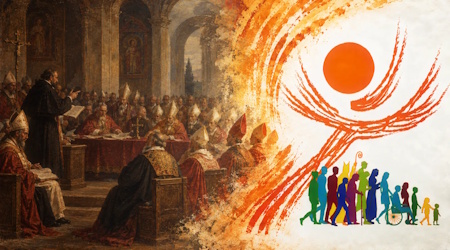
From Synods to "Synodality"...
RETAIN FAITH AND TRADITION
"You will not cast aside the knowledge of the supernatural. You will not cast aside the truth of Faith and set up a faith based on the immorality of man. No! You will retain the Faith and Tradition as given to you, not making changes that cater to the basic carnal nature of mankind. You are misleading Our sheep. Pray! Get down on your knees now and pray! You will gain nothing by socializing." - Our Lady of the Roses, October 6, 1974
"RESTORE MY HOUSE!
My Mother has given you My way. It is a simple road that must be followed. The rules have been given to you that must not be changed, as you cater to the basic carnal nature of man, a generation that has fallen! You will not make changes within My House, for you have dispersed My sheep. You will restore My House to its former glory." - Jesus, December 28, 1976
The above Messages from Our Lady were given to Veronica Lueken at Bayside, New York. Read more
Lepantoin.org reported on October 6, 2026:
For nearly two thousand years, the Catholic Church had synods. What she did not have, at least in anything resembling its present sense, was synodality.
And this is more than a semantic distinction.
A synod is something concrete, namely, an assembly convened for a particular ecclesiastical purpose. The adjective synodal naturally follows, describing something pertaining to such an assembly. But synodality is different; it is an abstract noun, and a remarkably recent one.
The International Theological Commission (a Vatican theological advisory body established by Paul VI) acknowledged as much in its 2018 document, Synodality in the Life and Mission of the Church. It described synodality as a "neologism" that had appeared in theological, canonical, and pastoral literature only "in recent decades," called it a "linguistic novelty" requiring "careful theological clarification," and conceded that synodality is found "neither explicitly as a term nor as a concept" in the teaching of the Second Vatican Council.
That admission presents an immediate puzzle. The same document that identifies synodality as a recent linguistic innovation later describes it as an "essential dimension of the Church," while Pope Francis had already called synodality a "constitutive element of the Church" in 2015. How did a word absent even from Vatican II come, within a few decades, to describe something belonging to the constitution of the Church herself?
Recent scholarship traces the theological use of synodality to the German canonist Klaus Mörsdorf in 1966. His student Eugenio Corecco developed the concept further; by 1977 he was arguing that synodality could not be reduced to an operative practice but constituted an "ontological dimension of the ecclesial constitution." A survey of documents on the Vatican website found the Italian sinodalità appearing for the first time under John Paul II in 1994, in only six of his documents and two of Benedict XVI's. Under Francis, its use accelerated dramatically.
Then came October 17, 2015. Speaking on the fiftieth anniversary of Paul VI's establishment of the Synod of Bishops, Pope Francis declared in his 2015 address that "the path of synodality is the path that God expects from the Church of the third millennium." It was a programmatic statement, and an important chronological marker: Francis articulated his vision of synodality six years before the formal launch of the process that would become the Synod on Synodality.
Three years later, the ITC supplied the concept with an extensive theological framework, describing it as the Church's specific modus vivendi et operandi, the way the People of God lives and acts through the participation of all its members in the Church's life and mission. By 2018, the Commission itself distinguished three levels: synodality as a general way the Church lives and acts, as institutional structures and processes, and only third as particular synodal events.
So, first there was the synod, an assembly. Then synodal, describing what pertained to one. Finally came synodality, an abstract theological category increasingly detached from any particular synodal event and applied instead to the ordinary life, mission, and constitution of the Church.
This does not by itself establish that the development is illegitimate. Theological vocabulary develops, and the age of a word tells us nothing about the truth of the thing it signifies. But it does establish the question that must be answered. The Church did not suddenly discover synods in the twentieth century; she had possessed them from antiquity. What emerged after Vatican II was an abstract principle that gradually came to describe not simply something the Church does, but something the Church is. The question is not why the Church began holding synods. She always did. The question is why, after nearly two thousand years of synods, she came to need "synodality" to explain what constitutes the Church herself.
Before Synodality
If synodality is a new word for an ancient reality, that reality should be easy to identify in the Church's prior teaching. The place to begin is not with synods, but with the Church herself.
Catholic theology has never understood the Church as a collection of passive believers ruled by an ecclesiastical bureaucracy. Every member of the Mystical Body receives supernatural life through Christ, and the faithful believe, worship, profess, and bear witness according to their state. But Catholic theology has never treated the functions of the hierarchy and the faithful as interchangeable. This has long been expressed with two terms: Ecclesia docens, the teaching Church, and Ecclesia discens, the learning Church. The distinction did not divide the Church into two Churches, but rather distinguished functions within one supernatural body. Christ entrusted the apostolic teaching office to the hierarchy, while the faithful received, professed, preserved, and lived the faith taught to them.
This matters for the sensus fidei ("sense of faith"), a genuine supernatural reality, not another name for Catholic public opinion or the accumulated personal experience of the baptized. The term refers to the supernatural capacity by which believers, formed by faith and moved by the Holy Spirit, recognize and adhere to the truth of the faith. When considered as held and manifested by the faithful collectively, it is often called the sensus fidelium ("sense of the faithful"). Even the Catechism, drawing on Lumen Gentium, preserves this structure: the whole body of the faithful cannot err in belief when it manifests universal consent in faith and morals, yet the same passage describes the People of God as "guided by the sacred teaching authority," receiving "the faith, once for all delivered to the saints," adhering to it, penetrating it more deeply, and applying it more fully. The verbs matter. The faith is received, adhered to, penetrated, applied. The sensus fidei does not constitute a second magisterium or a parallel organ of revelation, but rather enables the Church to recognize, from within, the truth she has received.
Two papal acts illustrate the distinction well. In 1849, five years before defining the dogma of the Immaculate Conception, Pius IX issued Ubi Primum, asking the world's bishops to report the devotion and desire of their clergy and faithful for a solemn definition; when he defined the dogma in Ineffabilis Deus in 1854, he pointed back to that worldwide agreement. Nearly a century later, Pius XII followed the same course before defining the Assumption, issuing Deiparae Virginis in 1946 and then, in Munificentissimus Deus, pointing to the extraordinary agreement of bishops and faithful as evidence that the doctrine belonged to the faith of the Church.
But what theological function did those consultations perform? They did not create the doctrines being defined, nor did the popes see themselves as asking the Church collectively to discover what God might now be revealing. They sought evidence of a faith already possessed. Pius XII invokes the governing principle explicitly in Munificentissimus Deus, quoting the First Vatican Council that the Holy Spirit was not promised to Peter's successors so that, by his revelation, they might disclose new doctrine, but so that with his assistance they might guard faithfully and expound the revelation handed down through the Apostles.
The faithful perform a real function here without becoming the source of either revelation or ecclesiastical authority. They receive the faith, recognize it, profess it, and their widespread and enduring adherence can testify powerfully that a doctrine belongs to the faith received and lived throughout the Church. But reception is not constitution. The 2014 ITC study, Sensus Fidei in the Life of the Church, itself places these two Marian definitions together, distinguishing the "concordant teaching" of the bishops from the "concordant faith" of the Christian people. The two realities cooperate; they are not identical.
This provides a clear baseline. The faithful possess a genuine supernatural sense of the faith. Pastors may consult them, even on matters of enormous doctrinal importance, and their agreement can testify to the faith received and lived throughout the Church. But the movement remains fundamentally recognitive, meaning the faithful recognize and bear witness to a faith already received rather than determine what the faith is. The sensus fidei recognizes the faith that has been given; it does not, by itself, supply new revelation, create doctrine, or constitute a second teaching authority. The issue is not whether the hierarchy listens to the faithful; it plainly can and historically has. The issue is what theological function that listening performs. Contemporary synodality does not abandon the sensus fidei; it gives it considerably more work to do.
From Recognition to Discernment
The perennial emphasis, then, is on recognizing and bearing witness to a faith already received. But in the years immediately preceding the rise of synodality as a governing concept, another dimension receives explicit emphasis.
The 2014 ITC document begins conventionally. The sensus fidei is an instinct enabling the faithful to "recognise and endorse authentic Christian doctrine and practice, and to reject what is false." But in paragraph 65, the Commission explains that this instinct enables a believer, confronting new historical and cultural circumstances, to perceive appropriate ways of bearing witness to Christ, and that the sensus fidei fidelis thereby acquires a "prospective dimension." Five paragraphs later, the language broadens further: the sensus fidei is "proactive and interactive," giving the faithful an intuition concerning "the right way forward." The Commission roots this explicitly in "the faith already lived," but the conceptual expansion is significant. The sensus fidei is no longer described only as the capacity to recognize what has been received; it is also assigned a role in discerning where to go next. The Commission's conclusion makes the connection explicit. The faithful can also sense what Pope Francis had already called "new ways for the journey" of the pilgrim people, and bishops and priests need to remain close to the people so that these new ways can be recognized.
One year later, Francis placed the same idea at the heart of his emerging theology of synodality. In his 2015 address, after invoking Vatican II's teaching that the whole body of the faithful cannot err when it manifests universal consensus, which he called the Church's infallibilitas in credendo, he said: "The sensus fidei prevents a rigid separation between an Ecclesia docens and an Ecclesia discens," because the flock possesses "an instinctive ability to discern the new ways that the Lord is revealing to the Church." That claim goes beyond saying ordinary Catholics can recognize whether something accords with the apostolic faith, or that pastors should listen because their people possess useful experience and prudence. It asserts an instinctive capacity to discern new ways the Lord is revealing. Francis connected this directly to his decision to consult the People of God before the two Synods on the Family, while cautioning that consultation alone could never be sufficient to identify the sensus fidei. The sequence, nonetheless, was now visible: the faithful possess the sensus fidei; the sensus fidei can discern new ways revealed by the Lord; therefore, pastors must listen to the faithful.
By 2021, that sequence became the formal architecture of the Synod on Synodality. The Preparatory Document states that bishops are called to discern what the Spirit is saying to the Church "not by themselves but by listening to the People of God," who share in Christ's prophetic office, and describes the synodal Church as one in which the faithful, bishops and Bishop of Rome are "all listening to each other" and to the Holy Spirit, so as to know what he "says to the Churches." The Vademecum makes the mechanism even clearer: the objective is for the entire People of God to listen to what the Spirit is saying, through Scripture and Tradition but also by listening to one another; "the heart of the synodal experience is listening to God through listening to one another."
This is not merely preliminary fact-gathering before the hierarchy exercises its proper authority; it explicitly connects listening to discernment. Nor should it be confused with democracy, a distinction the documents themselves insist upon. The Preparatory Document states expressly that consulting the People of God does not mean importing democratic dynamics of majority rule; synodality occurs within a "hierarchically structured community," and pastors remain the authentic guardians, interpreters, and witnesses of the faith. Francis makes the same point, explaining that a synod is not a parliament, and the Synod of Bishops remains subject to the Bishop of Rome's authority. The more important question, then, is not whether hierarchy survives, but what happens inside the hierarchy's exercise of authority before the final decision is made.
A superior may consult others because he lacks information, or because prudent government requires knowledge of those being governed. None of that makes consultation itself a source for determining what God is saying to the Church. Synodal listening is described differently. The Preparatory Document says the Church's ability to imagine a different future depends largely on "listening, dialogue, and community discernment," and asks what steps "the Spirit" is inviting the Church to take. The object of the listening has expanded. The hierarchy is not simply listening about the faithful but listening to the faithful to discern the Spirit. The hierarchy does not stand outside the Church, and a bishop can certainly learn from the holiness and wisdom of an ordinary Catholic. But once that truth is incorporated into a process for discerning what the Spirit is presently saying, the question is no longer simply whether the teaching Church should listen to the learning Church, but whether reciprocal listening itself participates in determining what the teaching Church is to discern, teach, or do.
In the older examples, consultation helped the hierarchy recognize a faith already present, that is, the object preceded the consultation. In the synodal model, consultation participates in a process whose object is still being discerned. Listening becomes discernment; discernment seeks the voice of the Spirit; and the voice of the faithful becomes one of the places the hierarchy is instructed to listen for it. The hierarchy remains, but the process by which it arrives at judgment has been reconceived.
Constitution and Reception
If the Magisterium is now said to operate in dialogue with the sensus fidelium ("sense of the faithful"), the collective expression of the sensus fidei ("sense of faith"), what is the relationship between the voice that teaches and the voice to which it listens?
The Vademecum states that the bishops, together with the Pope, exercise the Church's authentic teaching authority, but not apart from the People of God; they exercise their office "in dialogue with the sensus fidelium, the living voice of the People of God." Taken alone, that need not imply anything novel; as the Marian consultations show, the faith of the Christian people has long possessed theological significance. But the relationship must be stated precisely: the faith of the Church is not true because the faithful receive it; the faithful receive it because it is true.
The First Vatican Council's Dei Filius describes the faith entrusted to the Church as a divine deposit to be faithfully guarded and declared, rejecting the idea that doctrine can acquire a different meaning merely because human knowledge develops. Development in understanding is possible; reversal is not. Pastor Aeternus makes the corresponding point for papal authority, namely, that the Holy Spirit was promised to Peter's successors not to disclose new doctrine, but to guard and expound faithfully what was already transmitted. Revelation is entrusted to the Church; the Magisterium guards and expounds it; the faithful receive and profess it, and their reception may become strong evidence of the Church's possession of that faith. But reception does not constitute revelation, nor the authority by which revelation is taught.
There is a genuinely traditional sense in which the faithful are a living witness to the faith, since Christianity is preached, believed and lived, not merely archived. But a living witness is not necessarily a living oracle, and the 2014 ITC document itself warns repeatedly that the sensus fidei cannot be identified with majority opinion. Not every baptized person's judgment manifests it; authentic participation presupposes faith, participation in the Church's life, receptivity toward the Magisterium, holiness, humility, and concern for the Church's good. If every opinion counted as the voice of the Spirit, synodal consultation would be theologically meaningless.
The synodal model rejects that. The 2021 Vademecum insists that a synod is not a parliament or a battle between competing interests, and the goal is to discern what the Spirit wants, not what most people want. But if consultation is not a vote, and the views of the baptized cannot automatically be identified with the sensus fidei, someone must discern which voices authentically manifest it. The documents return that responsibility to the pastors, the authentic guardians, interpreters, and witnesses of the faith.
This produces an unusual circularity. The faithful are consulted because their voices may disclose what the Spirit is saying, yet those voices cannot simply be assumed to manifest the sensus fidei. They must themselves be discerned by pastors who are instructed to discern the Spirit by listening to the faithful. That is not logically incoherent; discernment can involve reciprocal evidence and correction. But it does make theological authority harder to locate.
The perennial model is straightforward. The hierarchy teaches the revealed deposit; the faithful receive and recognize it; their reception can witness to its presence, while the hierarchy remains responsible for authoritatively judging its content. The synodal model retains those categories but places them inside a reciprocal process in which the teaching Church listens to the learning Church because the learning Church possesses an instinct for discerning new ways, both listen to one another, and the hierarchy exercises its authority within the results. The distinction between Ecclesia docens and Ecclesia discens has not disappeared, but the movement between them has changed.
Reception can testify to what the Church possesses; it does not constitute what the Church possesses. If "dialogue with the sensus fidelium" means the Magisterium attends carefully to the faith already received and lived, there is no obvious conflict with the traditional model. If it means reciprocal discernment becomes a constitutive means by which the Church discovers what the Spirit is presently directing her to teach or do, the claim is considerably stronger. The difference lies not in whether the faithful have a voice. They always have. It lies in what that voice is now being asked to reveal.
When "Synodality" Becomes Essential
When the ITC described synodality in 2018 as an "essential dimension of the Church," it was not simply renaming the ancient practice of holding synods. The Commission's own three senses make that clear: synodality first denotes a general way the Church lives and acts, second the structures and processes expressing that reality institutionally, and only third particular synodal events. A synod is no longer the primary reality from which synodal is derived; particular synods instead become manifestations of something more fundamental, namely, that the Church herself is synodal. The 2018 document describes synodality as the Church's specific modus vivendi et operandi, manifested as the whole People of God walking together, gathering in assembly, and participating in the Church's mission.
The conceptual chain assembled across the preceding sections can now be stated simply:
- The People of God possess lived experience and the sensus fidei, the supernatural appreciation of the faith.
- This leads to reciprocal listening among the members of the Church.
- Through this dialogue, the community engages in communal discernment.
- Together, they listen for the Holy Spirit guiding their steps.
- This discernment reveals and shapes the Church's path forward.
Once assembled, Francis's claim that synodality is a "constitutive element of the Church" becomes intelligible within the new framework he is establishing. It is constitutive not because the Church happens to convene synods, but because this process of walking, listening, and discerning together is presented as an expression of what the Church fundamentally is.
The Preparatory Document develops the same principle, describing synodality as "the form, the style, and the structure of the Church" and asking how responsibility and power are exercised and through what structures. It later insists that the three levels of synodality must be held together: the ordinary style of ecclesial life, the structures and processes that embody it, and particular synodal events. Without embodiment in structures and processes, synodality risks remaining merely rhetorical.
If synodality were merely an optional pastoral technique, the Church could dispense with it when it is unhelpful. If it is constitutive, however, its institutional realization becomes an ecclesiological imperative, and the question changes from whether the Church should use synodal processes to how adequately her existing structures express her synodal nature. The ITC itself makes the connection explicit, stating that consultation of the laity is "indispensable" for initiating processes of discernment, calling for regular synodal processes at the institutional level, and urging that existing structures be renewed while remaining open to the creation of new ones.
Yet one distinction remains essential. None of these documents formally teaches that ecclesiastical jurisdiction originates in the faithful. The ITC situates synodality within the Church's hierarchical constitution; the episcopate retains its sacramental and governing office, and the Bishop of Rome retains his distinctive primatial authority. The 2021 Preparatory Document likewise presents the apostles as authoritatively mediating the people's relationship to Revelation and warns that removing their distinctive role breaks the relationship with evangelical truth. That qualification should be taken seriously.
But it does not resolve the deeper question, which is not who possesses final juridical authority, but how the Church understands the process through which that authority discerns what ought to be done. A bishop may remain the bishop, and a synodal assembly may remain formally consultative, yet if the exercise of authority is increasingly situated within a constitutive process meant to disclose what the Spirit is saying through the whole People of God, the ecclesiological significance of consultation has changed even where the final signature has not. The synod is now presented as an expression of a deeper synodal principle said to belong to the Church's constitution itself.
That is a much larger claim than the Church has historically made of her synods.
Can the Two Conceptions Be Reconciled?
In several respects, the answer is plainly yes. Nothing contrary to Catholic tradition follows merely from saying the Holy Spirit works throughout the Church, that the faithful possess the sensus fidei, or that the hierarchy may consult the faithful before making judgments, as Pius IX and Pius XII did before two solemn dogmatic definitions. Nor is there anything problematic in speaking of discernment concerning the Church's path forward; the deposit of faith does not change, but the circumstances in which the Church must preach, govern and sanctify certainly do.
However, the object of that discernment must be specified. The Church can certainly discern new pastoral methods, prudential applications, disciplinary changes, and forms of governance appropriate to new circumstances. But these are not all of the same theological order as the revealed deposit itself. Yet the recurring language of discerning "new ways" the Lord is revealing or discovering what the Spirit is presently saying does not always make clear what precisely is being discerned. A new pastoral method is one thing; a new direction in doctrine or morals is another. The question, therefore, is not simply whether the Church may discern where the Spirit is leading her, but what kinds of things can properly remain open to such discernment. Without identifying its object, an appeal to discernment leaves unresolved precisely where the process's limits lie.
The difficulty begins somewhere more precise: when the sensus fidei moves from recognizing and applying the faith already received toward discerning "new ways" the Lord is revealing; when listening to the faithful becomes the means by which pastors discern what the Spirit is saying; when the Magisterium is described as operating "in dialogue with" the living voice of the People of God; and when this reciprocal process is described not merely as useful, but as constitutive of the Church. At that point the question is not whether consultation can coexist with hierarchy. It plainly can. The question is whether reciprocal communal discernment has acquired a theological function that traditional ecclesiology did not assign to it.
That question is harder to set aside once placed beside an older warning. In Pascendi Dominici Gregis, Pius X described and condemned the Modernist conception in which the Church is the product of a "collective conscience," and ecclesiastical authority, rather than coming immediately from God, "emanates vitally from the Church itself." Because authority is understood to arise from the religious consciousness, Pius X explains, it consequently remains dependent upon that consciousness.
The resemblance should not be overstated. Contemporary synodal documents repeatedly affirm the Church's hierarchical constitution, the distinctive authority of bishops, and the primacy of the Bishop of Rome. Identifying the two systems outright would therefore prove too much. But Pascendi is instructive precisely where Pius X turns to the relationship between authority and the religious consciousness of believers. In the Modernist system he describes, individual consciences act upon the collective conscience, which in turn exerts pressure upon ecclesiastical authority. In the doctrinal sphere, Pius X describes a Magisterium whose formulations are expected to correspond to that common consciousness and which, because it ultimately arises from individual consciences, remains dependent upon them. He consequently identifies pressure toward democratic forms and continuing doctrinal evolution as practical consequences of the system.
The point is not that contemporary synodality reproduces the Modernism condemned in Pascendi. It does not make the same claims about the origin of ecclesiastical authority, and its official documents expressly retain hierarchical authority. The relevance of Pascendi is narrower. Pius X had already identified the ecclesiological stakes involved when the religious consciousness of the faithful is assigned a constitutive role in the operation of ecclesiastical authority.
The faithful can witness to the faith without constituting it. They can be consulted without possessing jurisdiction. They can assist pastors without becoming a parallel Magisterium and recognize how the Gospel must be lived under new circumstances without becoming an organ through which new revelation enters the Church. All of that can coexist. What cannot simply be assumed is that it remains unchanged once assembled into a permanent reciprocal process through which the entire People of God seeks together to discern what the Spirit is presently saying and where He is leading the Church.
Perhaps the contemporary theology of synodality can ultimately be interpreted within those limits. But if so, the newer theology must explain precisely: how the sensus fidei can become prospective without becoming revelatory; how the faithful can participate in discerning the Church's direction without acquiring a function proper to the teaching or governing office; how the Magisterium can operate "in dialogue with" the living voice of the People of God while remaining its authoritative interpreter rather than its product; and how a process unknown as a theological category for most of the Church's history can now be called constitutive of the Church without altering what constitutes her.
These are not semantic objections. They concern the location of authority, the function of the sensus fidei, the nature of revelation, and the Church's understanding of herself. Nor can they be settled merely by repeating that synodality is not democracy. The more basic question is what happens before the vote that supposedly is not taking place: how voices are gathered, what theological significance is attributed to them, how they are discerned, and how the resulting discernment enters the exercise of ecclesiastical authority.
That is where an idea becomes an institution.
And to understand what has changed, we must ask a simpler historical question.
Before "synodality," what was a synod?
Be sure to email this page to all your friends.
NO EXCUSE
"There is no excuse accepted now by the Eternal Father among the clergy, who now offend the Eternal Father by misleading the children of God upon earth. The experimentation and changes must be stopped and reversed! There is no other course." - Our Lady, August 4, 1979
 The Virgin Mary's Bayside Prophecy Books are Now Available in E-book Version. Click Here Now!
When you pray the Holy Rosary, you have Our Lady's hand in yours. When you pray the Holy Rosary, you have the power of God in your hands. Start now! Click here...
Our Lady of the Roses Awesome Bayside Prophecies... https://www.tldm.org/Bayside/ These prophecies came from Jesus, Mary, and the saints to Veronica Lueken at Bayside, NY, from 1968 to 1995.
Directives from Heaven... https://www.tldm.org/directives/directives.htm
 PDF
PDFD212 - Changes, Part 2
PDFD545 - Novelty & Experimentation, Part 1
PDFD546 - Novelty & Experimentation, Part 2
PDF