 These Last Days News - October 22, 2026
We encourage everyone to share this web page with others, especially bishops and clergy.
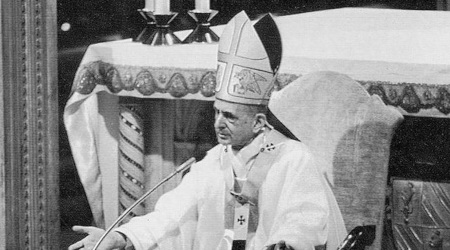
In 1976, Archbishop Bugnini Proposed Authorization of the Traditional Mass. (Impostor) Paul VI Said No.
PLASTIC SURGERY
"My child, I bring to you a sad truth, one that must be made known to mankind .... Our dear beloved Vicar, Pope Paul VI, he suffers much at the hands of those he trusts....
He is not able to do his mission. They have laid him low, My child. He is ill, he is very ill. Now there is one who is ruling in his place, an impostor, created from the minds of the agents of satan. Plastic surgery, My child--the best of surgeons were used to create this impostor.
Shout from the rooftops! He must be exposed and removed. Behind him, My child, there are three who have given themselves to satan. You do not receive the truth in your country and the world. Your Vicar is a prisoner....
Casaroli, you shall condemn your soul to hell! Giovanni Benelli, what road have you taken? You are on the road to hell and damnation! Villot, leader of evil, take yourself from among those traitors; you are not unknown to the Eternal Father." - Our Lady of the Roses, September 27, 1975
TO DISCREDIT
"This impostor, who has been given the image of the Pope, Our Vicar Paul VI, will pose and assume a role of compromise to the world. It is the plan of the evil ones about him ... to discredit your Vicar by placing him in print and photographs in a compromising position to destroy him." - Our Lady of the Roses, April 10, 1976
The above Messages from Our Lady were given to Veronica Lueken at Bayside, New York. Read more
Infovaticana.com reported on October 21, 2026:
[TLDM Editor's note: Our Lady of the Roses warned us in 1975 that Pope Paul VI had been replaced by an impostor. She also revealed that Cardinal Villot was part of the plot to replace Pope Paul.]
In the summer of 1976, while priests were being ordained in Écône against Rome's express prohibition, the man whom half the traditional Church pointed to as the great demolisher of the old Mass was heading the pontifical representation in Tehran. From there he wrote to the Secretariat of State proposing something that still surprises today: that the traditional Mass be authorized again, with conditions, to defuse the conflict with Archbishop Lefebvre.
The episode is reconstructed by French historian Yves Chiron in Annibale Bugnini. Reformador de la liturgia, a biography published in France in 2016 that Homo Legens has just released in Spanish. According to its author, it is the first work entirely devoted to the Vincentian religious who directed the post-conciliar liturgical reform. Chiron draws, among other sources, on the autobiographical memoirs that Annibale Bugnini finished writing in Iran in 1977 and that were not published until 2012, on the centenary of his birth.
Homo Legens
To understand the scene, one must recall how Bugnini came to Persia. In July 1975, after more than a decade as secretary of the Consilium and then of the Congregation for Divine Worship, he was abruptly removed when Paul VI merged that dicastery with the one for the Sacraments. According to the author, he rejected a first posting as nuncio to Uruguay, arguing that he did not speak Spanish, and in January 1976 he accepted being sent to Iran, where the diplomatic language was French.
Meanwhile, the standoff between Rome and Écône was hardening. On 29 June 1976 Lefebvre ordained thirteen priests despite the prohibition he had received, and on 22 July the Holy See imposed suspension a divinis on him. At the beginning of that month, Chiron recounts, the Secretary of State, Cardinal Jean Villot, had sent all nunciatures a thick dossier on the case. Bugnini read it in Tehran and replied with a revealing letter: he considered Lefebvre an obstinate man, and his collaborators even more harmful, yet he advised continuing with patience, exhortation and prayer, and avoiding at all costs a rupture that would make any return far more difficult. The sanction, however, had already been decided.
The most striking development came in September. Cardinal Sergio Pignedoli, on his way to Japan, stopped in Tehran to visit his friend. Chiron maintains that it was not merely a gesture of friendship: Paul VI wanted to convey a sign of affection to the collaborator he had been forced to remove a year earlier, and he would hint as much to Bugnini himself during an audience in March 1977. In those conversations the Lefebvre case arose, and Pignedoli encouraged the nuncio to pass on to Rome the idea that was on his mind.
Bugnini wrote again to Villot. His proposal, as the book summarizes it, consisted of four commitments. Lefebvre had to declare that the new Mass was neither heretical nor Protestant, and that neither were those who had prepared and approved it. In return, the ordinary of the 1962 Missal would be used, though with the readings of the new lectionary, in the vernacular and from an ambo facing the faithful. The old Mass would be celebrated in designated churches and at fixed times, or for groups that had difficulty adapting to the new rite, and its application would remain under the pastoral care of the diocesan bishop. The man who had led the reform was sketching, years in advance, something very much like an indult regime.
The reply came at the beginning of October through Villot. The Pope, he conveyed, did not consider it opportune to grant then what had been refused in the past, so as not to aggravate confusion and unrest or diminish the Holy See's credibility. "The door closed by Paul VI would be reopened by John Paul II," writes Chiron, who later recalls the 1984 indult, the 1988 motu proprio and the Summorum Pontificum of Benedict XVI in 2007.
The episode does not rehabilitate Bugnini or turn him into what he was not. Chiron maintains that the reform he prepared went beyond what the Council had foreseen, and he does not spare the reader severe judgments from those who worked alongside him, such as that of Cardinal Antonelli, who reproached him for a grave lack of theological formation. Yet the letter from Tehran complicates the caricature: the man responsible for replacing the old ordinary of the Mass was also the one who, from his exile, imagined a formula for both rites to coexist without breaking communion.
Half a century later, with the traditional Mass and the Priestly Fraternity of Saint Pius X once again at the center of ecclesial conversation, that letter is read with different eyes.
The biography covers the rest of his career: the "paraphrased" Mass that Bugnini rehearsed with large placards in a shantytown on the outskirts of Rome, his removal on the eve of the Council, the method with which he prepared the constitution on the liturgy, his fall in 1975 and the accusation of belonging to Freemasonry, which the author examines with sources in hand. And it leaves open the question with which the book closes: whether Bugnini truly loved and served the liturgy, as he wished his epitaph to say, or contributed to what Cardinal Ratzinger called its disintegration.
Be sure to email this page to all your friends.
IMPERSONATES
"Yes, it is a fact and a truth that there is another who impersonates him and goes about having photographs taken. And there is a voice that comes out upon your air waves, a very good imitation of your Holy Father. It is all the master deception created by the evil forces that are seeking to destroy your Faith, My child." - Our Lady of the Roses, March 18, 1977
PEN OF BENELLI, VILLOT
"You cannot accept now what comes from Rome, for they do not come - these bulls and these directions are not written by the pen of Pope Paul VI. They are written by the pen of Benelli and Villot." - Our Lady of the Roses, September 27, 1975
 The Virgin Mary's Bayside Prophecy Books are Now Available in E-book Version. Click Here Now!
When you pray the Holy Rosary, you have Our Lady's hand in yours. When you pray the Holy Rosary, you have the power of God in your hands. Start now! Click here...
Our Lady of the Roses Awesome Bayside Prophecies... https://www.tldm.org/Bayside/ These prophecies came from Jesus, Mary, and the saints to Veronica Lueken at Bayside, NY, from 1968 to 1995.
Directives from Heaven... https://www.tldm.org/directives/directives.htm
 PDF
D50 - The Impostor Pope
PDFD129 - Third Secret of Fatima Explained: Part 1 - 666 in Rome
PDFD130 - Third Secret of Fatima Explained: Part 2 - Satan entered the Church in 1972
PDFD131 - Third Secret of Fatima Explained: Part 3 - Satan entered the highest realms of the hierarchy
PDFD132 - Third Secret of Fatima Explained: Part 4 - There shall be bishop against bishop and cardinal against cardinal, as satan has set himself in their midst.
PDFD133 - Third Secret of Fatima Explained: Part 5 - The Apocalypse / Revelations
PDF