 These Last Days News - November 11, 2026
We encourage everyone to share this web page with others, especially bishops and clergy.
Only 29% of American Catholics Believe in the Real Presence: Questions About Eucharistic Renewal...
PENANCE, ATONEMENT, ACTS OF LOVE
"Penance, atonement, and acts of love We cry for. My Mother gives you the plan for your salvation. Remember--the day will come when you will remember this, when you will be tried and found wanting, or ready for the jubilant entrance into My Kingdom! Keep your thoughts on this, My children. It will all be yours." - Jesus, May 30, 1971
"PERSEVERE IN THE DAYS AHEAD"
"When a soul is lost, he will have been lost of his own free will. Graces are given to you in abundance. Should you cast them aside or refuse to accept them in your blindness, you shall fall fast into darkness and go onto the wide road to your destruction. Pray a constant vigilance of atonement.
We have asked for recognition among mankind. The Message from Heaven has been given to many seers upon your earth. This message has been cast aside by many. Many shall be called before the final count, but only a few shall be chosen. This decision is yours.
The time for preparation grows short. The time of trial is upon you. Your world shall see and experience a crucible of great suffering and trial.
My Mother has wandered throughout your world preparing you that you may go through this crucible without a loss of faith and hope. Keep a constant vigilance in your homes and upon your earth and you will be given the way. Persevere in the days ahead and you will win your crown." - Jesus, December 28, 1974
The above Messages from Our Lady were given to Veronica Lueken at Bayside, New York. Read more
Zenit.org reported on November 10, 2026:
by Tim Daniels
Three years of nationwide efforts to rekindle devotion to the Eucharist have left the US Catholic Church facing an uncomfortable question: how deeply do Catholics actually believe in the central mystery of their faith? A new academic study suggests that, despite an ambitious campaign led by the bishops and a major national Eucharistic Congress, belief that the bread and wine become the Body and Blood of Christ remains strikingly low.
According to research by sociologists Brad Vermurlen, Mark Regnerus and Anne Morse, published in the 2026 edition of Sociological Inquiry, only 29% of self-identified American Catholics affirm the Church's teaching on the Real Presence. The findings, presented by Regnerus on 3 November, are virtually unchanged from a 2019 Pew Research Center survey, which recorded 31%. The difference is not statistically significant.
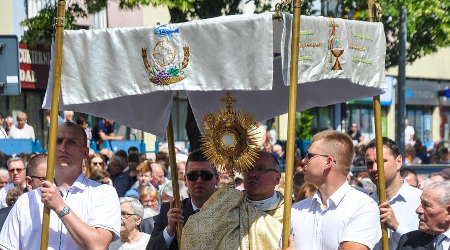
The results are particularly noteworthy because they follow the National Eucharistic Revival, the initiative launched by the United States Conference of Catholic Bishops between 2022 and 2025 to strengthen understanding and devotion to the Eucharist. Its most visible moment came in July 2024, when approximately 50,000 people gathered in Indianapolis for the first National Eucharistic Congress in 83 years. The new research does not measure the campaign's direct impact, but it offers a snapshot of Catholic belief after its conclusion — and gives little indication of a broad change in the figures.

The researchers surveyed just over 1,000 Catholics drawn from a representative September 2025 study of 5,400 American adults conducted through Ipsos's KnowledgePanel. Their approach differed from earlier surveys by offering three possible answers: that the bread and wine become Christ's Body and Blood, that they are merely symbols, or that respondents were unsure. Regnerus noted that for every participant who expressed uncertainty, almost six chose the symbolic interpretation.
The figures also reveal a pronounced connection between belief and religious practice. Among Catholics who attend Mass every week, approximately 60% affirm the Real Presence; among the most regular churchgoers, the proportion approaches 70%. It rises to 88% among those who attend weekly, regard faith as the most important part of their lives and had attended Mass the previous weekend. By contrast, income, sex, age, race, geographical region and political ideology made little difference. Religious commitment was the strongest indicator, although it explained only about a quarter of the variation in responses.
Regnerus pointed out that the problem is not new: a 1992 Gallup survey found that just 30% agreed with a comparable statement. He therefore interprets the figures less as evidence of a conscious rejection of Catholic doctrine than as a symptom of wider disengagement from religious life. His proposed response is straightforward: evangelisation, clarity and explanation, with priests teaching the Eucharistic doctrine without ambiguity.
The findings nevertheless sit uneasily alongside a more optimistic assessment published by the bishops' conference on 15 January. Based on research by Vinea Research involving approximately 2,500 lay Catholics, clergy and Church personnel, that report indicated belief levels above 90% in all three groups. The two studies, however, cannot be treated as directly comparable. The Vinea survey focused largely on committed Catholics and included Church personnel, whereas the new research sought a representative sample of self-identified Catholics, including those less closely connected to parish life. The bishops' own assessment had also acknowledged the difficulty of reaching younger people and those distant from the Church.
The disparity highlights a persistent problem in Catholic pastoral strategy: measuring the faith of active parishioners is not the same as understanding what the wider Catholic population believes. A successful congress, large processions and strong participation among practising Catholics can demonstrate genuine enthusiasm without necessarily reaching those whose connection to the Church has become nominal.
The study has also reopened a debate about the way the Eucharist is celebrated. Traditionalist theologian and liturgist Peter Kwasniewski described the findings as evidence that the multimillion-dollar revival had failed. He argued that the problem cannot be addressed through catechesis alone while elements of the liturgy that visibly express the sacred character of the Eucharist and encourage adoration remain diminished or absent in the modern liturgical practice. In his view, this is the unresolved issue that Church leaders must confront.
That argument, however, goes beyond what the researchers established. The study does not examine the influence of liturgical forms, nor does it attribute the low level of belief to changes in the celebration of Mass. Kwasniewski's criticism should therefore be understood as a theological and liturgical interpretation of the figures, not as a conclusion drawn by the authors.
What the research does establish is that the Eucharistic question cannot be reduced to a communications problem or solved simply by organising occasional large-scale events. Catholic teaching holds that the Eucharist is not merely a symbolic reminder of Christ but Christ himself, truly present under the appearances of bread and wine. This doctrine, rooted in the Church's understanding of the Last Supper and expressed through the liturgy, is fundamental to Catholic identity.
If seven out of ten Catholics do not affirm that teaching, the challenge reaches well beyond a single pastoral initiative. It concerns the transmission of the faith, the formation of children and young people, the quality of preaching and the ability of parishes to explain what happens at the altar. The Indianapolis Congress may have renewed enthusiasm among many participants, but the figures suggest that the deeper task remains unfinished: helping Catholics understand not simply what the Church does at Mass, but what it believes is taking place there.
Be sure to email this page to all your friends.
IMMORTALITY OF THE SOUL
"My child, in counseling others you must stress the immortality of the soul. There are many false witnesses who do not believe any longer in hell and purgatory.
There is no death of the soul. There is life immediately after physical death--life beyond the veil, be it Heaven, the Kingdom of your God, purgatory, or banishment forever in hell, the abode of the damned.
The false theory of the non-existence of life after death is only proposed to bring about the fall of man. For if man believes there is no life, he will disport himself in all manner of sin and abominations. There is discipline from the beginning of time asked, and there are rules to be followed, My children. It is the way of Heaven, but it is a simple way." - Jesus, June 9, 1979
 The Virgin Mary's Bayside Prophecy Books are Now Available in E-book Version. Click Here Now!
When you pray the Holy Rosary, you have Our Lady's hand in yours. When you pray the Holy Rosary, you have the power of God in your hands. Start now! Click here...
Our Lady of the Roses Awesome Bayside Prophecies... https://www.tldm.org/Bayside/ These prophecies came from Jesus, Mary, and the saints to Veronica Lueken at Bayside, NY, from 1968 to 1995.
Directives from Heaven... https://www.tldm.org/directives/directives.htm
 PDF
D325 - A Flicker of Faith
PDFD326 - Divine Intervention
PDFD327 - Time is Running Out
PDFD449 - The Greatest Trials
PDFD450 - Kingdom of Satan
PDFD451 - Visions of Hell, Part 1
PDFD452 - Visions of Hell, Part 2
PDFD453 - Reality of Hell
PDFD454 - Loss of Faith
PDFD449 - The Greatest Trials
PDFD450 - Kingdom of Satan
PDFD451 - Visions of Hell, Part 1
PDFD452 - Visions of Hell, Part 2
PDFD453 - Reality of Hell
PDFD454 - Loss of Faith
PDF