 These Last Days News - August 31, 2026
We encourage everyone to share this web page with others, especially bishops and clergy.
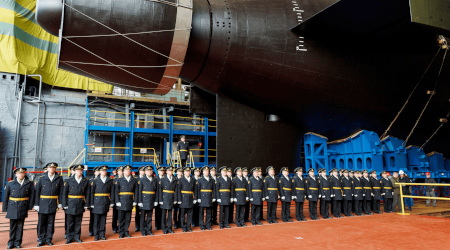
Russia Launches ‘Doomsday Submarine’ Carrying Nuclear Poseidon Weapons Capable of ‘Unleashing Tsunamis’...
MASTER PLAN OF TAKEOVER
"Do not take lightly the reports of ships out on the sea and submarines. They are there, My child and My children, and they are not out for a joy ride. It is all part of the master plan for the takeover of the United States and Canada.
I know, I heard the voice also, My child, that said that the United States shall be taken over without a shot to ring out. That is not true, My children. Should they advance upon you as they plan, there will be bloodshed in the streets, blood flowing and mother's hearts breaking in sorrow. Oh, how they will gnash their teeth and cry bitter tears of regret that they did not foresee or listen to the voices from Heaven crying out: Prepare now, for you do not have much longer to exist as a free nation.
My child and My children, I could go back through the years and remember how many times I came upon earth to try to warn you. Those nations that listened were free from harm. But they had to pray the Rosary--the Rosary and the Scapular." - Our Lady of the Roses, April 14, 1984
The above Messages from Our Lady were given to Veronica Lueken at Bayside, New York. Read more
Slaynews.com reported on August 31, 2026:
by Frank Bergman
Russian President Vladimir Putin’s terrifying new nuclear "doomsday submarine" has reportedly been put to sea for the first time, carrying weapons designed to potentially unleash radioactive tsunamis against enemy coastlines.
The Kremlin quietly sent the 10,000-ton Khabarovsk nuclear submarine into sea trials in the White Sea last week.
The vessel has been specifically designed to carry as many as six Poseidon nuclear-powered torpedoes alongside conventional anti-ship and land-attack missiles.
Poseidon has been described by former Russian President Dmitry Medvedev as a genuine "doomsday weapon."
The deployment comes as Kremlin propagandists openly call for Putin to unleash the weapon against Britain.
Russian State TV Threatens to ‘Hit’ Britain with Poseidon
The Poseidon torpedo is unlike a conventional nuclear missile.
The massive underwater weapon is reportedly between 65 and 80 feet long, approximately 6.5 feet in diameter, and capable of traveling more than 6,000 miles.
It is also said to be capable of diving to depths of approximately 3,280 feet.
The weapon’s most chilling potential use involves detonating its nuclear warhead underwater near an enemy coastline.
Analysts say such a blast could potentially generate a massive radioactive surge toward shore, devastating coastal cities and contaminating surrounding areas.
Russian propagandists have repeatedly seized on that scenario to threaten Western nations.
In recent days, prominent Kremlin voices have demanded retaliation against Britain over its decision to provide Ukraine with drones subsequently used to strike Russian territory.
Russian state television presenter Vladimir Solovyov issued an extraordinary threat against the UK.
"Give the British three days to learn to breathe underwater, then hit them with Poseidon," Solovyov said.
Russian media figures have previously boasted that Poseidon could "drown Britain."
Western analysts have cautioned that some of those apocalyptic claims are likely exaggerated and that the feasibility of creating a continent-spanning radioactive tsunami remains uncertain.
However, the weapon was deliberately conceived to create precisely that kind of nuclear terror.
Putin Claims ‘There Is No Way to Intercept It’
Putin has personally touted Poseidon as a weapon without an equivalent anywhere else in the world.
Earlier this year, the Russian leader confirmed that the system had been tested after being launched from a submarine and activating its onboard nuclear reactor.
"There is nothing like this," Putin told military officials last year.
"There is no way to intercept it."
Putin’s assertion that Poseidon cannot be intercepted has not been independently verified.
Nevertheless, the system was developed in response to the United States withdrawing from the Anti-Ballistic Missile Treaty in 2002.
Its purpose is to provide Russia with another means of delivering catastrophic nuclear retaliation even against an adversary protected by increasingly sophisticated missile defenses.
The weapon is designed to travel underwater rather than follow the trajectory of a conventional ballistic missile.
That potentially gives Russia another route around traditional missile-defense systems.
And even if Poseidon cannot produce every apocalyptic effect described by Kremlin propagandists, an underwater nuclear detonation near a populated coastline could still have devastating consequences.
Coastal infrastructure could be destroyed, harbors contaminated, and surrounding areas exposed to radioactive material.
Experts Warn Russia Would Face Devastating Nuclear Retaliation
Despite the threats coming from Russian television, defense experts believe Putin would be extremely unlikely to actually deploy Poseidon against Britain except in the most catastrophic circumstances.
Dr. Richard Connolly, an expert on Russian defense policy and associate fellow at the Royal United Services Institute, described Poseidon as a specialized weapon intended for an extreme scenario.
"Poseidon is what you might call a boutique capability," Connolly said.
"They are not making it in large numbers, and it’s been designed for the very worst of scenarios."
He warned that any Russian nuclear attack against Britain would trigger the threat of devastating retaliation from the UK’s Trident nuclear deterrent.
"If they were to do what the Russian TV presenters are proposing, they’d face retaliation from Britain’s Trident nuclear deterrent," Connolly said.
"So they wouldn’t do it, because they know they’d pay a price."
That deterrence calculation remains the central barrier preventing nuclear threats from becoming nuclear war.
But Khabarovsk’s first trip to sea means the Kremlin is moving closer to having another operational system capable of delivering its nuclear arsenal.
Russia’s $1 Billion Nuclear Monster Heads to Sea
The Khabarovsk reportedly cost approximately $1 billion to build and displaces around 10,000 tons.
Russian Defense Minister Andrei Belousov previously celebrated the submarine as a major expansion of Moscow’s underwater military capabilities.
"The heavy nuclear-powered missile cruiser Khabarovsk is being launched from the renowned Sevmash shipyard," Belousov said.
"Carrying underwater weapons and robotic systems, it will enable us to successfully secure Russia’s maritime borders and protect its national interests in various parts of the world’s oceans."
The submarine has now quietly moved from the shipyard into sea trials.
For years, Poseidon has existed largely as one of the Kremlin’s most ominous nuclear threats.
The weapon is surrounded by propaganda, extraordinary claims, and warnings of radioactive waves crashing into Western cities.
Now the submarine built to carry up to six of the weapons has reportedly gone to sea for the first time.
And as Moscow’s propagandists openly fantasize about using Poseidon against Britain, Russia’s newest nuclear threat is moving another step closer to operational reality.
Be sure to email this page to all your friends.
"Russia has but one plan: to capture the whole world. They will do this without heart or conscience. Therefore, know that I ask you again, as your God in the Trinity, I ask you to contact the Holy Father—through pen or prose, or the written script—to contact the Holy Father and beg him to consecrate Russia to the Immaculate Heart of My Mother. This has not been done, My children." - Jesus, May 17, 1986
ELIMINATION OF NATIONS
"Sin is insanity, and this insanity shall set in motion the elimination of many nations upon your earth. My Mother has cried in the past for you to pray and do penance, or Russia would send her errors throughout the world." - Jesus, May 13, 1978
 The Virgin Mary's Bayside Prophecy Books are Now Available in E-book Version. Click Here Now!
When you pray the Holy Rosary, you have Our Lady's hand in yours. When you pray the Holy Rosary, you have the power of God in your hands. Start now! Click here...
Our Lady of the Roses Awesome Bayside Prophecies... https://www.tldm.org/Bayside/ These prophecies came from Jesus, Mary, and the saints to Veronica Lueken at Bayside, NY, from 1968 to 1995.
Directives from Heaven... https://www.tldm.org/directives/directives.htm
 PDF
PDFD101 - Russia and China, Part 1
PDFD102 - Russia and China, Part 2
PDFD103 - Communism
PDFD104 - Invasion
PDFD136 - Visions of the Great War: The Mideast
PDFD137 - Visions of the Great War: Russia and China
PDFD156 - Terrorism
PDFD283 - The Deceit of Russia
PDF