 These Last Days News - August 24, 2026
We encourage everyone to share this web page with others, especially bishops and clergy.
The Nuns Who Pretend to Concelebrate Mass...
"Already We hear you clamor for the ordination of woman. No woman shall stand in My House to represent Me! How dare you bring in this heresy to My House! I shall go among you and I shall sling you out from My temples!" - Jesus, December 27, 1975
OUT OF THE WORLD
"The road to Heaven, my sisters, is a narrow one and not difficult to follow unless you choose to turn away. Even a short duration in the world will soil your soul. You must not, my sisters, give yourselves to the world in thought or deed or dress. Your example must be as one as Our Lady is dressed--a long habit that reaches to the ground.
When you, my children, and sisters, discard a proper attire--dress and habit--you do much destruction to your order, to your vocation, for you no longer are an example of purity and commanding respect. You do not receive respect. You are a scandal to your vocation, my sisters! You must not be obedient to the cry of the serpent. The rule must be followed within the convents. My sisters, you will gain nothing by leaving and going into the world. It is a deception of Satan to destroy your vocation and true purpose as brides of Christ. Come out of the darkness, my sisters!" - St. Theresa, October 2, 1975
"When I had the Last Supper with the Apostles, My Mother was not present. If I had it in My power from the Eternal Father to make a priestess, I would surely have chosen My Mother; but, no, there were no women present at the first Dedication." - Jesus, October 2, 1987
The above Messages from Our Lady were given to Veronica Lueken at Bayside, New York. Read more
Infovaticana.com reported on August 20, 2026:
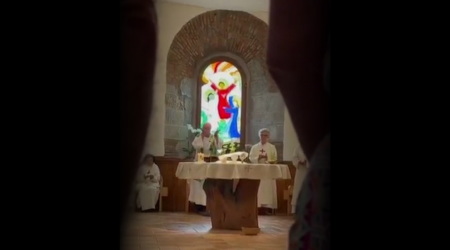
A video accessed by InfoVaticana shows how, at the Trinitarian monastery of Suesa (Cantabria), the community of nuns surrounds the altar with hands extended during the Eucharistic Prayer while the celebrant alters the words of consecration: he feminizes them, replaces "for many" with "for all humanity," and substitutes the Lord’s command—"Do this in memory of me"—with a formula of his own making. This is not an isolated episode: the community itself has spent years theorizing and teaching this manner of celebration, with the endorsement of diocesan institutions. All of this is taking place in the diocese governed by Bishop Arturo Ros Murgadas.
In the footage, recorded in the church of the Monastery of the Most Holy Trinity in Suesa (Ribamontán al Mar, Diocese of Santander), the priest does not occupy any place of prominence. The nuns, arranged in a circle around the altar, extend their hands during the Eucharistic Prayer in the epiclesis gesture reserved for the concelebrating priest. The visual effect is unmistakable: a simulated concelebration in which the ordained minister is dissolved into the assembly.
Moreover, the celebrant does not take the bread or the chalice in his hands when pronouncing the words of consecration, as the Roman Missal prescribes. Over the bread he says: "Take and eat of it, all of you." And over the chalice, this is the formula the video records verbatim:
"In the same way, when supper was ended, he took the chalice, and once more giving you thanks, he passed it to them, saying: Take and drink of it, all of you, for this is the chalice of my blood, the blood of the new and eternal covenant, which will be poured out for you and for all humanity for the forgiveness of sins. Do this to remember that I am in your midst as one who serves."
Four alterations in a single formula
Comparison with the text of the Roman Missal reveals at least four deliberate manipulations.
The first is the feminization of the Lord’s words—"all of you" (feminine), "for you" (feminine)—which redirects to the present assembly, a female community, what Christ pronounced at the institution of the Eucharist concerning the Apostles.
The second is the substitution of pro multis ("for many") with "all humanity," a translation the Holy See expressly corrected: in 2006 the Congregation for Divine Worship ordered the recovery of fidelity to the biblical text, and in 2012 Benedict XVI dedicated a letter to the German episcopate explaining why "for many" is non-negotiable.
The third is the alteration of the institution narrative: where the Missal states that "he gave it to his disciples," the celebrant says "he passed it to them," erasing from the account the disciples—the Twelve, to whom the Lord conferred the priesthood at that very Supper—and suggesting a chalice circulating horizontally through the assembly.
And the fourth, the most striking: the suppression of the command "Do this in memory of me," replaced by "do this to remember that I am in your midst as one who serves," an insertion taken from Luke 22:27 that shifts the sacrificial memorial of the Eucharist toward a purely diaconal and communal reading. This is no nuance: the command of remembrance is precisely the foundation of ministerial priesthood and of the sacramental renewal of the sacrifice. Removing it from the institution narrative, in a celebration whose staging already blurs the priest, is consistent with everything else.
Canon 846 §1 of the Code of Canon Law is unequivocal: no one may add, remove, or change anything on his own initiative in the liturgical books. The Instruction Redemptionis Sacramentum (2004) classifies the alteration of Eucharistic Prayers as a most grave abuse (n. 59) and expressly prohibits the lay faithful—and religious women are counted as such for these purposes—from adopting gestures proper to the celebrating priest, precisely to avoid any appearance of concelebration (nn. 52-53; cf. Ecclesiae de mysterio, art. 6).
It is not a whim: it is a program
What the video shows will not surprise anyone who has followed the public trajectory of this community. In October 2022, a group of scouts from Biscay who spent a weekend retreat at the monastery published an enthusiastic chronicle in which they described, without noting any problem, exactly the same thing: "a circular monastic choir, without hierarchical spaces," "a female community forming an open circumference," and the "use of inclusive language" at the Masses.
The community itself theorizes this openly. In 2016 they organized the workshop "The Gesture in the Liturgy" at the monastery, disseminated through the progressive bulletin Eclesalia, whose announcement—signed by the community—declared: "The time when liturgy was left solely in the hands of the presbyterate is coming to an end" and invited participants "to dare with other gestures, other symbols," including "communal dance as Jesus himself did." The workshop was coordinated by Jesuit Carlos del Valle together with an instructor of "contemplative dance." The monastery’s website maintains a section dedicated to these circular dances, with YouTube videos, which are practiced in a prayerful context.
Even more striking is the institutional endorsement. The Diocesan Institute of Theology and Pastoral Ministry (IDTP) of the Diocese of Bilbao offers the course "The Frameworks of the Liturgy: Creativity and Fidelity," whose stated objective is that communities may "be creative and explore the limits of the liturgical canon." The session dedicated to "the participation of the community in the liturgy" is "facilitated by the community of Trinitarian nuns of Suesa." In other words, the community not only celebrates in this way but also trains pastoral agents in this understanding of the liturgy, under the umbrella of a diocesan institute.
"Descending from the patriarchal mentality"
The ideological substrate is no secret either. In June 2022, on the occasion of the Pro Orantibus Day, the community set out in Religión Digital its contributions to the Synod: they denounced a Church that is "pyramidal and hierarchical, where norms come from above," called for "descending from the patriarchal mentality to live in the horizontality of relations among equals," and maintained that women’s participation "on equal terms in the Catholic Church is a structural question, not a secondary reform." They asked the Dicastery for Institutes of Consecrated Life "to let the nuns think, not to have criteria imposed on them from above."
The aesthetics accompany the discourse: the nuns retain the Trinitarian habit with its cross, but have dispensed with the veil, giving them an ambiguously clerical appearance—closer to that of a presbyter with a Roman collar than to that of a contemplative nun—consistent with the staging of the circle around the altar. Televisión Española devoted a report to them on the program Pueblo de Dios whose title says it all: "Suesa, in feminine and plural."
The responsibility of Bishop Arturo Ros
All of this is occurring in the Diocese of Santander, already shaken by the Torrelavega scandal, and whose bishop since December 2023 is Bishop Arturo Pablo Ros Murgadas, appointed by Pope Francis after his time as auxiliary of Valencia. The Monastery of Suesa, founded in 1860 and canonically erected in 1887 by Bishop Sánchez de Castro, falls under the vigilance of the local ordinary with regard to sacred liturgy: canon 392 §2 obliges the diocesan bishop to ensure "that abuses do not creep into ecclesiastical discipline, especially concerning the ministry of the word and the celebration of the sacraments," without prejudice to the competencies of the Trinitarian Order and the Dicastery for Divine Worship.
The monastery church is open to the public, with Sunday Eucharist at 9 a.m. The questions for the bishop’s office are concrete: Does Bishop Ros know the manner in which Mass is celebrated in Suesa? Is he aware that the formula of consecration is systematically altered? Does he know that this community of his diocese acts as a liturgical formator in the neighboring Diocese of Bilbao? And, if he does know, what measures has he taken?
Redemptionis Sacramentum recalls that any member of the faithful has the right to report liturgical abuses to the diocesan bishop or directly to the Apostolic See (nn. 183-184). This newspaper has been able to verify that the practices described are not the result of a day’s improvisation, but of a celebratory program that has been assumed, theorized, and exported. The question, once again, is who watches and who remains silent.
Be sure to email this page to all your friends.
HOW DARE YOU
"No woman shall stand in the Sacrifice as a priest. How dare you set yourselves for a change created by satan!" Our Lady of the Roses, March 18, 1976"
WOMAN'S GLORY
"Woman, who has come from Adam, would regain her glory by childbearing. This, too, has she cast aside for the ways of darkness." Our Lady of the Roses, March 24, 1974"
 The Virgin Mary's Bayside Prophecy Books are Now Available in E-book Version. Click Here Now!
When you pray the Holy Rosary, you have Our Lady's hand in yours. When you pray the Holy Rosary, you have the power of God in your hands. Start now! Click here...
Our Lady of the Roses Awesome Bayside Prophecies... https://www.tldm.org/Bayside/ These prophecies came from Jesus, Mary, and the saints to Veronica Lueken at Bayside, NY, from 1968 to 1995.
Directives from Heaven... https://www.tldm.org/directives/directives.htm
 PDF
PDFD35 - Nuns
PDFD127 - Vatican II
PDFD173 - Women Priests
PDFD178 - Head Coverings
PDFD179 - Women's Liberation
PDFD211 - Changes, Part 1
PDFD212 - Changes, Part 2
PDFD248 - Man's Authority
PDFD378 - The Convents, Part 1
PDFD379 - The Convents, Part 2
PDF