 These Last Days News - October 13, 2026
We encourage everyone to share this web page with others, especially bishops and clergy.
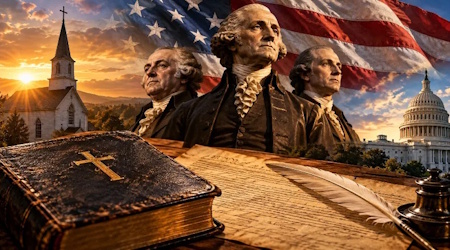
The Republic Stands Only as Long as Its Christian Foundation Holds...
WHEN TEACHINGS TURN FROM GOD TO MAN…
"Learn a simple lesson from the past, My children. When the morals of a country start to go down into darkness, and the teachings turn from God to man, that country will soon be ended. First the spiritual life and then the material life of your country shall be destroyed." - Jesus, October 2, l976
AMERICA FAST BECOMING RULED BY A COMMUNIST STATE
My Mother has counseled you well to prepare your household. As parents, as human beings created by your God, you have become as a nation degenerate in your seekings and godless in your rule until the saints in Heaven cry out for all Heaven to stop the abominations being committed now upon earth. Your country is fast becoming ruled by a communist state. Is this what you will permit? Enslavement of your children? Every indication is given that you have become lax and blindly proceed onto your own destruction." - Jesus, September 14, 1979
The above Messages from Our Lady were given to Veronica Lueken at Bayside, New York. Read more
Jdrucker.Substack.com reported on October 13, 2026:
The United States is a Christian nation that has always allowed the free practice of any religion. History is clear to anyone without an agenda. The people who wrote the founding documents, the state constitutions, and the early laws were overwhelmingly Christian. They built a system that refused to establish a national church while protecting the free exercise of faith. This was to protect the church from the state, not the state from the church.
The moment that Christian character is stripped away, the liberty that came with it does not remain as a free-floating secular gift. It erodes. Our adversaries understand this. That is why they work so hard to rewrite the founding, empty the public square of any Christian reference, and treat the original arrangement as an accident they have finally corrected.
A common misconception, even among conservatives and Christians, is that the Bill of Rights grants us our freedoms. The name itself is misleading. It should have been called the Bill of Restrictions on Government. Our rights are endowed by our Creator. The "Bill of Rights" is designed to prohibit government from taking away those rights.
The Supreme Court was unambiguous in 1892. In Church of the Holy Trinity v. United States, a unanimous Court held that a federal ban on importing contract labor did not apply when a New York church hired a minister from England. Justice David Brewer did not pretend the statute’s literal words were unclear. He simply refused to read them against the nation’s actual character.
After surveying colonial charters, the Mayflower Compact, early state constitutions, oaths of office, and the ordinary customs of the people, he wrote that the accumulated evidence showed "this is a Christian nation." The Western Journal later noted that the Court treated that Christian identity as decisive. A legislature representing a religious people would not have intended to make it harder for a church to hire a pastor. The decision stands as a clear judicial acknowledgment of what the country was.
The Founders Were Not Confused About the Foundation
John Adams made the practical point without poetry. Addressing the Massachusetts militia in 1798, he said, "Our Constitution was made only for a moral and religious people. It is wholly inadequate to the government of any other."
Townhall has returned to that warning more than once. Adams understood that limited government only works when the people restrain themselves. When the moral grammar supplied by Christianity is removed, the remaining constitutional structure cannot contain the passions it was never designed to police alone. He made the same claim in other letters. The general principles on which independence was won, he told Jefferson, were the general principles of Christianity.
John Jay, the first Chief Justice, was equally direct. In 1816 he wrote that Providence had given Americans the choice of their rulers, "and it is the duty, as well as the privilege and interest, of our Christian nation to select and prefer Christians for their rulers."
This was the judgment of a man who helped write the Federalist Papers and shaped the early Court.
George Washington treated religion and morality as indispensable supports of political prosperity in his Farewell Address. These were not outliers speaking for a fringe. They described the country they had helped form.
The early state constitutions make the same point in legal language. Delaware's 1776 constitution required officeholders to profess faith in God the Father, in Jesus Christ His only Son, and in the Holy Ghost, and to acknowledge the Old and New Testaments as given by divine inspiration. Maryland required a declaration of belief in the Christian religion. Other states limited office to Protestants or Christians. The federal Constitution barred religious tests for national office precisely because the states already had their own arrangements. The First Amendment then blocked Congress from establishing a national church or prohibiting free exercise. That was a Christian people protecting religious liberty for everyone, not a secular people inventing neutrality after the fact.
Free Exercise Was the Arrangement, Not the Contradiction
Patrick Henry's often-quoted observation captures the logic even if its exact attribution is debated. The nation was founded by Christians on the Gospel of Jesus Christ, and that is why people of other faiths received asylum and freedom of worship. The First Amendment's free exercise clause did not invent tolerance. It codified a practice already shaped by a Christian majority that saw no need to compel belief while still expecting public life to rest on Christian moral premises. Sabbath laws, public recognition of Christianity, and the ordinary use of biblical language in law and custom were normal. They were not hidden theocracies. They were the visible habits of a Christian people who refused to copy Europe's established churches.
The Treaty of Tripoli is the favorite counter-example. Article 11 states that the government of the United States "is not in any sense founded on the Christian Religion." The language was a diplomatic assurance to the Barbary powers that America was not waging religious war against Islam. It does not erase the charters, the state constitutions, the Court decisions, or the public practices that defined the nation's character.
Treaties do not rewrite founding documents. They address specific foreign concerns. The document's existence proves the opposite of what secularists claim. A Christian nation could still negotiate on practical terms with Muslim states without pretending its own people and laws were something else.
What Remains When the Foundation Is Removed
Adams had made the most accurate statement in the history of our nation, and we're seeing the repercussions of not heeding it in real time today. A constitution that limits government power assumes a people who will not use their remaining freedom to destroy one another or the system itself. Remove the Christian moral framework that once made that assumption plausible, and the structure becomes inadequate. Courts begin treating any public acknowledgment of Christianity as suspect. Schools treat biblical literacy as optional or dangerous. Institutions enforce new moral codes while claiming neutrality.
The adversaries of the old order do not hide the goal. They want the First Amendment's protections without the Christian people who wrote them and the Christian assumptions that made them workable.
The result is not a freer multi-faith society in which every belief is equally at home. It is a society in which the earlier freedoms become harder to defend once the people who sustained them no longer share the premises those freedoms rested on.
Religious liberty for all was a Christian achievement. It is not self-sustaining once the Christianity is gone. The republic does not stand on abstract ideas floating above culture. It stands only as long as the Christian foundation that produced both the limited government and the free exercise of every religion continues to hold.
When that foundation is deliberately weakened, the loss is not merely cultural. It is practical. The arrangement Adams described stops working. The adversaries who push the weakening know exactly what they are doing.
Be sure to email this page to all your friends.
UNLESS...
"The cross, My child, that was placed upon your flag* has full meaning now to you, for your country, America the beautiful, shall fall unless there is now a complete reversal—not a renewal, My child, but a reversal of the ways that have set you into darkness." - Our Lady of the Roses, May 29, 1976
 The Virgin Mary's Bayside Prophecy Books are Now Available in E-book Version. Click Here Now!
When you pray the Holy Rosary, you have Our Lady's hand in yours. When you pray the Holy Rosary, you have the power of God in your hands. Start now! Click here...
Our Lady of the Roses Awesome Bayside Prophecies... https://www.tldm.org/Bayside/ These prophecies came from Jesus, Mary, and the saints to Veronica Lueken at Bayside, NY, from 1968 to 1995.
Directives from Heaven... https://www.tldm.org/directives/directives.htm
 PDF
PDFD353 - Dark Clouds Over America
PDFD397 - End of the Era
PDF