 These Last Days News - September 8, 2026
We encourage everyone to share this web page with others, especially bishops and clergy.
TikTok Built a Counterfeit Christ and Christians Keep Typing Amen....
"The lessons of your Faith have been given to you for all time without change. My Son is forever, for God is, God was, and God always will be. My Son is your God in the Father and the Holy Ghost. Do not cast aside your knowledge in faith of the Trinity. Do not cast aside your knowledge in faith of My Son's divinity. Do not recrucify My Son upon your earth and in His Church, His House. You call upon you a heavy hand of punishment from the Eternal Father!" - Our Lady of the Roses, December 24, 1976
"My children, you must protest the offenses being committed against the divinity of My Son. Prayer is a great weapon, but unless you act and pray too, My children, you proceed nowhere." - Our Lady of the Roses, November 1, 1977
The above Messages from Our Lady were given to Veronica Lueken at Bayside, New York. Read more
Discern.tv reported on September 8, 2026:
by Emiliano Ruiz
Open TikTok long enough and a stranger with a halo will start preaching at you. He looks like Jesus. He talks like a late-night infomercial. He tells you a door is about to open, your breakthrough is coming, and the devil does not want you to hear this. Then he gives the altar call that actually matters to the account owner.
Type amen. Share if you believe. Do not skip if you love Him.
That is not a revival. That is a harvest of clicks wearing a robe.
Christian creator Taylor Alesia laid the scam out in mid-August, and she is right to be angry. The faces are generated. The voices are generated. In some clips, even the "Jesus" staring into the camera is a machine. Believers still pile into the comments with "I receive this" as if the algorithm just laid hands on them.
The Hook Is Always the Same
The script barely changes. A soft-focus Savior promises sudden money, sudden healing, sudden favor. A caption dares you to prove your faith by performing for the platform. Skip the video and you are ashamed of the Gospel. Comment amen and you are a child of God. Share it and a blessing unlocks.
That is not how the Lord talks. That is how a slot machine talks.
"A new door is about to open for you. The challenges you are currently facing are about to come to an end."
Alesia has been watching this circus for about a year. What she cannot get over is how many Christians treat the bait as a word from Heaven. The person talking is not a person. The prophecy is not a prophecy. The only spirit reliably present is the one that fattens an engagement graph.
False Christs are not a new problem. Scripture already warned the church what the last days would look like. "For there shall arise false Christs, and false prophets, and shall shew great signs and wonders; insomuch that, if it were possible, they shall deceive the very elect." The signs used to require a magician. Now they require a prompt.
This Is an Industry, Not a Miracle
The amen farms did not appear out of nowhere. Marketers have already measured the gold rush. One AI-Jesus TikTok account racked up roughly 178 million views in five months by repeating the same five miracle templates and begging viewers to tag a friend. Cancer hair grows back. Skeletons stand up. Clay becomes a child. The cross gets a remix. Then the caption asks you to prove you love Jesus by spreading the clip.
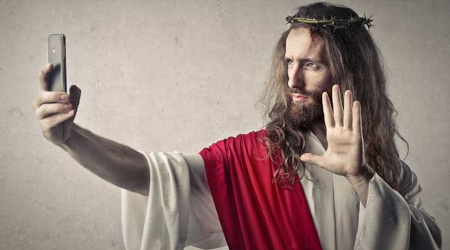
Separate from the blessing bait, another wave of AI Bible "influencer" videos turned Moses, Daniel, Mary, and even Christ into selfie vloggers. Some of those clips are goofy. Some are blasphemous on purpose. Christians split over whether they were clever outreach or a joke at the Lord’s expense. The amen videos are worse than the jokes. They pretend to be pastoral care.
The same hunger is being billed by the minute. Startups now sell video chats with an AI Jesus trained on sermons and styled after a television actor, at a couple of dollars a minute, with a monthly package if you want more face time with the counterfeit. Switzerland already stuck a screen-Jesus in a confessional and called it an experiment. Deepfake pastors have shown up on TikTok preaching sermons their real congregations never heard and asking for money the real men never requested.
Facebook spent two years drowning grandparents in "Shrimp Jesus" slop for the same reason TikTok now drowns new believers in glowing prophets. The sacred is cheap engagement. Cheap engagement is cash.
Baby Christians Are the Product
Alesia’s sharpest point is the one the church keeps dodging. New believers are hungry. They do not yet know the difference between the voice of the Shepherd and a synthesized baritone reading a prosperity Mad Lib. If their first "word from the Lord" comes from a For You page, they will start treating the feed like a prophet.
That is how you outsource a Bible. You stop opening the Book and start waiting for a stranger’s avatar to assign you a breakthrough. You measure faith by whether you typed amen under a clip that was generated to make you type amen.
God can use a phone. He has used worse tools than a phone. What He does not do is blackmail His children with a share button. He does not hide the Gospel behind "the devil does not want you to hear this." He does not need your comment to finish the atonement.
Test the clip the way you would test a stranger in a pulpit. Does it preach repentance, or a sudden pile of opportunities? Does it send you to Scripture, or to the comments? Does it exalt Christ crucified, or a handsome interpolation that exists to keep you scrolling?
If the "Jesus" on your screen needs a like to complete the blessing, he is not Jesus. Close the app. Open the Word. The real Christ does not farm your amen. He bought you with blood, and He does not need TikTok to finish the sentence.
Be sure to email this page to all your friends.
PROTEST
"My children, you must protest the offenses being committed against the divinity of My Son. Prayer is a great weapon, but unless you act and pray too, My children, you proceed nowhere. You become lax, indifferent; apathy sets in. Each and every individual of conscionable age shall be tested." - Our Lady of the Roses, November 1, 1977
DISTORT AND DENY
"Do you not recognize, My children, that satan will seek to distort and deny My words? Open your ears! Pray for the light! As shepherds, why do you choose to cast Me aside when I have been sent to you by the Father?
The offenses to the divinity of My Son are great!" - Our Lady of the Roses, October 6, 1974
 The Virgin Mary's Bayside Prophecy Books are Now Available in E-book Version. Click Here Now!
When you pray the Holy Rosary, you have Our Lady's hand in yours. When you pray the Holy Rosary, you have the power of God in your hands. Start now! Click here...
Our Lady of the Roses Awesome Bayside Prophecies... https://www.tldm.org/Bayside/ These prophecies came from Jesus, Mary, and the saints to Veronica Lueken at Bayside, NY, from 1968 to 1995.
Directives from Heaven... https://www.tldm.org/directives/directives.htm
 PDF
PDFD87 - Divinity of Jesus Christ
PDFD117 - Miracles
PDFD119 - Jesus Christ, Redeemer
PDFD123 - Catholic Church, Part 1
PDFD124 - Catholic Church, Part 2
PDF