 These Last Days News - August 26, 2026
We encourage everyone to share this web page with others, especially bishops and clergy.
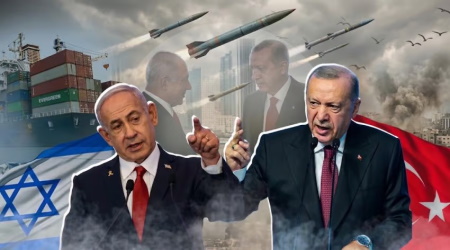
Turkey’s Syrian Gambit Puts Israel on a Collision Course...
WORLD WAR III
"Veronica - . . . "Our Lady now is looking down sadly. And I see She's pointing now to what looks like a map. Oh, my! Now as I am watching—it's a map of... oh, I can see Jerusalem, and Egypt, Arabia, French Morocco, Africa. Oh, my goodness! There seems to be a very dense darkness now settling upon those countries. Oh, my!
And Our Lady is saying:
Our Lady - "The start of the Third World War, My child." - March 29, 1975"
ISRAEL IN FLAMES
"Veronica - "... and there's another map. And I see Israel, and countries about it; they're all aflame....
The wars shall increase, and the carnage shall increase, and those who are living will often envy the dead, so great will be the suffering of mankind.... When he left the Eternal Father he turned to satan, and this is his reward." - Our Lady, June 30, 1984
The above Messages from Our Lady were given to Veronica Lueken at Bayside, New York. Read more
Spectator.org reported on August 25, 2026:
The diplomatic fallout over the weekend following an Israeli airstrike in northwest Syria last week exposes Turkey’s increasing military ambitions in the Middle East and casts doubt on U.S. mediations between Syria, Turkey, and Israel.
Overnight on Monday, Aug. 16, Syrian state television reported eight Israeli air strikes on the Abu Duhur Military Airport, 45 miles from the northwest Turkish border, resulting in damage to infrastructure but with no casualties. The Abu Duhur base has been out of service as a military airfield since 2013 and was refitted in 2024 as a military training center for the new Syrian army.
Jerusalem confirmed the air strikes, stating it was a preemptive measure to deter the deployment of additional Turkish military forces in Syria. Israeli officials had previously warned their counterparts in Damascus that allowing continued Turkish military activity in Syria would constitute a breach of an agreed-upon security status quo and result in Israeli intervention. "Israel and Syria agreed to a status quo in security matters, which Syria was on the verge of breaching by permitting Turkish troops to deploy at an airbase near Aleppo," Israeli Prime Minister Benjamin Netanyahu’s office said in an English-language statement.
"We will not tolerate a Turkish military entrenchment in Syria that threatens Israel," Netanyahu said. "Apparently, they [Syria] didn’t hear it clearly enough, so we made sure they understood it better." The strikes, according to an Israeli security source on Israel’s Kan public media, were carried out only after attempts at dialogue with Syria on the issue had failed.
U.S., Turkish, and Syrian officials condemned the strikes. Syrian Foreign Minister Asaad al-Shaibani confirmed that Turkish officers had visited the base before the strike as part of "ongoing military cooperation in the areas of training and the exchange of expertise." Al-Shaibani further denied claims of a military buildup and stressed that Syria maintains its sovereignty and the right to partner with regional powers in rebuilding its military and economic capabilities following the overthrow of the Bashar al-Assad regime in 2024.
According to the Syrian Observatory for Human Rights, the recent Turkish military delegation to Abu Duhur was part of new efforts to reactivate the airfield as a military base.
U.S. ambassador to Turkey and special envoy to Syria, Tom Barrack, accused Israel of starting an "unnecessary escalation that does not advance regional stability." Barrack’s criticism of Israel continued relentlessly over the weekend after a Friday interview on Mario Nawfal’s podcast. While accusing Israel of "occupying" the Golan Heights — in direct contradiction of U.S. President Donald Trump’s 2016 presidential proclamation that recognized Israeli sovereignty of the Golan — Barrack suggested that Israel was either trying to "bait" Turkey into conflict ahead of Jerusalem’s October elections, or that the strike was the result of miscommunication between Israeli intelligence and the military.
Israeli Foreign Minister Gideon Sa’ar called Barrack’s claims "full of inaccuracies." Having witnessed the detrimental effects of Iran’s infiltration into Gaza and Lebanon over the past years, Sa’ar stated on Israel’s Channel 12 that Jerusalem doesn’t want "the same situation with Turkey in Syria." The Israeli airstrikes in northwest Syria, therefore, signaled Jerusalem’s commitment to curbing Turkey’s increasing regional influence and ensuring the security status quo along the Israeli-Syrian border.
If maintaining regional security is Barrack’s primary concern, then Turkey’s strategic military role in Syria, open hostility toward Israel, and regional alliances with other Sunni states need a closer examination.
Although Israel and Turkey maintained stable relations before Oct. 7, 2023, both sides kept their distance. Between 2021 and 2023, I met regularly with Ankara’s General Consul to the West Bank on Mount Scopus in Jerusalem. Our conversations, always amicable, nonetheless revealed to me the extent to which Ankara’s previous mission to Israel prioritized its ties to Palestinian factions in the West Bank and Gaza over peaceful relations with Jerusalem.
Israeli-Turkish relations not only collapsed after Oct. 7, but turned hostile with Ankara’s condemnation of Israel’s military action against Hamas and Hezbollah.
Israel now maintains a precautionary posture toward Turkey and has taken strategic action in the recent past to keep Turkish political and military influence at bay in Gaza, Lebanon, and Syria. This posture has, at times, conflicted with U.S. interests in the region. Turkey maintains the second largest army in NATO, and Trump’s administration sees Ankara’s military power and geographical position as a vital partner in the reconstruction of Syria and in regional efforts to counter Iran. Having lifted sanctions on Ankara for its purchase of Russia’s S-400 missile systems in 2020, Trump has now floated the idea of selling F-35 fighter jets to Turkey in a move that will bolster NATO’s position in the Middle East, but at the cost of significantly jeopardizing Israel’s superior air power in the region.
Ankara’s military sponsorship of the new government in Damascus has also opened the potential for Turkish influence to encroach on Israel’s northern border. An anonymous Syrian security source told Israel’s Israel Hayom daily news over the weekend that Turkey’s military influence has become more pronounced in western Syria and the port cities of Latakia and Tartus. "Officials representing Turkish intelligence and the Turkish military are playing in Syria as if it were their private playground," the Syrian source said.
The Qatari Al-Araby network and the Syrian Observatory for Human Rights reported in July the ongoing movement of Turkish military trucks and armored vehicles in northeastern Syria to reinforce communication lines with Turkish military outposts in the cities of Deir ez-Zor and Ras al-Ayn. These outposts were established during the fog of the 2024 war that overthrew the Assad regime, and pose a direct threat to the Kurdish communities in northern Syria.
Following a visit by Turkish naval forces to Latakia — the first Turkish naval visit in 15 years — Turkish Naval Commander Ercüment Tatlioğlu stated that the warship flotilla was part of an effort "to strengthen military cooperation between Turkey and Syria."
Emerging in the background of Turkey’s strategic maneuvers in Syria is the recent Mecca Joint Defense Agreement signed in early August by Turkey, Saudi Arabia, and Pakistan, which adds a new, complex security mechanism to the region. On the surface, this NATO-styled, Sunni-Muslim defense alliance creates a formidable bulwark against Shiite Iran and Iranian proxies in Iraq and Yemen. It also creates a military and geopolitical trap to ensnare Israel.
Turkey has long viewed Israel’s growing military partnership with Greece and Cyprus as a threat to its Eastern Mediterranean hegemony. With Greece being a member of NATO, Turkey’s new alliances through the Mecca Agreement afford Ankara greater freedom and more leverage to pursue its own regional agenda. According to Ahmed Altuwaijri at the Middle East Eye, part of Turkey’s motivation in the Mecca Agreement is to seek "a broader network to reduce its vulnerability to pressure from any single axis."
The Mecca Agreement stipulates that an armed attack against any one signatory is regarded as an armed attack against all three. This means that isolated clashes from Kashmir to Syria to Northern Cyprus have the potential to domino effect into regional conflicts. This also means that Israel’s national security efforts at buffering Turkey’s entrenchment in Syria could draw critical reaction and response from Saudi Arabia and Pakistan.
With Ankara now wearing two hats, it’s unclear if Turkish military encroachment into Syria is to advance NATO’s defense bulwark against Iran, or to bring Damascus under the umbrella of the Mecca Agreement’s military pact. Turkey’s ambitions and maneuvers should be viewed with greater precaution, and US mediators should think twice before condemning Israel’s efforts to curb Ankara’s influence in Syria.
Be sure to email this page to all your friends.
A WORLD AFLAME
"Syria has the key to the solution of world peace or the Third World War. It will be the destruction of three-quarters of the world. A world aflame, with also the Ball of Redemption." - Our Lady of the Roses, May 30, 1981
 The Virgin Mary's Bayside Prophecy Books are Now Available in E-book Version. Click Here Now!
When you pray the Holy Rosary, you have Our Lady's hand in yours. When you pray the Holy Rosary, you have the power of God in your hands. Start now! Click here...
Our Lady of the Roses Awesome Bayside Prophecies... https://www.tldm.org/Bayside/ These prophecies came from Jesus, Mary, and the saints to Veronica Lueken at Bayside, NY, from 1968 to 1995.
Directives from Heaven... https://www.tldm.org/directives/directives.htm
 PDF
PDFD197 - Wars are a Punishment for Man's Sins
PDFD282 - Nuclear War
PDFD322 - Warnings Unrecognized
PDF