 These Last Days News - September 24, 2026
We encourage everyone to share this web page with others, especially bishops and clergy.
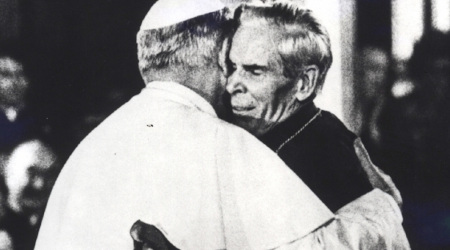
Why Fulton Sheen Makes Both Extremes Uncomfortable...
CROWNS
"You will keep in the hearts of all true believers the knowledge of the existence of the saints, My children and My child. For they, too, passed through many crucibles of suffering upon earth. It was in this manner that they received their crowns." - Our Lady of the Roses, June 9, 1979
ONCE AMONG YOU
"You see, My children, these are the saints in Heaven. They were once among you, and have won their crowns through perseverance, prayer, and sacrifice. Their example should be followed, for they will lead you to the Kingdom of God the Father, the eternal Kingdom of joy, peace, and reward--a reward far beyond all that your human mind could comprehend, My children." - Our Lady of the Roses, May 17, 1975
The above Messages from Our Lady were given to Veronica Lueken at Bayside, New York. Read more
Epistles.online reported on September 24, 2026:
Today, as Archbishop Fulton J. Sheen is beatified, I find myself reflecting on why this remarkable bishop continues to speak to Catholics across generations—and why he can make both progressives and radical traditionalists uncomfortable.
What I appreciate about Sheen is that he does not fit neatly into today's Catholic camps. He was firmly rooted in traditional Catholic teaching, yet he was not what I would call a radical traditionalist. He defended the faith without compromise while remaining willing to engage the modern world and communicate the Gospel in ways people could understand.
Some Catholics with a more liberal outlook may find Sheen too traditional. He spoke openly about sin, repentance, judgment, hell, the devil, the Eucharist, confession, marriage, and moral law. He did not reduce Christianity to simply being kind, accepting everyone, or working for social causes. For Sheen, Christianity was ultimately about Christ, conversion, and the transformation of the human person through grace. He was not afraid to say that some things are objectively wrong or that people sometimes need to change their lives and return to God.
But what I find equally interesting is that some radical traditionalists can also have problems with Sheen. This may seem strange because Sheen was a bishop who preached traditional Catholic doctrine long before the Second Vatican Council. He spoke about the Mass, the Eucharist, the Blessed Virgin Mary, confession, and the spiritual life with a clarity that many Catholics today would appreciate. Yet Sheen was not interested in making opposition to the modern world the center of Catholic life.
Sheen used television, radio, books, and other modern forms of communication to reach millions of people. He understood that Catholics could not simply retreat from society and complain about how bad the modern world had become. If the world was confused, Catholics had to bring Christ into that world. He did not compromise Catholic teaching in order to reach modern people, but neither did he refuse to reach them simply because they lived in a modern culture.
That distinction is important to me. A Catholic can engage the modern world without surrendering Catholic doctrine. We can use modern technology without accepting every modern idea. We can criticize errors without treating every person who holds those errors as an enemy. Sheen seemed to understand this balance very well.
This is also why I find him refreshing at a time when Catholics can easily become divided into opposing camps. We have progressives and traditionalists, conservatives and liberals, and Catholics who sometimes seem to define themselves mainly by which group they oppose. It can become easy to spend more time identifying someone's camp than discussing Christ, the Gospel, and the Deposit of Faith.
Sheen does not fit comfortably into those categories. He could be uncompromising about Catholic doctrine without becoming consumed by bitterness. He could criticize the errors of the modern world without refusing to engage with modern people. He could love the traditions of the Church without believing that Catholics must remain trapped in the past.
I think there is something important here for Catholics today. Being faithful does not mean accepting everything modern. But rejecting everything modern does not automatically make someone more faithful either. The Church has existed in many cultures and historical periods. Our task is to preserve what must never change while finding faithful ways to communicate that truth to people living today.
That is one reason I appreciate Fulton Sheen. He reminds me that Catholic fidelity does not require choosing between truth and charity, doctrine and evangelization, or tradition and engagement with the world. We need all of them. Sheen was Catholic without apology, faithful to tradition without being trapped in the past, and willing to enter the modern world without becoming a disciple of it. In an age when Catholics can so easily become divided into opposing camps, that is a lesson worth remembering.
Be sure to email this page to all your friends.
DEDICATION MUST BE RETURNED
"Holiness, piety, dedication must be returned to the churches, or the vocations will fall. The churches will be emptied, and the leaders will be imprisoned by their enemies that have come to them as angels of light, but with ravenous hearts." - Jesus, June 5, 1975
 The Virgin Mary's Bayside Prophecy Books are Now Available in E-book Version. Click Here Now!
When you pray the Holy Rosary, you have Our Lady's hand in yours. When you pray the Holy Rosary, you have the power of God in your hands. Start now! Click here...
Our Lady of the Roses Awesome Bayside Prophecies... https://www.tldm.org/Bayside/ These prophecies came from Jesus, Mary, and the saints to Veronica Lueken at Bayside, NY, from 1968 to 1995.
Directives from Heaven... https://www.tldm.org/directives/directives.htm
 PDF
PDFD233 - Vocations, Part 1
PDFD234 - Vocations, Part 2
PDFD243 - Holiness
PDFD244 - Prayer and Works
PDFD252 - Reverence
PDFD439 - Glory and Honor, Part 1
PDFD440 - Glory and Honor, Part 2
PDFD441 - Heavenly Reward, Part 1
PDFD442 - Heavenly Reward, Part 2
PDFD445 - Christ the King
PDFD446 - Kingdom of God, Part 1
PDFD447 - Kingdom of God, Part 2
PDFD448 - Kingdom of God, Part 3
PDF