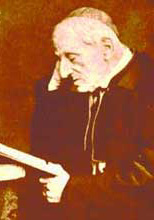
 Thoughts
on alterations in the liturgy by Cardinal John Henry Newman...
Thoughts
on alterations in the liturgy by Cardinal John Henry Newman...| Home - Latest News | Introduction | Bayside Prophecies | Directives from Heaven | Shopping Cart | Testimonies | Veronica Lueken | Miraculous Photos | Bible | Radio Program | Bayside Videos |
Thoughts
on alterations in the liturgy by Cardinal John Henry Newman...“I have cautioned the priests, the hierarchy in My Son’s Church, to remove their pride and arrogance from their beings and their hearts. Their way has become a way of the world, governed by man and not by his God. This new way will only lead to total destruction, of not only the souls but the body.” – Our Lady of the Roses, October 6, 1978
John Henry Newman, one of the best-known religious writers and preachers of the 19th century, was a convert to Catholicism from Anglicanism at the age of 44 and later became a Cardinal. The following is Newman's "Thoughts on alterations in the liturgy respectfully addressed to the clergy":
Attempts are making to get the Liturgy altered. My dear Brethren, I beseech you, consider with me, whether you ought not to resist the alteration of even one jot or tittle of it. Though you would in your own private judgments wish to have this or that phrase or arrangement amended, is this a time to concede one tittle?
Why do I say this? because, though most of you would wish some immaterial points altered, yet not many of you agree in those points, and not many of you agree what is and what is not immaterial. If all your respective emendations are taken, the alterations in the Services will be extensive; and though each will gain something he wishes, he will lose more from those alterations which he did not wish. Tell me, are the present imperfections (as they seem to each) of such a nature, and so many, that their removal will compensate for the recasting of much which each thinks to be no imperfection, or rather an excellence?
There are persons who wish the Marriage Service emended; there are others who would be indignant at the changes proposed. There are some who wish the Consecration Prayer in the Holy Sacrament to be what it was in King Edward's first book; there are others who think this would be an approach to Popery. There are some who wish the imprecatory Psalms omitted; there are others who would lament this omission as savoring of the shallow and detestable liberalism of the day. There are some who wish the Services shortened; there are others who think we should have far more Services, and more frequent attendance at public worship than we have.
How few would be pleased by any given alterations; and how many pained!
But once begin altering, and there will be no reason or justice in stopping, till the criticisms of all parties are satisfied. Thus, will not the Liturgy be in the evil case described in the well- known story, of the picture subjected by the artist to the observations of passers-by? And, even to speak at present of comparatively immaterial alterations, I mean such as do not infringe upon the doctrines of the Prayer Book, will not it even with these be a changed book, and will not that new book be for certain an inconsistent one, the alterations being made, not on principle, but upon chance objections urged from various quarters?
But this is not all. A taste for criticism grows upon the mind. When we begin to examine and take to pieces, our judgment becomes perplexed, and our feelings unsettled. I do not know whether others feel this to the same extent, but for myself, I confess there are few parts of the Service that I could not disturb myself about, and feel fastidious at, if I allowed my mind in this abuse of reason. First, e.g. I might object to the opening sentences; "they are not evangelical enough; CHRIST is not mentioned in them; they are principally from the Old Testament." Then I should criticize the exhortation, as having too many words, and as antiquated in style. I might find it hard to speak against the Confession; but "the Absolution," it might be said, "is not strong enough; it is a mere declaration, not an announcement of pardon to those who have confessed." And so on.
|
"Have we any security, if we once begin, that we shall ever end? Shall not we pass from non-essentials to essentials? And then, on looking back after the mischief is done, what excuse shall we be able to make for ourselves for having encouraged such proceedings at first?" |
Now I think this unsettling of the mind a frightful thing; both to ourselves, and more so to our flocks. They have long regarded the Prayer Book with reverence as the say of their faith and devotion. The weaker sort it will make skeptical; the better it will offend and pain. Take, e.g. an alteration which some have offered in the Creed, to omit or otherwise word the clause, "He descended into hell." Is it no comfort for mourners to be told that CHRIST Himself has been in that unseen state, or Paradise, which is the allotted place of sojourn for departed spirits? Is it not very easy to explain the ambiguous word, is it any great harm if it is misunderstood, and is it not very difficult to find any substitute for it in harmony with the composition of the Creed? I suspect we should find the best men in the number of those who would retain it as it is. On the other hand, will not the unstable learn from us the habit of criticizing what they should never think of but as a divine voice supplied by the Church for their need?
But as regards ourselves, the Clergy, what will be the effect of this temper of innovation in us? We have the power to bring about changes in the Liturgy; shall we not exert it? Have we any security, if we once begin, that we shall ever end? Shall not we pass from non-essentials to essentials? And then, on looking back after the mischief is done, what excuse shall we be able to make for ourselves for having encouraged such proceedings at first? Were there grievous errors in the Prayer Book, something might be said for beginning, but who can point out any? cannot we very well bear things as they are? does any part of it seriously disquiet us? no--we have before now freely given our testimony to its accordance with Scripture.
But it may be said that "we must conciliate an outcry which is made; that some alteration is demanded." By whom? no one can tell who cries, or who can be conciliated. some of the laity, I suppose. Now consider this carefully. Who are these lay persons? Are they serious men, and are their consciences involuntarily hurt by the things they wish altered? Are they not rather the men you meet in company, worldly men, with little personal religion, of lax conversation and lax professed principles, who sometimes perhaps come to Church, and then are wearied and disgusted? Is it not so? You have been dining, perhaps, with a wealthy neighbor, or fall in with this great Statesman, or that noble Land-holder, who considers the Church two centuries behind the world, and expresses to you wonder that its enlightened members do nothing to improve it. And then you get ashamed, and are betrayed into admissions which sober reason disapproves. You consider, too, that it is a great pity so estimable or so influential a man should be disaffected to the Church; and you go away with a vague notion that something must be done to conciliate such persons. Is this to bear about you the solemn office of a GUIDE and TEACHER in Israel, or to follow a lead?
But consider what are the concessions which would conciliate such men. Would immaterial alterations? Do you really think they care one jot about the verbal or other changes which some recommend, and others are disposed to grant? whether "the unseen state" is substituted for "hell," "condemnation" for "damnation," or the order of Sunday Lessons is remodelled? No;--they dislike the doctrine of the Liturgy. These men of the world do not like the anathemas of the Athanasian Creed, and other such peculiarities of our Services. But even were the alterations, which would please them, small, are they the persons whom it is of use, whom it is becoming to conciliate by going out of our way?
|
"... we certainly countenance the notion of the day, that love and love only is in the Gospel the character of ALMIGHTY GOD and the duty of regenerate man; whereas the Gospel, rightly understood, shows His Infinite Holiness and Justice as well as His Infinite Love; and it enjoins on men the duties of zeal towards Him, hatred of sin, and separation from sinners, as well as that of kindness and charity." |
I need not go on to speak against doctrinal alterations, because most thinking men are sufficiently averse to them. But, I earnestly beg you to consider whether we must not come to them if we once begin. For by altering immaterials, we merely raise without gratifying the desire of correcting; we excite the craving, but withhold the food. And it should be observed, that the changes called immaterial often contain in themselves the germ of some principle, of which they are thus the introduction:-- e.g. If we were to leave out the imprecatory Psalms, we certainly countenance the notion of the day, that love and love only is in the Gospel the character of ALMIGHTY GOD and the duty of regenerate man; whereas the Gospel, rightly understood, shows His Infinite Holiness and Justice as well as His Infinite Love; and it enjoins on men the duties of zeal towards Him, hatred of sin, and separation from sinners, as well as that of kindness and charity.
To the above observations it may be answered, that changes have formerly been made in the Services without leading to the issue I am predicting now; and therefore they may be safely made again. But, waving all other remarks in answer to this argument, is not this enough, viz. that there is peril? No one will deny that the rage of the day is for concession. Have we not already granted (political) points, without stopping the course of innovation? This is a fact. Now, is it worth while even to risk fearful changes merely to gain petty improvements, allowing those which are proposed to be such?
We know not what is to come upon us; but the writer for one will try so to acquit himself now, that if any irremediable calamity befalls the Church, he may not have to vex himself with the recollections of silence on his part and indifference, when he might have been up and alive. There was a time when he, as well as others, might feel the wish, or rather the temptation, of steering a middle course between parties; but if so, a more close attention to passing events has cured his infirmity. In a day like this there are but two sides, zeal and persecution, the Church and the world; and those who attempt to occupy the ground between them, at best will lose their labor, but probably will be drawn back to the latter. Be practical, I respectfully urge you; do not attempt impossibilities; sail not as if in pleasure boats upon a troubled sea. Not a word falls to the ground, in a time like this. Speculations about ecclesiastical improvements which might be innocent at other times, have a strength of mischief now. They are realized before he who utters them understands that he has committed himself.
Be prepared then for petitioning against any alterations in the Prayer Book which may be proposed. And, should you see that our Fathers the Bishops seem to countenance them, petition still. Petition them. They will thank you for such a proceeding. They do not wish these alterations; but how can they resist them without the support of their Clergy? They consent to them, (if they do,) partly from the notion that they are thus pleasing you. Undeceive them. They will be rejoiced to hear that you are as unwilling to receive them as they are. However, if after all there be persons determined to allow some alterations, then let them quickly make up their minds how far they will go. They think it easier to draw the line elsewhere, than as things now exist. Let them point out the limit of their concessions now; and let them keep to it then; and, (if they can do this,) I will say that, though they are not as wise as they might have been, they are at least firm, and have at last come right.
We hear many complaints about the Burial Service, as unsuitable for the use for which it was intended. It expresses a hope, that the person departed, over whom it is read, will be saved; and this is said to be dangerous when expressed about all who are called Christians, as leading the laity to low views of the spiritual attainments necessary for salvation; and distressing the Clergy who have to read it.
Now I do not deny, I frankly own, it is sometimes distressing to use the Service; but this it must ever be in the nature of things; wherever you draw the line. Do you pretend you can discriminate the wheat from the tares? of course not.
It is often distressing to use this Service, because it is often distressing to think of the dead at all; not that you are without hope, but because you have fear also.
How many are there whom you know well enough to dare to give any judgment about? Is a Clergyman only to express a hope where he has grounds for having it? Are not the feelings of relatives to be considered? And may there not be a difference of judgments? I may hope more, another less. If each is to use the precise words which suit his own judgment, then we can have no words at all.
But it may be said, "everything of a personal nature may be left out from the service." And do you really wish this? Is this the way in which your flock will wish their lost friends to be treated? a cold "edification," but no affectionate valediction to the departed? Why not pursue this course of (supposed) improvement, and advocate the omission of the Service altogether.
Are we to have no kind and religious thoughts over the good, lest we should include the bad?
|
"I will join heart and hand with any who will struggle for a restoration of that "godly discipline," the restoration of which our Church publicly professes she considers desirable; but GOD forbid any one should so depart from her spirit, as to mould her formularies to fit the case of deliberate sinners!" |
But it will be said, that, at least we ought not to read the Service over the flagrantly wicked; over those who are a scandal to religion. but this is a very different position. I agree with it entirely. Of course we should not do so, and truly the Church never meant we should. She never wished we should profess our hope of the salvation of habitual drunkards and swearers, open sinners, blasphemers, and the like; not as daring to despair of their salvation, but thinking it unseemly to honour their memory. Though the Church is not endowed with a power of absolute judgment upon individuals, yet she is directed to decide according to external indications, in order to hold up the rules of GOD'S governance, and afford a type of it, and an assistance towards the realizing it. As she denies to the scandalously wicked the LORD'S Supper, so does she deprive them of her other privileges.
The Church, I say, does not bid us read the Service over open sinners. Hear her own words introducing the Service. "The office ensuing is not to be used for any that die unbaptized, or excommunicate, or have laid violent hands upon themselves." There is no room to doubt whom she meant to be excommunicated, open sinners. Those therefore who are pained at the general use of the Service, should rather strive to restore the practice of excommunication, than to alter the words used in the Service. Surely, if we do not this, we are clearly defrauding the religious, for the sake of keeping close to the wicked.
Here we see the common course of things in the world. We omit a duty. In consequence our services become inconsistent. Instead of retracing our steps we alter the Service. What is this but, as it were, to sin upon principle? While we keep to our principles, our sins are inconsistencies; at length, sensitive of the absurdity which inconsistency involves, we accommodate our professions to our practice. This is ever the way of the world; but it should not be the way of the church.
I will join heart and hand with any who will struggle for a restoration of that "godly discipline," the restoration of which our Church publicly professes she considers desirable; but GOD forbid any one should so depart from her spirit, as to mould her formularies to fit the case of deliberate sinners! And is not this what we are plainly doing, if we alter the Burial Service as proposed? we are recognizing the right of men to receive Christian Burial, about whom we do not like to express a hope. Why should they have Christian burial at all?
It will be said that the restoration of the practice of Excommunication is impracticable; and that therefore the other alternative must be taken, as the only one open to us. Of course it is impossible, if no one attempts to restore it; but if all willed it, how would it be impossible; and if no one stirs because he thinks no one else will, he is arguing in a circle.
But, after all, what have we to do with probabilities and prospects in matters of plain duty? Were a man the only member of the Church who felt it a duty to return to the Ancient Discipline, yet a duty is a duty, though he be alone. It is one of the great sins of our times to look to consequences in matters of plain duty. Is not this such a case? If not, prove that it is not; but do not argue from consequences.
In the meanwhile I offer the following texts in evidence of the duty.
Matth. xviii. 15-17; Rom. xvi.17; 1 Cor. v. 7-13; 2 Thess. iii. 6,14,15; 2 Tim. iii.5; Tit. 10,11; 2 John 10,11; /pre
THE PRINCIPLE OF UNITY
Testimony of St. Clement, the associate of St. Paul, (Phil. iv. 3.) to the Apostolical Succession.
The Apostles knew, through our LORD JESUS CHRIST, that strife would arise for the Episcopate. Wherefore having received an accurate foreknowledge, they appointed the men I before mentioned, and have given an orderly succession, that on their death other approved men might receive in turn their office. Ep. i. 44.
Testimony of St. Ignatius, the friend of St. Peter, to the Episcopacy.
Your celebrated Presbytery, worthy of GOD, is closely knit to the Bishop, as the strings to a harp, and so by means of your unanimity and concordant love JESUS CHRIST is sung. Eph. 4.
There are those who profess to acknowledge a Bishop, but do everything without him. Such men appear to lack a clear conscience. Magn. 4.
He for whom I am bound is my witness that I have not learned this doctrine from mortal men. The Spirit proclaimed to me these words: "Without the Bishop do nothing." Phil. 7.
With these and other such strong passages in the Apostolical Fathers, how can we permit ourselves in our present <practical> disregard of the Episcopal Authority? Are not we apt to obey only so far as the law obliges us? Do we support the Bishop, and strive to move all together with him as our bond of union and head; or is not our every-day conduct as if, except with respect to certain periodical forms and customs, we were each independent in his own parish?
"The plan for your salvation was given. It was a simple plan of faith, faith in what has been given to you in the past! You mock the past in Tradition! You set yourselves to build a new church. The gates of hell shall never prevail against My Church!
"Man shall not judge My Church on the actions of man, for man now is taking it and building a church for man, not to honor his God, the Eternal Father, not to honor and prepare his soul for the entrance over the veil! No! He is now wasting valuable time in promoting a mode of humanism and modernism. You are feeding the nature, the carnal nature of mankind, while you are starving their spirit.” - Jesus, May 15, 1976
Our Lady of the Roses' Awesome
Bayside Prophecies...
https://www.tldm.org/Bayside/
These prophecies came from Jesus, Mary, and the saints to Veronica
Lueken at Bayside, NY, from 1968 to 1995:
A RENEWAL?
"I gave you My human life upon earth, and what have you done? You crucify Me again in My own House, My Church! You crucify those who stand in righteousness in My Church and cast them out, as you rebuild My Church. For what? A renewal? And what are you renewing? What is your renewal? What are you renewing? Have you found fault with My way? Shall you create a new way of man? I say unto you, you blaspheme! You have cast yourself out of the light into the darkness, O pastors.
"I cannot at this time give you, My child, dates. It would be of no merit to give the date now that you ask, My child. That will be given to you in secret. Let others speculate, but I say unto you, you must be prepared at all times, for it will come upon you suddenly.
"There is no reason to modernize My Church. Discipline must be returned.
"My Mother has made many visits to earth, crying out to you to stop now, turn back, do penance, make atonement for your sins. And what has She met but derision, lukewarmness, and arrogance!” – Jesus, February 1, 1978ACKNOWLEDGE ERROR HAS BEEN FOLLOWED
"Awaken from your slumber, My pastors. You will turn back now and retrieve what you have lost when you have succumbed to the errors of humanism and modernism. Do not be filled with pride. Be humble and accept your cross. Acknowledge before mankind that error has been followed, for to err is human, My children. But when you know you have made a mistake, what have you to gain but to follow this road of folly. Turn back and start again.
"I left with you a true foundation of faith. This faith is slowly being taken from your world. There are only small flickers of light throughout your world. The darkness is heavily closing in upon you. Know, My children, that you must hasten to follow the direction of My Mother.
"All who have command by their rank in the governing of Our sheep must do a full pardon in suffering, must gain this full pardon in suffering from the Eternal Father.” - Jesus, August 14, 1976TURN BACK WHILE THERE IS TIME
“My children, I counsel you now as your God to turn back while there is time. The sands of the hourglass are falling through; the grains are few. How many of you have prepared yourselves? Too late will there be much weeping and gnashing of teeth. Too late, I say unto you! For you who have not heeded My Mother’s counsel shall die a cruel death. And this death shall exist as you go as dead souls into hell. And I say unto you: hell shall be filled with mitres if you continue on your present course. Pray, My children, a constant vigilance of prayer throughout your country and all of the countries of the earth.” - Jesus, May 26, 1979THEIR OWN RULE
Veronica - Now He's extending His right hand and opening—oh, He's opening His garment. And oh, on His garment is a huge heart; but from all angles, right and left, there are knives piercing His heart.
Now He's removing—oh, I can—Jesus has a crown of thorns about His head, which He's removing now and placing in the center of His chest. It balances over a huge sword. Now He's pointing to the sword. The sword goes straight through His heart and comes out the other side. Oh, Jesus said:
Jesus - "See, My child, the heavy sword that man has placed within My heart. This sword has been placed there by the men of God who have chosen to set up their own rule within My House. This sword shall be taken out by Michael and be brought upon the world to cleanse you and to force your return to the ways of your God!" – June 16, 1973ACT IMMEDIATELY
“There must be holiness returned to My Son’s Church. This responsibility weighs heavily on the shoulders of the clergy, the hierarchy. I assure you, My clergy, unless you act immediately upon the counsel from Heaven, many mitres shall fall into hell.” – Our Lady, July 14, 1979“YOU MOCK THE PAST”
"The plan for your salvation was given. It was a simple plan of faith, faith in what has been given to you in the past! You mock the past in Tradition! You set yourselves to build a new church. The gates of hell shall never prevail against My Church!
"Man shall not judge My Church on the actions of man, for man now is taking it and building a church for man, not to honor his God, the Eternal Father, not to honor and prepare his soul for the entrance over the veil! No! He is now wasting valuable time in promoting a mode of humanism and modernism. You are feeding the nature, the carnal nature of mankind, while you are starving their spirit.” - Jesus, May 15, 1976NOT ENOUGH PRAYERS
“Not enough prayers have been offered for your clergy. Many bishops proceed onto a road that will lead them to hell, but sadly they will take many others with them.
“There must be a complete cleansing of My Son’s Church. What do you do, My children, when your house has been infested by rodents or vermin? You clean out your house. You do not abandon it, for it has taken much love and much labor to build the walls. You do not abandon it, but you work and pray, and use every means to clean out My Son’s House, His Church.” – Our Lady, November 20, 1979ARROGANCE AND PRIDE
“The Messages from Heaven, My child and My children, are given for all mankind. Much emphasis has been placed through time on the Message to the clergy in My Son’s House for reason. They are being deluded and misled by satan.
“This has come about only because arrogance and pride has entered upon them. They no longer pray but have succumbed to the errors of humanism and modernism. Holiness must be returned to the vocation. And this can only be acquired by restoring prayer in My Son’s House and especially the prayer life that is so lacking now in the clergy.
“In your well-meaning actions of opening My Son’s Church to all without conversion, you have allowed yourself to associate with heretics and unbelievers. In this manner you are compromising your Faith. My children, recognize what is happening now in My Son’s Church.” – Our Lady, July 25, 1978TURN BACK AND START AGAIN
"Many leaders who wear the red hats, My children—pray for them, for many have fallen to satan. I say unto you, as your God: Turn back, Red Hats, for you, too, shall meet the fires of hell. The Red Hat has fallen, and the Purple Hat is being misled. Woe, woe, woe to the inhabitants of the earth! Houses will blow in the wind, and skin will dry up and blow off the bones as if it had never been! Eyes will see and still not believe, so great is the power of satan now upon mankind.
"I warn you now, My children, that you must turn back and start again. Do not renew My Church by commending it to satan, by destroying it. You cannot destroy the foundation. You crumble the walls. Like rats you are burrowing, O Red Hats, into the foundation of My Church. I say unto you, there is not a man living upon earth now who hears My voice that shall not face the great trial ahead.” - Jesus, September 14, 1976ADMIT YOUR MISTAKES
“Do not be prideful, My hierarchy. Admit when you make a mistake. Admit and start again. You owe nothing to the world and man, but you will stand before the Eternal Father. He will chastise those He loves, but He wants you to be humble of heart. Admit your mistakes and start over.” – Jesus, October 6, 1978MANY LED ASTRAY
“Please, My children, pray for your priests. Many are being led astray. Discipline and the rule must be followed in the priesthood. This brings great sorrow to the Eternal Father and My Son to see the manner in which the priesthood has cast aside the rule in the name of modernism and humanism.
“The destruction of souls accelerates. My children, can you not recognize the path you have allowed yourself to go upon? It is a way of destruction. It is not the way as given by My Son, for you have set yourselves to build a new church, a church for the glorification of man.” - Our Lady, March 25, 1978HAVE SET UP THEIR OWN CHURCH
"There is much work to be done to return My House, My Church, to its previous state of dedication, purity, and holiness. Much that has happened within My House, the direction was not given by your Vicar, Pope Paul. In arrogance, many Red Hats have set themselves to set up their own church, and it is fast becoming one of man and not of your God. There are no angels directing you in this building. The spirit you receive is not of light, but of darkness in your building. Restore My Church to its former glory, or I shall set My hand down fast upon you! The Eternal Father is long-suffering and merciful, but My hand is growing heavy!” - Jesus, October 6, 1976GO BACK
“It is not without reason that all of the past descendants of Peter guided you well against the false precepts of modernism and humanism in My Son’s Church and the world. And now, My children, it is of a fact: by their fruits will they be known. And what have been the fruits of this humanistic and modernistic approach but discord, disunity and a loss of souls to Heaven.
“I say unto you: unless you turn back now, bishops and cardinals, and restore My Son’s House... Do not be prideful; it is too late for false pride! You must admit your errors. Turn back and start over! You were given a simple rule to follow. These rules were given to you and written for you in the Book of Life, your Bible. You have chosen in your arrogance and pride to cast aside these teachings and to build another church upon earth, a church of man. You are building it without the help of the angels.” – Our Lady, September 13, 1978THIS NEW WAY
“I have cautioned the priests, the hierarchy in My Son’s Church, to remove their pride and arrogance from their beings and their hearts. Their way has become a way of the world, governed by man and not by his God. This new way will only lead to total destruction, of not only the souls but the body.” – Our Lady, October 6, 1978
Directives from Heaven... https://www.tldm.org/directives/directives.htm
D127 - Vatican II
D161 - The Great Apostasy
D193 - Turn back: You are on the wrong road
D211 - Changes, Part 1
D212 - Changes, Part 2
Articles...
“Kneel before your God in the Eucharist”
https://www.tldm.org/News5/kneeling.htmVatican on kneeling for holy Communion
https://www.tldm.org/vatican%20letter.htmThe case for the Latin Mass
https://www.tldm.org/news5/latinmass.htmShould women cover their heads in Church?
https://www.tldm.org/news6/veils.htmPope John Paul II recommends praying the St. Michael Exorcism
https://www.tldm.org/news6/exorcism.htmRestore the high altar
https://www.tldm.org/news5/main%5Faltar.htm"You cannot separate Tradition from your Faith"
https://www.tldm.org/news6/tradition1.htmVatican II, part 1: Infiltration of the Church
https://www.tldm.org/News6/VaticanII-1.htmVatican II, part 2: Dark clouds forming before Vatican II
https://www.tldm.org/News6/VaticanII-2.htmVatican II, part 3: the satanic revolution gains momentum at the Council
https://www.tldm.org/News6/VaticanII-3.htm
Click here to email this page to a friend.
 There are 4 Things You Must Have to Survive
the End Times:
There are 4 Things You Must Have to Survive
the End Times:
1.) The Douay-Rheims Holy Bible...
"I ask that all who hear My voice will take their Bibles, and if they do not have one, search, but find the right Bible, those printed not after 1965, My children." - Jesus, October 5, 1985
"You must all obtain a copy of the Book of life and love, the Bible. Do not accept the new mods. Try to find in your bookstores the old Bibles, My children, for many are being changed to suit the carnal nature of man. I repeat, sin has become a way of life." - Our Lady, October 6, 1992
"I must ask you all to read but a few short chapters a day now, the Book of life and love, your Bible. Knowledge must be gained for all the disciples of My Son, for you will be attacked by scientific minds. But do not be concerned what you will say to them when accosted, for the words will be given to you by the Spirit." - Our Lady, April 10, 1976
The Douay-Rheims Bible was published in 1899. It is the official Bible of the Roman Catholic Church. Almost all other Bibles have been rewritten by Satan. See: https://www.tldm.org/directives/d33.htm , https://www.tldm.org/directives/d415.htm and https://www.tldm.org/directives/d182.htm If you don't have a Douay-Rheims Bible order it now! (Order Form) Yours and your loved ones salvation could depend on it.
Read the Bible cover to cover. If you read 4 chapters a day, you will complete the whole Bible in 334 days. I have read the Bible 2 times and working on the third time. A 75 year old Baptism gentleman told me that he and his wife have read the Bible nine times. Wow!
2.) The Complete Virgin Mary’s Bayside Prophesies in 6 Paperback Books..
The Virgin Mary brings directions from God, the Father in Heaven on how to survive the end times. God, the Father, through the Virgin Mary, tells what is coming, how to prepare for it, how to survive it, and how to even stop it. These six volumes along with the Bible are most important to save yourself and your loved ones. Order it now. Tomorrow may be to late. These 6 pocket size paperback books costs $33.00. (Order Form)
3.) Heaven's Home Protection Packet...
Heaven’s Home Protection Packet...
Our Lord stated we must have crucifixes upon the outside of all of our outside doors. In the "Heaven’s Home Protection Packet" there are instructions, four crucifixes, a tube of special cement for wooden or metal crucifixes. Wooden crucifixes adhere better to the doors when the aluminum strap is removed from the back. Put a light coat of cement on the back of the crucifix and then press it to the outside of the door. If you have any problems, you can call us at 616-698-6448 for assistance. This Heaven’s Home Protection Packet is available for a donation of $10.00 plus $4.00 shipping and handling. Send $14.00 to TLD Ministries, P.O. Box 40, Lowell, MI 49331. Item # P15 (Order Form)Crucifix on front and back door... The only real protection against terrorists...
Jesus - "Pray and wear your sacramentals. And, also, My children, I ask you again to place a crucifix upon your door. Both front and back doors must have a crucifix. I say this to you because there will be carnage within your areas, and this will pass you by if you keep your crucifix upon your doors." (6-30-84) (Testimonies of lives and homes saved by the crucifixes.) https://www.tldm.org/news/crucifix.htm (Order Form)
4.) Heaven's Personal Protection Packet...
Incredible Bayside Prophecies on the United States and Canada book . . .Heaven’s Personal Protection Packet . . .
Our Lady tells us to be protected from all evil, we must wear the following sacramentals around our necks: a Rosary, a crucifix, the St. Benedict medal, Our Lady of the Roses medal, the Miraculous Medal, and the scapular. We have all of these sacramentals in a packet we call "Heaven's Personal Protection Packet." This packet is available for a donation of $7.00 plus $3.00 shipping and handling. Send $10.00 to TLD Ministries, P.O. Box 40, Lowell, MI 49331. Item # P5 (Order Form)Our Lady of the Roses, Mary Help of Mothers promises to help protect our children. On September 13, 1977, She said, "He has an army of ogres wandering now throughout your country and all of the countries of the world. They are in possession of great power; so wear your sacramentals, and protect your children and your households. Learn the use every day of holy water throughout your household. Insist even with obstructions, insist that your children always wear a sacramental. One day they will understand that they will repel the demons."
On February 1, 1974, Our Lady said, "My children, know the value of these sacramentals. Guard your children well. You must awaken to the knowledge that you will not be protected without the sacramentals. Guard your children's souls. They must be surrounded with an aura of purity. Remove them if necessary from the sources of contamination, be it your schools or even false pastors."
This Heaven’s Personal Protection Packet is available for a donation of $7.00 plus $3.00 shipping and handling. Send $10.00 to TLD Ministries, P.O. Box 40, Lowell, MI 49331. You may use your MasterCard, VISA, or American Express and call 1-616-698-6448. Item # P5 (Order Form)
We have researched the Bayside Prophecies on the United States and Canada and put these outstanding prophecies in a 360 page pocket size paperback book. Veronica said it was very good. It tells what is going to happen here and how to prepare for it. Every North American must read this book! Item #B2 Cost $5.00 (Order Form)
Your names have been written in Heaven… "It is not by accident that you are called by My Mother, for your names have been written in Heaven.... But with this great grace you have great responsibility to send this Message from Heaven throughout the world, for if you are able to recover just one more for Heaven, an additional star shall be placed in your crown." - Jesus, August 5, 1975
My gift to help spread Our Lady of the Roses' messages to the world.

| Home - Latest News | Introduction | Bayside Prophecies | Directives from Heaven | Shopping Cart | Miracles & Cures | Veronica Lueken | Miraculous Photos | Bible | Radio Program | Bayside Videos |
We encourage everyone to print or email copies of this web page to all the Bishops and all the clergy. Also, email or send this web page to the news media and as many people as possible.
The electronic form of this document is copyrighted.
Quotations are permissible as long as this web site is acknowledged with a
hyperlink to:
https://www.tldm.org
Copyright © These Last Days Ministries, Inc. 1996 - 2026 All rights
reserved.
P.O. Box 40
616-698-6448
Lowell, MI 49331-0040
Revised: March 12, 2026

